Two Men at the Top, Two Ships in the Spratlys
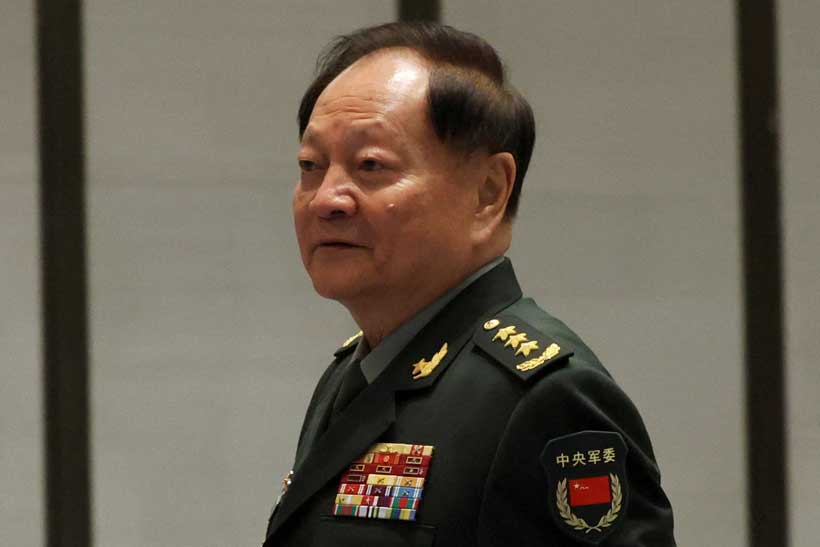
Today China marks National Day with the smallest military high command in its modern history. On 21 September, state media announced that Zhang Youxia, first vice-chairman of the Central Military Commission, and Liu Zhenli, chief of the Joint Staff, had been expelled from the Party and the army for having “formed cliques and factions” and being “disloyal and dishonest to the party.” The Commission, which commands the entire armed forces, had seven members at the start of Xi’s third term. It now has two who are still active.
Three days earlier, 54 nautical miles off Palawan, China Coast Guard cutter 21585 repeatedly cut across the stern of a Philippine fisheries vessel until the two ships collided. On 27 September the PLA’s Southern Theater Command held joint naval and air drills at Scarborough Shoal, while the Coast Guard practised boarding and forced towing.
The Last Veterans Leave
Stay ahead of the geopolitical week.
MD Briefing delivers expert analysis across five global fronts — the Indo-Pacific, energy, geoeconomics, European security, and the Middle East — every Monday morning. Free.
Zhang and Liu were placed under investigation in January and removed from their posts in August. They were among the last senior officers with combat experience. Zhang commanded a company in the 1979 war with Vietnam and led troops at Laoshan in 1984. He was also the PLA’s senior contact with Washington, and met Jake Sullivan, then US national security adviser, in 2024. Their removal follows the fall of two defence ministers and of He Weidong, the previous first vice-chairman, and the promotion of Zhang Shengmin, the PLA’s anti-corruption chief, to vice-chairman.
Xi has set 2027, the PLA’s centenary, as the date by which the army should be capable of taking Taiwan by force. Researchers at the Jamestown Foundation argued in April that the loss of Zhang and Liu removes the PLA’s capacity for strategic-level joint planning, meaning the ability to run combined land, sea and air operations. They concluded the 2027 target will be missed.
Less Able to Fight, Less Able to Stop
Most analysis, including MD’s own, asks whether the purged PLA can still fight a major war. The answer is increasingly no, at least not in 2027. A deliberate invasion needs joint planners, trusted commanders and a high command willing to tell Xi what is not ready. The purge has removed all three. For Taiwan, that is good news in the short term.
But war by decision is not the most likely way the region’s next crisis will start. The more likely path is an accident at sea that nobody chose, and the purge makes China worse at managing that kind of crisis, for three reasons.
First, decisions now go to the top. Crisis management depends on officers below the leader being trusted to slow things down: to break off a pursuit, to accept an offer of rescue, or to call a counterpart before the facts are clear. After a purge in which caution can be read as disloyalty, commanders have every reason not to use that discretion and to pass decisions up the chain. The chain now ends at a commission with two active members, one of whom is Xi. Everything slows down just when speed matters most. When a Chinese cutter rammed a PLA Navy destroyer while chasing a Philippine vessel near Scarborough Shoal in August 2025, Beijing declined Manila’s offer of search and rescue. That was a political decision taken in the middle of a physical emergency.
Second, the Coast Guard is part of the same system. Since 2018 the China Coast Guard has been under the People’s Armed Police, which reports to the Central Military Commission. The cutters ramming Philippine ships are not a civilian agency operating on its own. They answer to the same hollowed-out command, and they are the forces most often in physical contact with a US treaty ally. Washington has said its defence treaty with Manila covers attacks on Philippine coast guard vessels.
Third, the personal channels to Washington are gone. Zhang was the PLA’s senior interlocutor with the US. Working-level talks continue: the two navies met under their Military Maritime Consultative Agreement in Hawaii in May. Last week’s summit also agreed to explore communication mechanisms for AI incidents. But working-level channels handle procedures. They cannot resolve a crisis in its first hour, which needs someone senior on the Chinese side trusted enough to call Washington. At present, that person may not exist.
Jamestown’s researchers make a related point: grey-zone operations, coercion that stops short of open war, have become the PLA’s “dress rehearsals for forced reunification” and its main source of operational training. A PLA that cannot rehearse an invasion properly will rehearse more at Scarborough and Sabina, closer to Philippine ships and with less experienced commanders.
The strongest objection is that the purge gives Xi tighter control, which should mean fewer unauthorised actions, and that the rammings are deliberate policy, not accidents. That is partly right: the pressure is ordered from above. But deciding the policy in Beijing is different from carrying it out at sea, where officers make split-second choices at 15 knots. The 2025 collision was two Chinese ships hitting each other, which no one in Beijing intended. Control over whether to apply pressure is not the same as control over what happens once ships are in contact.
Three Ways the Next Incident Ends
Base case (around 55%): more pressure, no war and no deaths. Coast Guard and PLA pressure on Philippine resupply missions rises through the winter. Rammings, water cannon and boarding drills continue, and there is at least one serious incident a month. No one is killed. The 2027 invasion window passes quietly, and Beijing talks up exercises in place of readiness it does not have. Xi fills the Central Military Commission with loyalists at the next Party plenum. The key assumption is continued luck at sea.
Downside (around 25%): a death at sea and a slow response. A Philippine sailor or fisherman is killed in a ramming or water-cannon attack near Sabina or Second Thomas Shoal. Manila asks whether the defence treaty applies. Beijing’s response is slow and defensive, because no one below Xi can move quickly to express regret or de-escalate. Washington, busy with Iran and trying to protect the trade truce with China, answers ambiguously. The crisis becomes a test of whether the US will stand by its alliance while it needs Beijing’s cooperation on trade. For readers, the exposure is South China Sea shipping insurance, Philippine assets and the sectors covered by the US–China truce.
Upside (around 20%): the fear of an accident produces a hotline. Both governments recognise the gap. The PLA names a Joint Staff chief with authority to deal with the US, and the channels discussed at the summit become a working crisis hotline, tested before APEC in Shenzhen in November. A thinner command would then have produced better crisis management, because both sides took the risk seriously.
Fewer Generals, Thinner Margins
Xi’s purge has made a planned Taiwan invasion in 2027 less likely. The officers who could plan it are gone, and those who remain are unlikely to tell Xi what is not ready. But it has made an unplanned crisis more dangerous. Authority is concentrated in a two-member commission, the Coast Guard answers to the same thin command, and the senior personal link to Washington has been removed. The danger has moved from a planned war over Taiwan to an accident near the Philippines.
Watch for two things. First, whether Beijing names a new Joint Staff chief and first vice-chairman, and whether either has combat or international experience. Second, how the Coast Guard treats the next Philippine resupply mission to Sabina or Second Thomas Shoal. That is where an accident is most likely to happen.
Xi now has a military that will not act without his approval. In a crisis at sea, that may mean it cannot act quickly enough to stop one.