Eurofighters Over Lielvārde
This week, four German Eurofighters and several dozen ground crew arrived at Lielvārde air base in central Latvia. They were sent at Riga’s request to protect the country’s airspace through Saturday’s election. The deployment follows a spring in which drones repeatedly crashed on Latvian territory. They were mostly Ukrainian drones aimed at Russian oil ports and pushed off course by Russian jamming. One exploded at an oil depot in Rēzekne, 40 km from the Russian border, and the defence minister resigned.
On the ground, however, the campaign has been about something else. According to OSW, the Polish think tank, it has centred on the finances of the national airline airBaltic, delays to the Rail Baltica railway and state funding for NGOs. The jets are protecting a vote that has barely mentioned them.
A Frontline Election About Everything Else
Stay ahead of the geopolitical week.
MD Briefing delivers expert analysis across five global fronts — the Indo-Pacific, energy, geoeconomics, European security, and the Middle East — every Monday morning. Free.
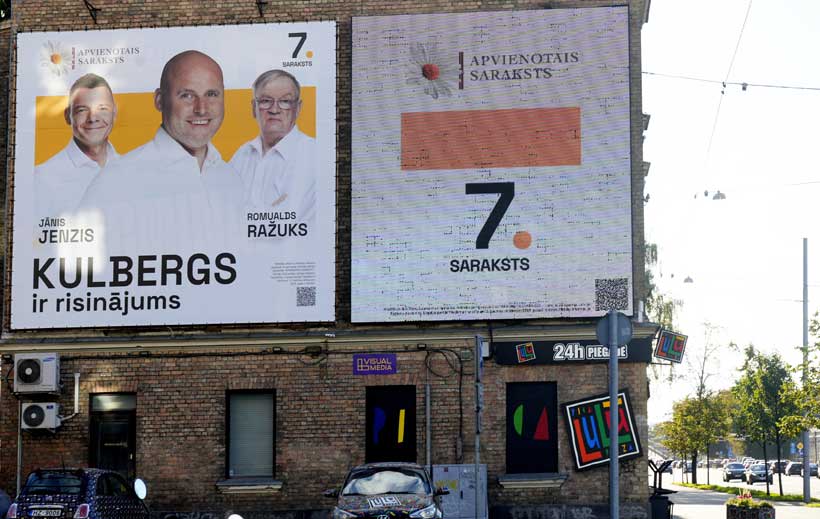
Prime Minister Andris Kulbergs took office in May, ending a series of coalition crises, and his United List has led the polls since. The Robert Schuman Foundation’s summary of early-September polling has the United List at 23.6%, Latvia First at 12.6%, the National Alliance at 11%, the Progressives at 10.7%, the Union of Greens and Farmers at 10.4%, the Sovereign Power alliance at 9.6% and New Unity at 8.9%. Seven parties look set to pass the 5% threshold. The expected result is a coalition of Latvian parties led by Kulbergs. Its main shared purpose is to keep out the two parties that draw most heavily on Russian-speaking voters: Ainārs Šlesers’s Latvia First and Sovereign Power.
Latvia plans to spend about 4.9% of GDP on defence, among the highest shares in NATO. No major Latvian party campaigns against that figure. That consensus is why defence barely features in the debate.
The Railway Is the Reinforcement Plan
The usual reading is that Latvians have moved on to everyday concerns. The better reading is that the consensus on defence has hidden the one security issue the country does argue about, Rail Baltica, by treating it as a question of cost overruns.
Rail Baltica is an 870-km standard-gauge line from Tallinn to the Lithuanian–Polish border. The Baltic states still run on the 1,520 mm Russian gauge, which forces every NATO train arriving from Poland to stop and transfer its load. Railways are the best way to move armoured vehicles and heavy equipment to the Baltics, and Rail Baltica was designed from the start to carry troops and heavy military equipment from west to east. In May, NATO assigned the German-Netherlands Corps to Latvia and Estonia, a command intended to receive 40,000 to 60,000 soldiers in a crisis. That plan assumes those troops and their equipment can get there. Without a continuous standard-gauge line, reinforcements depend on roads, ports and slow transfers between gauges.
This is where the budget debate misses the security question. The European Court of Auditors puts the whole project at €23.8 billion, up from €5.8 billion in 2017. The first phase, a single track, needs about €15 billion, with only about €5 billion secured. Latvia’s share of the overrun is around €5.5 billion. The chief executive of RB Rail, the joint venture running the project, says “saving money will almost certainly mean losing time.” Latvia is widely seen as the section most likely to fall behind.
The man most likely to lead the next government has already said what that means. As chair of the Saeima’s Rail Baltica inquiry in May 2025, Kulbergs said it would take “at least seven to eight years” to reach Salaspils, making 2035 the earliest date to reach the Estonian border. As Prime Minister in June, he rejected fixed deadlines, arguing that “a deadline of the 30th or any fixed date has the opposite effect. It creates stress.” As a budget position, that is defensible. As a defence position, it means Latvia is planning for Estonia’s reinforcement route to have a gap through the middle of the country for five years longer than NATO’s plans assume.
The second overlooked issue is the fifth of voters the coalition is designed to exclude. Russian speakers make up about a quarter of Latvia’s population. Latvia First and Sovereign Power together poll around 20 to 22%. The mainstream parties see both as outside Latvia’s security consensus, and Russia does use the Russian-speaking minority as a political lever. Moscow’s envoy at the UN has already threatened the Baltic states with retaliation, despite their NATO membership. But governing permanently without a fifth of the electorate has costs during a hybrid campaign. New rules restricting Russian in schools and the media, and a large group of long-term “non-citizens,” give Russian information operations material to work with. Excluding these parties is a legitimate choice. Doing it without offering those voters anything is where the risk lies.
The strongest objection is that Rail Baltica is a slow, peacetime project that no wartime plan relies on, and that NATO will reinforce the Baltics by air, sea and road whatever happens to it. That is true for the first days of a crisis. It is not true for the following weeks, when tanks, artillery and ammunition have to move in bulk, which is exactly the load railways carry and roads handle poorly. A reinforcement plan built around a railway that stops at the Latvian border does not fully work.
Three Coalitions, Three Railways
Base case (around 55%): a Kulbergs coalition with a vague Rail Baltica commitment. The United List forms a government with the National Alliance and the Greens and Farmers, possibly adding New Unity or the Progressives. The coalition agreement confirms Rail Baltica in general terms but sets no national funding share and no binding deadline. Latvia waits for the EU’s post-2028 budget. The combined vote of Latvia First and Sovereign Power lands around 20 to 25%. Their voters remain outside government, and the parties become the main opposition. The key assumption is that no drone incident or security shock during the coalition talks forces defence back to the top of the agenda.
Downside (around 25%): a weak coalition and a railway that drifts. A fragmented result forces a coalition of four or five parties that is already arguing over airBaltic and the budget. Rail Baltica funding slips another year, and Estonia begins domestic services on its own section, leaving Latvia as the obvious gap in the line. If the Russian-speaking parties do well above 25%, Moscow will present the result as proof of discrimination. For readers, the exposure falls on Baltic construction and logistics contracts, and on NATO planners who have assumed rail capacity will exist.
Upside (around 20%): Rail Baltica is funded as defence spending. The new government, pressed by NATO and Brussels, reclassifies part of Latvia’s share of Rail Baltica as military mobility spending that counts towards the 5% NATO target. That unlocks national money and possibly EU defence funds. This alone would turn the project from a budget scandal into a defence programme.
The Line on the Map
Latvia’s election is not a sign that security matters less on NATO’s frontline. It shows that defence is so settled that the one strategic issue voters still argue about, the railway meant to bring NATO troops into the country, is debated in the language of cost overruns. Meanwhile, a coalition built to exclude a fifth of voters will govern during a hybrid campaign aimed at exactly those voters.
Watch for two numbers after Saturday. The first is the combined vote share of Latvia First and Sovereign Power. The second is the Rail Baltica wording in the coalition agreement: a national funding share and a completion date would mean the new government treats it as defence. Vague language would mean the gap in the line continues.
NATO has sent jets to protect Latvia’s vote. What reinforcement actually depends on is a railway that the likely next Prime Minister does not want tied to a deadline.