


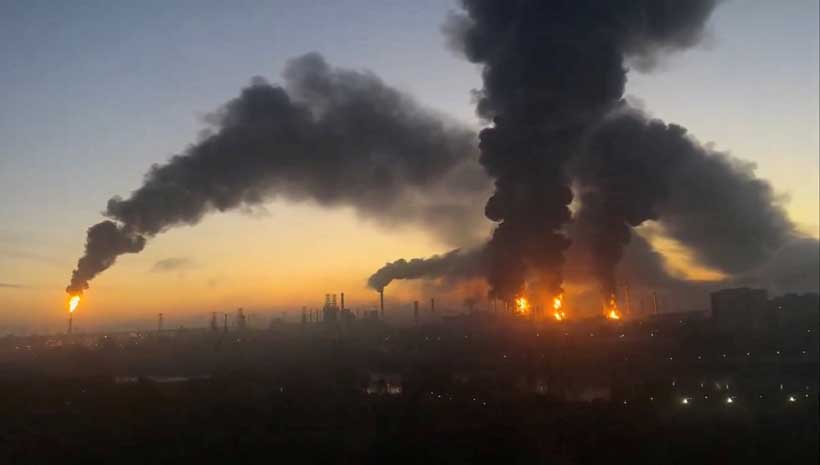
A Ukrainian drone attack has set fire to Russia’s Kirishi oil refinery, one of the country’s largest petroleum processing facilities, highlighting Kyiv’s continued efforts to disrupt Moscow’s energy infrastructure. The overnight strike in the northwestern Leningrad region also killed a woman after falling drone debris struck a residential building, according to regional governor Alexander Drozdenko.
The attack marks another escalation in Ukraine’s campaign against Russian oil facilities, which has intensified since late October following the failure of an energy ceasefire announced by US President Donald Trump to produce a meaningful halt in strikes.
The incident also comes amid renewed concerns over global fuel prices, with disruptions to Russian energy infrastructure adding pressure to markets already affected by the US-Israeli war with Iran.
Kirishi Refinery Targeted in Latest Ukrainian Drone Attack
The Kirishi refinery, formally known as Kirishinefteorgsintez, is located approximately 800 kilometres from the Ukrainian border in Russia’s Leningrad region. With a processing capacity of 20 million metric tons annually, equivalent to around 400,000 barrels per day, it is one of Russia’s most important refining facilities.
Stay ahead of the geopolitical week.
MD Briefing delivers expert analysis across five global fronts — the Indo-Pacific, energy, geoeconomics, European security, and the Middle East — every Monday morning. Free.
Governor Drozdenko said the refinery caught fire following the overnight drone attack but that emergency services had contained the blaze and were managing its aftermath.
He also reported that air defence forces had intercepted 113 Ukrainian drones during the night. The attack damaged an apartment building in the town of Kirishi, while debris from a downed drone struck the roof of a residential building in Vsevolozhsk, killing a woman.
Videos circulating on social media appeared to show a major fire at the refinery, although the footage had not been independently verified.
Kirishi has been targeted by Ukrainian forces several times previously, reflecting its importance to Russia’s energy infrastructure and petroleum production.
Ukraine Intensifies Its Campaign Against Russian Energy Infrastructure
The strike forms part of a broader Ukrainian strategy to target Russian refineries and weaken the country’s ability to process and distribute petroleum products.
Oil facilities have become increasingly important targets because damage to refining infrastructure can affect domestic fuel supplies, export revenues and the logistical networks supporting Russia’s economy.
Unlike attacks on individual military installations, refinery strikes can create wider economic consequences by disrupting the production of diesel, gasoline and other petroleum products. These fuels are also essential to military transportation and industrial activity.
Kyiv has intensified its attacks since the end of October, following the failure of Trump’s proposed energy ceasefire to meaningfully halt strikes against energy infrastructure.
The repeated targeting of major facilities also demonstrates Ukraine’s ability to conduct long-range drone operations against strategically important locations far from the front line.
Energy Infrastructure Becomes Part of Wider US Political Debate
The latest attack carries implications beyond the battlefield, particularly as rising fuel prices have become a political concern in the United States.
Trump has previously blamed Ukrainian attacks on Russian refineries for contributing to higher diesel and gasoline prices in the American market. Fuel costs were also among the economic concerns surrounding the Republican Party’s poor performance in the midterm elections.
However, the president has since acknowledged that the US decision, alongside Israel, to attack Iran played a major role in driving fuel prices higher.
The developments illustrate how separate geopolitical conflicts are increasingly interacting through international energy markets. Disruptions to Russian refining capacity can affect petroleum product supplies, while instability around the Strait of Hormuz threatens crude exports from the Middle East.
For governments and consumers, the combined impact creates uncertainty over fuel availability, transportation costs and inflation.
What Happens Next?
The immediate concern will be the extent of the damage to the Kirishi refinery and how quickly its operations can be restored. Its substantial processing capacity makes any prolonged disruption potentially significant for Russia’s petroleum production.
The attack also raises questions about the future of energy infrastructure ceasefire efforts. With Ukraine continuing to target Russian facilities and Moscow maintaining its military campaign, the prospects for a sustained halt to attacks remain uncertain.
For Kyiv, strikes on refineries offer a way to impose economic and logistical costs on Russia beyond the battlefield. For Moscow, protecting critical energy infrastructure is becoming an increasingly important security challenge.
As the war continues, Russian oil facilities are likely to remain strategically important targets, with consequences extending from military supply chains to global energy markets.
With information from Reuters.
