


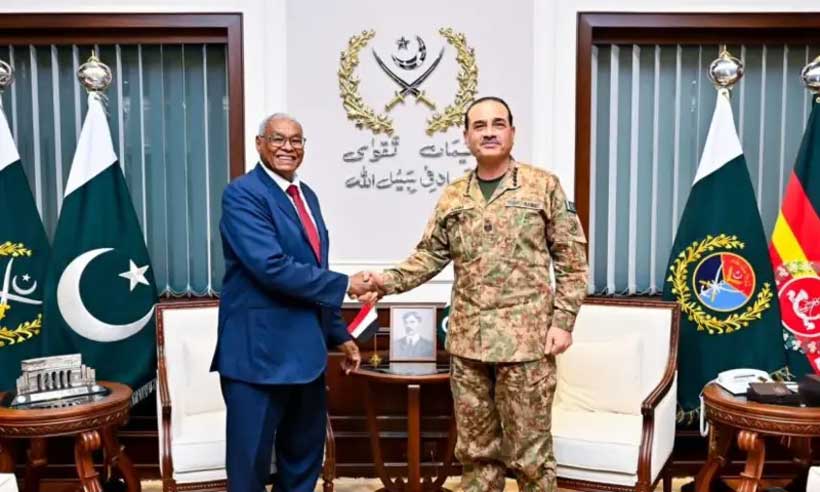
Pakistan and Sudan signed an agreement in Islamabad on November 7 allowing official and diplomatic passport holders to travel between the two countries without visas, Pakistan’s Interior Ministry said.
The two sides also agreed to sign a memorandum of understanding on cybercrime and to expand cooperation in security, police training and civil registration, the ministry said.
Reports since January have linked Sudan’s army-led authorities to Pakistani weapons supplies. The army’s war with the paramilitary Rapid Support Forces (RSF) is in its fourth year.
Sudan’s Interior Minister, Lieutenant General Babiker Samra Mustafa Ali, signed the agreement with his Pakistani counterpart, Mohsin Naqvi.
Stay ahead of the geopolitical week.
MD Briefing delivers expert analysis across five global fronts — the Indo-Pacific, energy, geoeconomics, European security, and the Middle East — every Monday morning. Free.
Naqvi said Pakistan was ready to help Sudan restore peace and rebuild, and Samra said Sudan hoped to draw on Pakistan’s experience against cybercrime, according to the ministry.
Samra met Prime Minister Shehbaz Sharif on November 5. The next day he met Field Marshal Asim Munir, Pakistan’s Chief of Defence Forces and Chief of Army Staff, in Rawalpindi, where they discussed security and counterterrorism cooperation, the military’s media wing ISPR said.
Naqvi and Samra discussed deploying UN peacekeepers in Sudan when they met in July, Naqvi said at the time.
From suspended deal to delivered armour
Pakistan was close to a $1.5 billion deal to supply weapons and jets to Sudan’s army, Reuters reported in January, citing a former senior air force official and three other sources.
Two sources said the package included 10 Karakoram-8 light attack aircraft, more than 200 drones and air defence systems. Retired Air Marshal Aamir Masood called it a “done deal” that would also include Super Mushshak trainers and possibly JF-17 fighters, according to Reuters.
Pakistan suspended the deal in April after Saudi Arabia said it would not pay for it, Reuters reported, citing two Pakistani security sources.
About 100 Pakistani Mohafiz-V armoured vehicles appeared in a Khartoum parade on August 2, and several sources told Radio France Internationale that Saudi Arabia had paid for them. The vehicle is made by Pakistan’s state-owned Heavy Industries Taxila on a Toyota Land Cruiser chassis and carries eight people.
None of the three governments has confirmed the financing or the terms of any deal.
Pakistani drones and jets could help the army regain the air supremacy it lost to RSF drones, Reuters reported in January. Areig Elhag, writing for the Washington Institute’s Fikra Forum, argued that the deal could prolong the war and turn Sudan into a proxy arena like Libya.
The war between the army, led by General Abdel Fattah al-Burhan, and the RSF, led by General Mohamed Hamdan Dagalo, began in April 2023.
Saudi-Turkish-Pakistani pact takes shape in Sudan
Saudi Crown Prince Mohammed bin Salman, Turkish President Recep Tayyip Erdoğan and Pakistani Prime Minister Shehbaz Sharif signed the Mecca Joint Defence Agreement on August 7.
Pakistan’s Foreign Ministry said the pact treats an attack on one member as an attack on all three. The risk consultancy RANE, citing the Financial Times, said the text lacks a clause requiring automatic collective defence.
Sudan is not a signatory but is the pact’s first arena, the French newspaper Le Monde reported. Ahmed Aboudouh, an associate fellow at Chatham House, told Le Monde that the three countries’ cooperation in Sudan “will now accelerate,” with Riyadh paying for Turkish drones and Pakistani weapons.
Saudi Arabia and Sudan’s army-led government signed their own cooperation agreement on August 17, Le Monde reported.
US pressure on Sudan
Neither the army nor the RSF “represent legitimate, constitutional governance for Sudan,” State Department spokesman Tommy Pigott said on September 22, The National reported. Sudan’s foreign ministry rejected the statement the next day.
Washington also withheld al-Burhan’s visa for the UN General Assembly, making it conditional on his accepting a 90-day ceasefire proposed by US adviser Massad Boulos, Reuters reported on September 22.
