


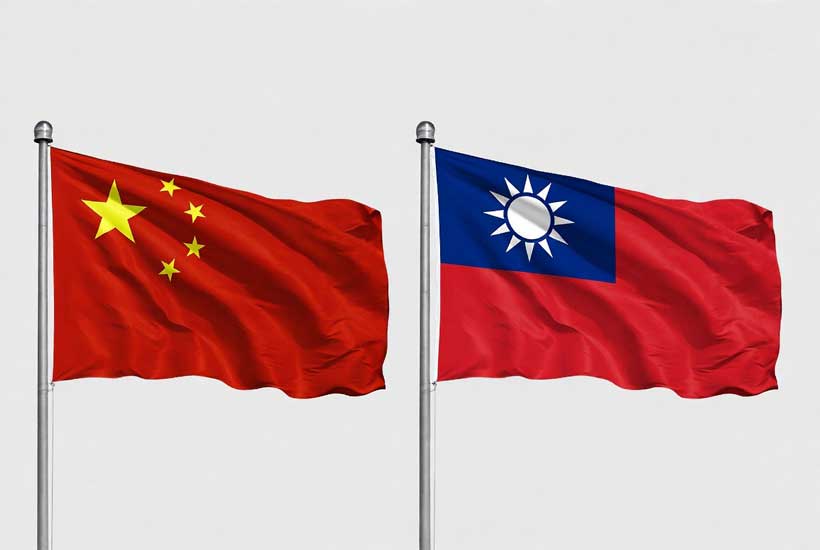
China has accused Taiwan’s government of distorting World War Two history, escalating a dispute over which side can claim the legacy of China’s wartime resistance against Japan.
Beijing’s Taiwan Affairs Office said on Wednesday that Taiwan’s ruling Democratic Progressive Party (DPP) was trying to undermine China’s official account of the war. Spokeswoman Zhang Han described the criticism as a “betrayal of history” and a “desecration of the martyrs.”
The dispute reflects a deeper disagreement over which Chinese government should be associated with the Allied victory over Japan. China says Communist forces were central to the resistance and that the war’s victory belongs to the Chinese nation as a whole. Taiwan argues that the Republic of China, rather than today’s People’s Republic of China, was the government that fought alongside the Allies during the war.
The Republic of China government relocated to Taiwan in 1949 after losing the Chinese civil war to Mao Zedong’s Communists. It remains Taiwan’s formal name.
Stay ahead of the geopolitical week.
MD Briefing delivers expert analysis across five global fronts — the Indo-Pacific, energy, geoeconomics, European security, and the Middle East — every Monday morning. Free.
A Battle Over Wartime History
Beijing’s official narrative gives significant importance to Communist guerrilla forces, describing them as a major force behind the resistance while giving comparatively less emphasis to the Kuomintang, the nationalist government that led China during most of the war.
Zhang acknowledged that Kuomintang forces fought Japan on the main battlefields but said Communist forces opened extensive battlefields behind Japanese lines.
She said the victory was achieved by the entire Chinese nation and should be jointly commemorated by people on both sides of the Taiwan Strait.
The dispute has intensified as Beijing and Washington have also highlighted their countries’ wartime cooperation. Chinese President Xi Jinping and US President Donald Trump discussed that shared history during their meeting last week.
Why Taiwan Rejects Beijing’s Narrative
Taiwan’s ruling DPP has promoted a distinct Taiwanese identity and has challenged Beijing’s claim that Taiwan is part of China. The island was under Japanese colonial rule from 1895 until Japan’s defeat in 1945, when control was transferred to the Republic of China government.
The ROC ruled Taiwan under martial law until 1987 and continues to be the island’s formal government, although Taiwan and China have been separately governed since the Chinese civil war.
For Beijing, however, the end of Japanese rule and Taiwan’s transfer to the ROC are part of a broader narrative of Chinese national victory. Zhang called Taiwan’s recovery a “shared glory” of the Chinese people.
The disagreement therefore goes beyond competing interpretations of World War Two. It is also tied to the unresolved political question of Taiwan’s identity and status.
Beijing has cut official communication with President Lai Ching-te and describes him as a separatist because of his government’s position on Taiwan’s sovereignty.
With information from Reuters.
