


A Test Disguised as a Triumph
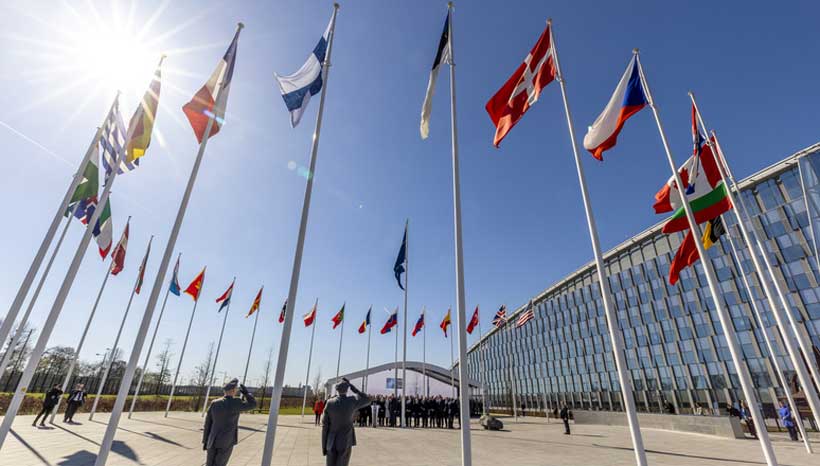
NATO’s Ankara summit produced the largest Ukraine funding commitment of the war: European allies and Canada pledged at least €70 billion in military support for 2026, with a comparable sum promised for 2027, bringing the two year target to roughly €140 billion. Alliance leaders declared that Europe now shoulders the vast majority of Ukraine’s security assistance, a milestone in the years long effort to shift costs away from Washington. Yet the same two days in Ankara produced a trade embargo threat against a founding member, a renewed American claim on Danish territory, and a presidential declaration that a ceasefire with Iran was over. The pledge was real. So was the disorder surrounding it. The question for anyone pricing European security risk is which of the two will define the alliance a year from now.
From Washington’s Bill to Europe’s
The Ankara summit was always going to be judged against a single benchmark: whether Europe could actually replace the funding Washington withdrew. Since returning to office in 2025, the Trump administration wound down direct US military aid shipments to Ukraine, replacing them with the Prioritized Ukraine Requirements List, or PURL, a mechanism under which European states and Canada fund Ukrainian purchases of American made equipment rather than the United States paying for it directly. By March 2026, NATO allies and partners had committed more than $4.8 billion under PURL, most of it already transferred. By the time leaders gathered in Ankara in July, that figure had grown past $5.5 billion across twenty six contributing countries. German Chancellor Friedrich Merz reportedly pushed hard for a fixed, headline funding figure at the summit after an earlier proposal to set aid at 0.25 percent of GDP failed to gain traction. What emerged was the €70 billion annual pledge, framed by NATO officials as proof that European burden sharing, long demanded by Washington, was finally arriving.
Stay ahead of the geopolitical week.
MD Briefing delivers expert analysis across five global fronts — the Indo-Pacific, energy, geoeconomics, European security, and the Middle East — every Monday morning. Free.
A Pledge Built on an Unfinished Foundation
The trouble is that the number and the unity it implies do not fully hold up under scrutiny. Start with the arithmetic. The €140 billion two year figure includes existing bilateral aid programs and funding linked to the European Union’s €90 billion loan facility for Ukraine covering 2026 and 2027. Even adding those together, officials briefed on the numbers say current EU and bilateral commitments do not fully cover the two year target, meaning additional financing will be needed that the summit declaration does not specify how allies will provide. Nor does the declaration spell out how the shortfall will be divided among member states, effectively leaving a hard question for NATO’s coordinating bodies to resolve later. A pledge that requires unallocated future financing is not the same as a funded commitment, and institutional readers who track sovereign and multilateral financing flows will recognize the difference.
Then there is the cohesion problem, which the summit did not so much reveal as broadcast. President Trump used his appearances in Ankara to call Spain a terrible partner and a wasted cause, ordering the Treasury Secretary to halt all trade with Madrid over its defense spending record and its perceived reluctance to back the American and Israeli campaign against Iran. He simultaneously revived his demand for control of Greenland, a Danish territory, prompting the European Union to publicly affirm that decisions about Greenland’s future belong to Greenlanders and Danes. NATO Secretary General Mark Rutte, tasked with holding the alliance together, conceded that Trump had a point about Chinese and Russian interest in the Arctic even as he tried to defuse the Greenland dispute itself. Trump also declared the fragile ceasefire with Iran effectively over, a position deeply unpopular among European allies who had hoped the summit would project unity rather than air a parallel conflict.
Set against this, the summit’s genuine successes deserve equal weight rather than dismissal. Trump’s offer to license Ukraine to manufacture Patriot missile systems domestically, if it proceeds, would mark a durable upgrade to Ukraine’s air defense industrial base rather than a one off transfer. Washington’s decision to ease sanctions on Turkey and move toward resuming F 35 sales reflects a genuine, if transactional, repair of one of NATO’s more damaged bilateral relationships, undoing a rift that dated back to Ankara’s purchase of Russian S 400 systems in 2019. And the PURL mechanism itself, whatever its funding gaps, has demonstrably kept weapons flowing to Ukraine for a full year without the political theater that accompanied earlier congressional aid fights in Washington. Twenty six countries voluntarily funding a common procurement list is not a trivial coordination achievement for an alliance of thirty two members with famously divergent threat perceptions.
There is also a pattern worth naming rather than treating as noise. The 2024 Washington summit set a specific Ukraine aid benchmark. The 2025 Hague summit dropped that benchmark entirely, focused instead on overall alliance defense spending, and left no quantitative commitment to Ukraine at all. Ankara’s return to a headline figure, even an unevenly funded one, suggests European governments concluded that vague solidarity language was no longer sufficient reassurance for Kyiv or for their own domestic audiences. Reading the summit purely through Trump’s outbursts risks missing that underlying shift in how European capitals are choosing to signal commitment.
What the summit therefore reveals is not that NATO is unified or fractured, but that it has become something more transactional than either: a coalition capable of assembling large financial commitments while simultaneously absorbing open hostility between its most powerful member and several of its founding partners. Whether that model is sustainable depends less on the communique than on whether Madrid, Copenhagen, and Washington find a way to manage their disputes without one of them exiting the funding architecture altogether.
Three Paths From Ankara
The most likely near term path is muddling through. European governments continue funding PURL and the EU loan facility at roughly current pace, the funding gap gets narrowed through additional bilateral pledges rather than resolved at the alliance level, and the Spain and Greenland disputes remain loud but contained, treated by NATO officials as the growing pains of a more balanced alliance rather than existential threats. This scenario keeps Ukraine’s air defense and munitions supply intact through 2026 without fully closing the financing shortfall.
A more optimistic path sees the Patriot licensing deal and Turkey’s sanctions relief become templates for deeper industrial cooperation, with European defense manufacturers gaining more direct access to American systems and the funding gap closing as new bilateral packages, similar to Germany’s Patriot and IRIS T commitments, accumulate faster than expected. In this scenario, Ankara is remembered as the summit where Europe’s defense industrial base began meaningfully absorbing responsibilities Washington once carried alone.
The less comfortable scenario is that the Spain dispute hardens rather than fades, either through actual trade restrictions or through Madrid using the confrontation to justify slower defense spending increases, while the Greenland claim continues to strain relations with Denmark and, by extension, Nordic contributors to PURL. If political capital in one or two capitals turns against continued funding, the unallocated portion of the €140 billion target becomes the mechanism through which the shortfall shows up not as a technical financing gap but as a visible reduction in what Ukraine actually receives in 2027. A prolonged Spain dispute would also complicate NATO planning beyond Ukraine, since Madrid’s cooperation matters for southern flank deployments and Mediterranean security coordination that have nothing to do with the current quarrel.
What to Watch Instead of the Communique
The Ankara summit’s headline number will dominate coverage, but it is the wrong indicator to track. The more useful signals are quieter: whether PURL contributions from individual countries keep pace with pledges rather than stalling after the summit’s media cycle fades, whether the Spain trade dispute produces any actual policy action beyond rhetoric, and whether the EU’s €90 billion loan facility disburses on schedule through 2026. NATO has shown it can produce large pledges under pressure. Ankara’s real test, and the one that matters for anyone modeling European security risk, is whether it can convert a pledge assembled amid open discord into funding that actually reaches Kyiv on the timeline it promised.
