Thirteen Days, Four Doors
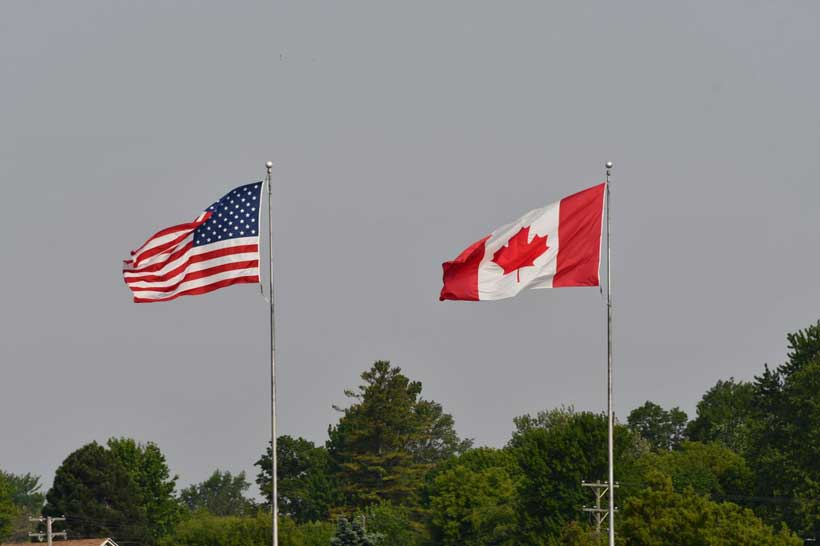
At 12:01 a.m. on 29 September, a US ban on nearly $1 billion of Canadian goods took effect: whisky, dairy by-products, Can-Am three-wheeled motorcycles. Economically it barely registers, since existing 50% tariffs had already priced most of those goods out of the American market. Politically, it lands at the end of the busiest fortnight in Canadian foreign policy in a generation. In thirteen days Mark Carney welcomed an offer to make Canada the EU’s first associate member, applied to join a UK-led Northern European military coalition, said Canada would diversify away from Starlink “no question”, and called the purchase of 72 more F-35s “a real decision”. He also confirmed that his government had examined the “extreme tail risk” of US military action against Canada. Read one at a time, these are trade-war reflexes. Read together, they describe a country building exits from American institutions, one door at a time.
From Tariffs to Tail Risk
The break is now twenty months old. In January Carney told Davos the world was in “the midst of a rupture, not a transition”, which earned him a personal rebuke from Donald Trump. Washington has since imposed 50% tariffs on roughly $20 billion of Canadian goods over alleged discrimination against US dairy, car and alcohol producers. Provinces pulled American liquor from their shelves in response, and the 29 September ban is the punishment for that retaliation.
Stay ahead of the geopolitical week.
MD Briefing delivers expert analysis across five global fronts — the Indo-Pacific, energy, geoeconomics, European security, and the Middle East — every Monday morning. Free.
In parallel, Ottawa has been putting up European scaffolding. In June the EU Council concluded Canada’s participation in SAFE, the bloc’s €150 billion defence-procurement loan instrument, making Canada its first non-European participant. In March the European Investment Bank signed a letter of intent to finance Canadian critical raw materials projects. On 16 September Ursula von der Leyen used her State of the Union address to propose “opening the door for Canada being the first associate member of the EU”. Trump called the idea “laughable” and threatened “very serious tariffs” on Europe if he judged it hostile, which turned a bilateral spat into a three-way trade risk. The structural constraint has not moved: roughly 70% of Canadian exports still go south.
A Second Switch for Every American One
Most coverage files these moves under the trade war. Wrong folder. Trade disputes are settled with trade concessions, and none of these steps can be traded back for a tariff cut.
Start with the jets. A fighter fleet is a forty-year dependency: whoever controls the software updates, spare parts and mission data controls whether the aircraft fly. Canada has locked in 16 F-35s and is funding long-lead parts for 14 more, but the review launched in March 2025 has blown through its September 2025 deadline. Saab has offered 72 Gripen E fighters and six GlobalEye surveillance aircraft, with assembly in Canada. The option now in play is a mixed fleet. Mixed fleets cost more to run, so this is not about price. It is about who can ground the Royal Canadian Air Force.
Starlink is the same logic in orbit. Ukraine taught every defence ministry that one company’s owner can switch a military’s communications on or off. Ottawa has put C$1.44 billion into Telesat’s Lightspeed constellation, and Carney now talks of European and Korean partners.
The Joint Expeditionary Force is the most revealing move because it is the least necessary. Canada is already in NATO. The JEF, which groups the UK with nine Nordic, Baltic and Dutch partners, adds no legal obligation. What it adds is a standing habit of planning and deploying together in the Arctic and North Atlantic without waiting for Washington. For a country whose Arctic defence has run through NORAD, the joint US-Canadian air defence command, joining a European framework for the same waters is a hedge against the bilateral arrangement itself. It is the logic that put Ottawa behind a multilateral defence bank in August: no single partner should hold every lever.
Together they form a pattern. In each domain where the United States holds a switch — air power, military satellite communications, Arctic security, market access — Canada is installing a second switch in Europe. Each step is reversible on paper and sticky in practice. Carney’s “tail risk” remark is the tell. A government that has gamed out a US military threat, however remote, is not negotiating over whey.
Here the language of goodwill misleads. Europe likes Canada, but Brussels does not invent a new tier of membership for a friend. It invents one for a supplier. The EU imports about 90% of the refined critical materials it uses, and China controls the processing of 19 of 20 energy-transition minerals. Chinese export controls on gallium, germanium, graphite and rare-earth technology halted European production lines between 2023 and 2025. The EU’s Critical Raw Materials Act requires the bloc to process 40% of its needs at home by 2030 and to source no more than 65% of any strategic material from a single country. Europe cannot meet those targets from its own geology.
Canada can help close that gap. It has nickel, cobalt, copper, graphite and rare earths. It has cheap, low-carbon hydropower to process them. CETA, the EU-Canada trade agreement, is already in force, and Ottawa has created a new C$2 billion Critical Minerals Sovereign Fund. Von der Leyen listed critical minerals and batteries next to defence production in her offer for a reason. Carney’s real leverage in Brussels sits in the midstream, the refining and processing stage. He can offer Europe processed supply that sits outside Chinese control and outside American reach, in exchange for a seat inside Europe’s defence-industrial and market structures. The same minerals explain Washington’s attention, which makes the choice of buyer strategic, not commercial.
The strongest objection is that geography always wins. Seven in ten export dollars go to the US. NORAD is not going anywhere. Lightspeed’s satellites will fly on SpaceX rockets, and a US fund owns 35.5% of Telesat. The first 16 F-35s cannot be undone, and cutting the rest carries contract penalties. “Associate membership” has no legal definition yet and needs the approval of member states that Trump has just threatened. All true: Canada cannot leave the American orbit. But exit here means options, not departure. The aim is to shrink the number of things Washington can switch off on its own, so that the next escalation costs Canada less. Measured that way, every step counts, even though none of them is finished.
Three Ways the Hedge Plays Out
Base case: the managed hedge (about 55%). Ottawa settles on a mixed fleet, keeping a smaller F-35 contingent built around the jets already committed and buying Gripens assembled in Canada. JEF accession moves through 2027. Associate membership advances as a set of sector agreements — minerals, defence industry, youth mobility — rather than a single treaty. The key assumption is that Trump’s threat against Europe stays rhetorical. The trade conflict grinds on unresolved, but each new institutional link makes the next round of US pressure slightly less effective.
Downside: Washington links trade to security (about 25%). The trigger is a formal F-35 cut or a signed Gripen contract, which the White House treats as the “hostile act” Trump warned about. Tariffs on European goods are then tied explicitly to the Canada file, alongside pressure on NORAD cooperation. Member states most dependent on US security guarantees slow the approvals that associate status needs. Canada pays the price in Washington before it has a landing pad in Brussels. Firms that supply both the US and EU defence markets from Canada would face the sharpest compliance and contract risk.
Upside: minerals for membership (about 20%). Brussels and Ottawa put a binding critical raw materials chapter first: the EIB lending inside Canada, EU purchase commitments for Canadian-processed rare earths and graphite, and Canadian projects counted towards the Critical Raw Materials Act targets. That would make associate status concrete before the politics catch up, and it would give Canada something Washington wants but cannot easily coerce: a second paying customer for its most strategic resource.
Watch the Jets
The trade war is the noise. The signal is a medium-sized ally rewiring its dependencies so that the next American shock costs less, and paying its way into Europe with the one asset Europe cannot produce for itself. That is a realignment, and minerals, not sentiment, are what make it affordable.
The thing to watch is the F-35 decision on the remaining 72 jets. If Ottawa formally reduces the order and signs with Saab, the realignment has moved from speeches into a forty-year commitment. Tariffs can be lifted by a signature in Washington. Fighter fleets, satellite networks and treaty memberships cannot, and that is exactly why Carney is buying them.