“First Comes November, Then Comes December”
On Sunday, Kremlin aide Yuri Ushakov said Moscow, Beijing and Washington had agreed “in principle” to a leaders’ meeting on the sidelines of the APEC summit in Shenzhen on 18–19 November, and that preparations had begun. Asked whether Vladimir Putin’s attendance at December’s G20 in Miami depended on it, he said: “Of course. First comes November, and then comes December.”
That sentence is the most candid description yet of what Moscow wants. Shenzhen is the entry ticket and Miami the reward. Nobody from Brussels, Tokyo or Taipei is on the guest list, yet each has something on the table: Europe’s leverage over a Ukraine settlement, Japan’s stance on Taiwan, and the chip export controls Taiwan agreed to criminalise nine days ago. A summit that the Kremlin says still has no clear agenda is the kind where absent parties get traded.
Two Summits, One Truce, No Agenda
Stay ahead of the geopolitical week.
MD Briefing delivers expert analysis across five global fronts — the Indo-Pacific, energy, geoeconomics, European security, and the Middle East — every Monday morning. Free.
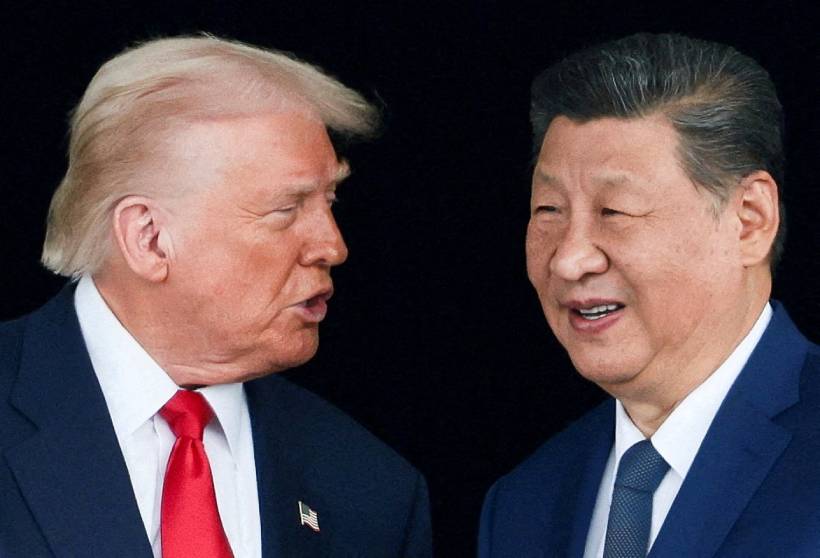
Trump and Xi have met twice this year. In Beijing in May they swapped soybean, Boeing and tariff commitments but left rare earths and chips unresolved. In Washington in September they adopted a framework of “strategic stability”. Beijing’s readout said Xi urged the US to “oppose” Taiwan independence, rather than merely “not support” it, and a roughly $14 billion Taiwan arms package has been held in abeyance since May. The trade truce now runs to 10 January 2027. Separately, China’s suspension of its October 2025 rare-earth controls expires on 10 November, eight days before Shenzhen.
On the Russian side, Washington this month waived most of the new sanctions in the Graham Act, approved purchases of Russian diesel and invited Putin to Miami. Trump says he would join a three-way meeting mainly to discuss nuclear arms control, not “so much for Ukraine”. Ukraine is not invited. Chinese officials have welcomed the idea privately but have not pushed for it.
Xi Holds the Gavel
Most coverage treats Shenzhen as a Russia story, or as Trump’s long-sought arms-control summit. Both readings miss the structure. A trilateral works like an auction: each participant wants something only the others can supply, and the host decides the order of business. Look at what each leader needs and Xi is the only one who can give all three something.
Putin wants the format more than any outcome. A table where the US, China and Russia discuss Ukraine without Ukraine or Europe is the Yalta-style great-power settlement Moscow has sought since 2022. Ushakov’s link between Shenzhen and Miami shows the sequence: Chinese hosting makes the photograph legitimate, and the photograph makes a G20 invitation politically survivable in Washington. Putin does not need Xi to endorse Russia’s territorial terms. He needs Xi to sit next to him while Trump discusses them.
Trump wants a deliverable and, quietly, help on Iran. A nuclear risk-reduction statement among the three largest nuclear powers would be a genuine headline, especially since the last US–Russia arms control treaty, New START, ran out in February. The more pressing need is in the Gulf. China is Iran’s largest oil customer, taking 13–14% of its crude imports from Iran before the war, and with Brent near $117 Trump is choosing between renewed strikes and continued pressure. Beijing’s influence on Tehran is the cheapest de-escalation tool he has.
Xi wants the three things only Washington can give. He wants the word “oppose” on Taiwan, the arms package kept frozen, and a softer line on technology controls. The newest target is Taipei’s own: on 16 October Taiwan announced it would add advanced AI chips and servers to its controlled-export list, with prison terms for smuggling to China. Taiwan committed to maintain an “effective and robust” export control regime in exchange for a 15% US tariff rate and a $250 billion investment pledge. And Xi arrives holding a chip of his own. Whether China renews the rare-earth suspension on 10 November, or saves the renewal to hand over in Shenzhen, will decide how much he can charge for it. TSMC is already hunting for non-Chinese rare-earth supplies, a sign of how real that leverage is.
Put those together and the trades write themselves. A rare-earth renewal and Chinese pressure on Tehran go to Trump. Ambiguous US wording on Taiwan, slower enforcement of chip controls and an extended arms freeze go to Xi. A trilateral communiqué on “strategic stability” that also mentions Ukraine goes to Putin. None of it needs to be written down to take effect.
The bill lands elsewhere. Europe pays first. A Ukraine framework blessed by three permanent members of the UN Security Council would leave Europe funding and guaranteeing a settlement it did not shape. The Commission’s response, that Europe will “play a key role” and that Ukraine’s territorial integrity must be respected, was an assertion, not leverage. Washington has already offered Moscow sanctions relief and resumed gas flows that Europe rejected. Japan pays on Taiwan. Sanae Takaichi will attend only if parliament allows, and Beijing still wants her to walk back her Taiwan remarks. Any US move toward “oppose” leaves Tokyo holding a firmer Taiwan position than its own ally. Taiwan pays twice. It accepted the political risk of criminalising chip exports to China as the price of a US trade deal. If Washington then trades softer enforcement for rare earths, Taipei bears the cost without the protection it was buying.
The strongest objection is that this will be a photo-op with no substance. Trump–Xi meetings have produced more pageantry than deliverables, and Beijing has not pushed for a three-way format. That is probably right about the text, and wrong about the cost. For the absent allies, the symbolism is the substance. Who sits at the table sets the framework, one word on Taiwan sets the baseline, and an enforcement deadline that quietly slips sends a market signal. Shenzhen was chosen to showcase Chinese technological power. A photograph of Xi hosting the presidents of the US and Russia there would be the most valuable thing Beijing has staged since the Olympics.
Three Versions of Shenzhen
Base case (around 50%): a short meeting, a nuclear statement, a lot of ambiguity. The three meet briefly and agree to start a “strategic stability” or nuclear risk dialogue, with Ukraine mentioned only in general terms. The real business happens in the Trump–Xi bilateral: the rare-earth suspension is renewed, the truce is extended past January, and the US Taiwan formula is left deliberately vague. Putin gets his photograph and his Miami invitation. Costs to allies are mostly symbolic but cumulative. The key assumption is that Trump keeps Iran on the pressure track rather than resuming strikes before Shenzhen.
Downside case (around 25%): a “Shenzhen understanding”. Trump needs Chinese help quickly, either because Hormuz deteriorates further or because a US strike on Iran needs to be contained, and pays for it. The three leaders endorse principles for Ukraine, such as a freeze on current lines and no NATO membership, while the US repeats Beijing’s “oppose” language or announces the arms package is shelved. Europe then faces a fait accompli at the Abu Dhabi talks, and Japan faces a Washington that has moved past Tokyo on Taiwan. For businesses, expect Taiwan’s chip-control bill to stall in the legislature.
Alternative case (around 25%): no trilateral. Renewed US–Iran hostilities, a breakdown of the mid-November Ukraine talks, or Beijing’s reluctance to be seen as Putin’s convener reduces Shenzhen to bilaterals. This is the best outcome for the absent allies. It is less likely than it looks, because all three leaders now have a stake in the photograph.
Watch the Tenth, Not the Eighteenth
The Shenzhen summit is not a peace conference. It is an auction run by the host, and the lots on offer belong mostly to people who are not in the room: Europe’s say over Ukraine, Japan’s Taiwan position, Taiwan’s chip controls.
The tell comes eight days early. If Beijing renews its rare-earth suspension quietly on 10 November, it is banking goodwill. If it lets the deadline pass, or saves the renewal for Shenzhen, it means to be paid for it, and the payment will be made in the currency of the absent. In great-power summits, the allies who aren’t at the table are usually what’s on the menu.