


Creative industries are becoming an independent area of international business. For Russia and African states, the prospects for cooperation are linked to joint content production, the development of digital products, international distribution, and access to new markets. At the same time, the success of such projects depends not only on professional ties but also on access to financing, intellectual property protection, and an understanding of national markets. Marina Mongush, president of the Unified Center for Creative Economy (ANO “Creative Economy”), discusses the Russian model of the creative economy, its international development, and new opportunities for cooperation with Africa.
The creative economy—a new factor in international competition
The creative economy in Russia is developing as an independent sector that creates intellectual products, generates added value, and enhances the competitiveness of businesses and territories. Its influence extends beyond individual industries: design, IT, media, cinema, and digital solutions are increasingly used in industry, trade, tourism, and the service sector.
This approach is based on the concept of the global creanomy, which became the main theme of the VII “Russian Creative Week,” held in Moscow. Under the title “Global Creanomy: Values That Unite the World,” the forum presented a value-oriented model in which intellectual products, technological competencies, and the uniqueness of an offering become independent factors of economic competitiveness.
Stay ahead of the geopolitical week.
MD Briefing delivers expert analysis across five global fronts — the Indo-Pacific, energy, geoeconomics, European security, and the Middle East — every Monday morning. Free.
“Today, competition is increasingly shifting from the realm of technology and resources to the sphere of meanings and values—and this is directly linked to how people see the world and make decisions. Creative industries—from IT and design to cinema, media, fashion, and architecture—are becoming the resource where these meanings are born and embedded in products,” notes Marina Mongush.
In the international economy, this approach makes it possible to expand traditional models of cooperation. Countries can not only exchange finished products but also pool technological, production, and entrepreneurial competencies to create joint products designed for multiple markets.
Russia and Africa: prospects for joint production
The audiovisual industry is becoming one of the promising areas of Russian-African cooperation. Joint film and animation production makes it possible to bring together writing and producing teams, technical resources, and distribution channels, creating projects for audiences in several countries at once.
In the music industry, opportunities are linked to collaboration among artists, labels and concert organizers, the development of international distribution and joint promotion. In design and fashion, they lie in production partnerships, new collections, and expanded sales channels.
Additional prospects are opened up by digital products, for which participants from different countries can jointly develop technological solutions, design interfaces and adapt services to the needs of local audiences.
At the same time, Africa cannot be viewed as a single market. The continent’s states differ in economic structure, consumer behavior, digital infrastructure, and business conditions. Therefore, promising projects must be built with the involvement of local companies and specialists, focusing on specific markets and the needs of their audiences.
Why do international projects need a common infrastructure?
The practice of developing the creative economy shows that even with strong entrepreneurial teams and professional ties, international cooperation does not arise automatically.
According to analysis by the Unified Center for Creative Economy, prerequisites for joint projects already exist in the Eurasian space: professional communities, educational infrastructure, and existing connections between entrepreneurs and developed individual industries. However, the full formation of a common market is constrained by a lack of mechanisms for joint production, the circulation of intellectual rights, financing and international distribution. This conclusion is also important for building Russian-African cooperation.
Intellectual property plays a special role. In cinema, music, animation and the digital industries, it is the rights to a product that determine the possibilities for licensing, further commercial use and the distribution of income between partners.
In Russia, the sector’s legal infrastructure continues to develop. One of the key milestones was the adoption in 2024 of the federal law on the development of creative industries, which created the basis for systematic support for entrepreneurs.
The next task is to develop tools that allow small creative companies to find foreign partners, attract investment, adapt products, and build sustainable sales channels.
International cooperation is at the center of the Ufa Forum.
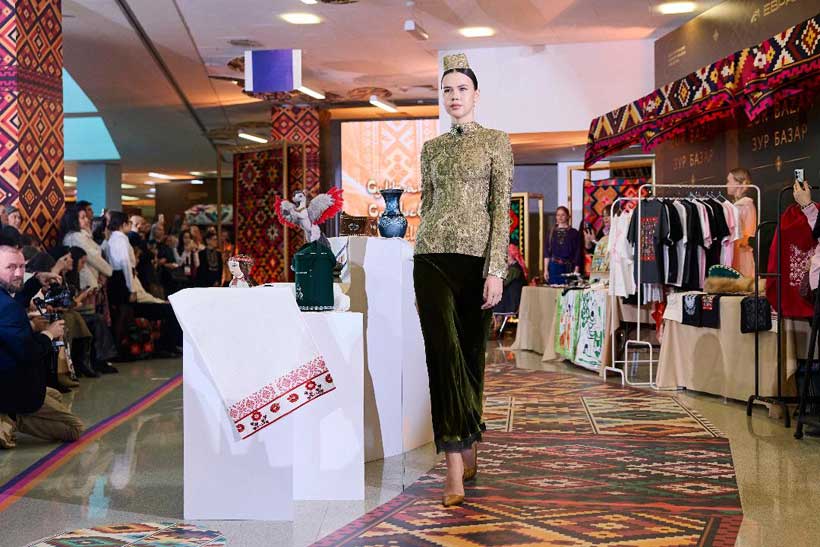
This agenda was put into practice at the international festival-forum “Russian Creative Week—Eurasia,” which took place on 2–4 November in Ufa.
The main theme of the forum was “Russia and Eurasia: From Eurasian Dialogue to Joint Projects.” Participants thoroughly discussed the development of joint production, international distribution, exports, the exchange of professional competencies, and interaction between creative industries and traditional sectors of the economy.
A separate place in the program was devoted to expanding cooperation with the countries of Africa and the Middle East. At a thematic session, experts put forward the initiative to create a unified alliance of creative industries, while noting the importance of working with international media and the need for creating more quality platforms for international dialogue in the field of the creative economy.
Among the participants were Nathan Brown, Director of Strategy for Africa and the Middle East at Saturn Five Consulting; Ibrahim Mello, an expert on Iran and the Middle East; and Louis Gouend, founder of the Hello Africa project.
How Creative Industries Are Adding Value to Traditional Products
One of the promising areas of the creative economy is the application of its tools in traditional industries. This concerns not only the creation of standalone products but also increasing the added value of existing production facilities.
In industry, design and digital technologies make it possible to develop new product solutions and improve the consumer characteristics of goods. In agribusiness, branding, packaging, and the development of product lines help companies move from selling raw materials to more complex offerings. In tourism, architecture, digital services, gastronomy, and the events industry make it possible to shape a comprehensive product for a territory.
This principle is also applicable to international projects. Russia and African states can consider cooperation opportunities not only directly within the creative industries but also at their intersection with manufacturing, the technology sector, agribusiness, and the service sector.
Priority—sustainable projects and measurable results
The development of Russian-African cooperation in the field of the creative economy presupposes a transition to regular joint work by entrepreneurs, technology companies, producers, and professional organizations.
At the same time, the effectiveness of international projects should be assessed not only by the number of contacts established but also by concrete economic results: the entry of products into new markets, sales volumes, the commercialization of intellectual rights, and the creation of jobs.
Of fundamental importance is equal partnership, in which participants jointly develop products, pool resources, and obtain economic results from their sale.
It is precisely this model that allows the creative economy to be viewed as a promising area of long-term cooperation between Russia and African states.
*The “Russian Creative Week” is the main federal event in the field of Russia’s creative economy, bringing together since 2020 representatives of government bodies, businesses, and the creative industries community. The forum serves as a platform for shaping a visionary agenda, new trends and strategies for the development of the creative economy, exchanging regional experience, launching joint initiatives, making practical business decisions and developing investment partnerships. Strategic sessions, foresights, and other formats of joint work allow participants to design new models for the development of creative industries and create conditions for their implementation.
