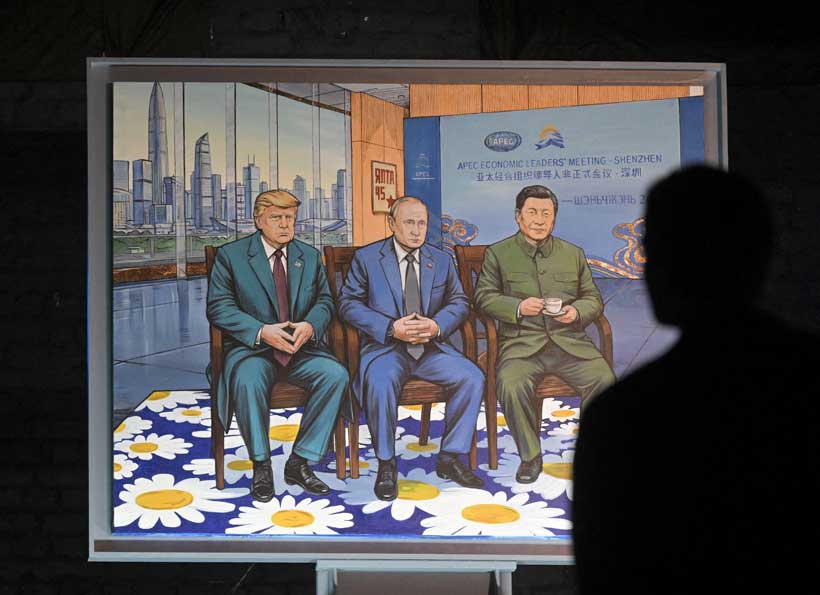
Next week, the leaders of the United States, China, and Russia may meet to discuss pressing global issues, including the wars in Ukraine and Iran, nuclear weapons, and artificial intelligence. However, the chances of reaching a significant agreement seem low. The exact agenda and format for the talks remain uncertain as preparations are ongoing. This potential meeting is expected to occur in Shenzhen during the Asia-Pacific Economic Cooperation forum.
Each leader has different objectives for the meeting. Russian President Vladimir Putin hopes to negotiate terms to end the war in Ukraine favorably for Russia. U.S. President Donald Trump, facing challenges due to recent electoral losses within his party, aims to make history with a three-way agreement on nuclear arms control. Chinese President Xi Jinping views this unpredictability with caution, given the contrasting styles of Trump’s improvisation and his own more structured approach. Trump’s push for arms control adds complexity because China, having significantly fewer nuclear weapons than the U.S. or Russia, does not see itself as a major nuclear power.
The idea of top leaders potentially cutting deals behind closed doors raises concerns for nations not involved, such as Ukraine and Taiwan. Trump’s planned meeting aligns with a history of previous high-profile diplomatic efforts during his presidency, though past meetings have not resulted in breakthroughs. A senior official from Trump’s administration stated they do not expect any nuclear agreements but hoped China would engage in discussions on the issue.
The proposed gathering has drawn comparisons to the 1945 Yalta Conference, which formalized power dynamics after World War II. For some Russian nationalists, the possibility of a new Yalta-esque meeting is exciting, potentially offering a way to conclude the conflict in Ukraine in Russia’s favor. Some Russian voices believe that this meeting elevates Russia’s status as a superpower alongside China and the U.S. However, fears over the implications of a “Yalta 2” scenario have spread, particularly in Kyiv, where Ukrainian President Volodymyr Zelenskiy expressed concern about potential shifts in influence.
Stay ahead of the geopolitical week.
MD Briefing delivers expert analysis across five global fronts — the Indo-Pacific, energy, geoeconomics, European security, and the Middle East — every Monday morning. Free.
China is approaching this meeting with reluctance, as the focus on nuclear talks is problematic for them, given their smaller nuclear arsenal compared to the U.S. and Russia. Despite this, China and Russia have developed closer ties in recent years, including cooperation in trade and military aspects. China’s leadership has been hesitant to add the Ukraine war to the agenda, while Trump is unlikely to address it in the trilateral discussions.
Overall, while there are expectations for the meeting to capture global attention, significant breakthroughs remain doubtful, as the leaders aim to assert their power and influence on the world stage.
With information from Reuters