


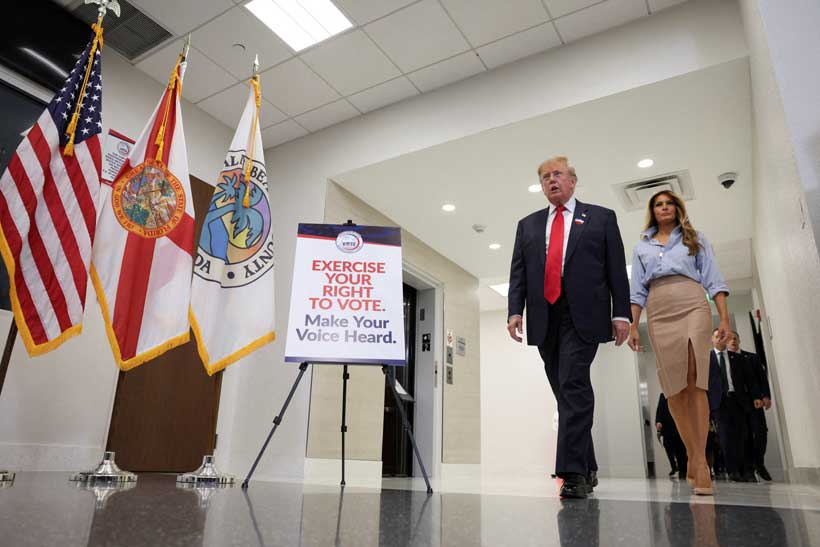
Elections have always been evidence of democracy. As it represents general will and gives power to citizens to choose their leaders and shape their country’s future. The USA is also one of the most famous democracies. The defeat of the Republican Party in its recent midterm elections symbolizes public opinion, and this transfer of power to Democrats demonstrates the practical essence of constitutionalism. This decisive defeat by 44 Republican votes in the 100-member US Senate and trailing by a wide margin of 157 Republican votes in the 435-member House of Representatives reflects a seismic change in domestic perception. What explains this shift? And what would its implications be for US foreign policy?
Reasons for Republicans’ Failure
One possible answer for this shift is the skyrocketing price of living. This surge has become an impediment to fulfilling basic necessities. Overall, prices increased by 3.7% over the year, primarily due to increasing prices of fuel and energy. In October diesel prices reached around the high record of $6.52 per gallon, which was seen in September, according to government data. Around 79% of voters stated inflation and financial crises as the cause of shifting their political affiliation, according to data from voter polls.
Another reason is the unpopular Iran war, which became the major source behind surging prices. The closure of the Strait of Hormuz resulted in high prices of fuel and energy. MAGA Republicans also considered it as reneging on its promise to make America First, which had been a key mantra during Trump’s election campaign. It was difficult for Americans to accept subservience to Israel’s interest. It further raised suspicion regarding US legislature and American-Israel Public Affairs Committee links, who work closely with the Israeli government and its agenda. All of this did not rest well with young Americans.
In addition to that, a voter-oriented campaign from Democrats was also a reason. Democrats won because they seemed to be more connected to people’s everyday problems. For instance, religion and faith were discussed with voters by Democrats like James Talaria and Adam Hamilton. Other Democrats like Abdul El-Syed and Annie Andrew pondered upon healthcare affordability and reducing political corruption. On the other side, Republican candidates like Ken Paxton were questioned for not addressing voters’ basic concerns.
Also, in the 2024 election, many Hispanic and Black people shifted their loyalties towards Republicans to let Trump win. But this phenomenon reversed, and many Hispanic and Black people supported the Democrats. Counties with a chiefly Hispanic population leaned towards Democrats, leading to a decline in support of Republicans of over 22% points compared to the 2024 elections, according to a New York Times analysis. This success of Democrats has challenged the longstanding political trend as they have gained seats in areas that were taken as unlikely to win for decades.
Foreign Policy Options Trump can avail
Although Republicans faced blows in midterm elections, Trump still remains the president till 2028. Now the question is how it will affect Washington’s foreign policy or what foreign policy options Trump is left with. Two points come to the forefront.
Firstly, the probability is less for the Trump to return to war with Iran because his entrance into the Middle East Chessboard had unfurl a wave of domestic opposition. Also, Republicans would not like to return with this unpopular war, as it could imperil the future of the party and its race for the White House. Indeed, America would like to bow out gracefully. As far as the importance of the Strait of Hormuz is concerned, everyone would appreciate a smooth sailing of cargo without any disruption of supplies like oil, gas, petroleum, etc.
Stay ahead of the geopolitical week.
MD Briefing delivers expert analysis across five global fronts — the Indo-Pacific, energy, geoeconomics, European security, and the Middle East — every Monday morning. Free.
On the other hand, keeping in view the lackadaisical approach of Trump and the unpredictable and erratic traits of his personality, it is likely that he will threaten Iran with bombing again. With the approaching elections, he backed off from military confrontation, but as the political constraints are lifted, he could return to his policies again. Congress can stop Trump, at least theoretically, by taking actions like reducing funding to arms and taking tariff imposition power back. But all these actions require enough seats in both the House and Senate, which Democrats do not have.
Secondly, the dimension of foreign policy that concerns us is how it will impact Pakistan-US relations. To this the Washington approach has always been pragmatic and used the lens of geopolitical interest. In the aftermath of the Pak-India 2025 military confrontation, Pakistan enjoys the image of a stabilizing force in the region. Also, the image of only states fighting terrorism in the form of proxies from India and Afghanistan contributes to its geopolitical importance. Pakistan and the US trade is blooming, and multiple areas of cooperation are seen between these two, such as IT and agriculture. So, most probably the relations will remain the same.
Ultimately, the failure of Republicans is more than just a political development. It represents growing dissatisfaction among Americans regarding Trump’s policies. For the Iran issue, the solution rests in diplomacy and going back to the drawing board, which is the Islamabad MOU. As it addresses both the US’s and Iran’s concerns, like restraining Iran from producing nuclear weapons and lifting up the economic sanctions from Iran. The Trio of Makkah Agreement can perform a significant role in facilitating the peace discussion between Iran and the US. Nevertheless, the opportunity for peace is limited, as caretaker Prime Minister Netanyahu might play some moves and drag the US again into this war. Moreover, many in Democrats tend to have pro-Israeli, pro-Indian, anti-Iranian, and anti-Chinese views, so American foreign policy will remain under discussion in Congress in months ahead.
