


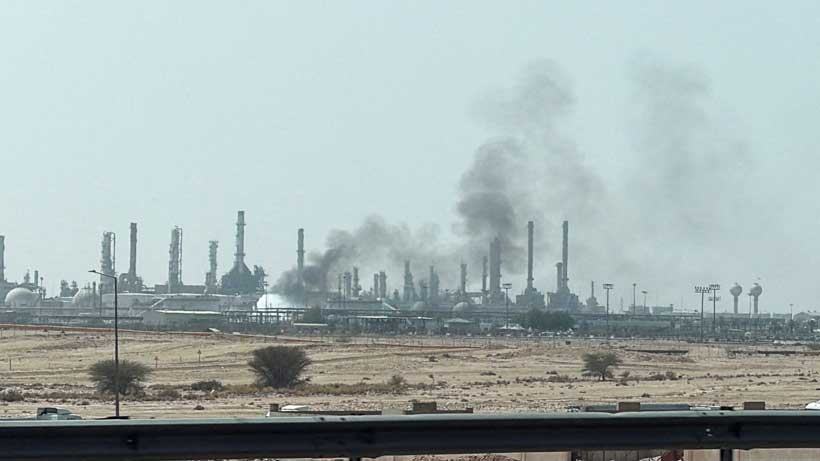
The attack on Aramco’s Riyadh tower shows a militia aiming at the Kingdom’s economic core and at one of the last open arteries of global energy supply.
On 8 November 2026, the glass facade of Saudi Aramco’s administrative tower in Riyadh’s King Abdullah Financial District was torn open across several floors. Saudi Arabia’s Energy Ministry attributed the damage to falling shrapnel from an attempted attack, and no one was killed. Yet the significance of the strike lies less in the physical damage than in the target. The district houses the Public Investment Fund, the Saudi stock exchange and major international banks. By aiming at it, Yemen’s Houthi militia signalled that its campaign against Saudi Arabia is no longer confined to border provinces or remote facilities. It is aimed at the economic heart of the Kingdom.
An escalating campaign, not an isolated strike
The Aramco attack is one episode in a widening pattern. The Houthis claimed that the same day’s operations, using ballistic and cruise missiles and drones, also targeted Riyadh airport, Aramco oil storage and the eastern city of Abqaiq. Over recent months, the group has struck King Khalid International Airport in Riyadh, King Fahd International Airport in Dammam, and the Ras Tanura and Rabigh refineries, among other targets. The human cost has been real: on 10 October, a Houthi strike on Riyadh’s airport killed at least 13 people and wounded more than 300. Pakistan’s Foreign Office has also condemned Houthi missile attacks on 24 October that targeted the Makkah and Madinah regions. The Aramco strike itself came only hours after Riyadh announced that in-person schooling would resume following weeks of remote learning forced by earlier attacks. When a capital city’s children cannot attend school, the claim that these are purely military operations falls apart.
Stay ahead of the geopolitical week.
MD Briefing delivers expert analysis across five global fronts — the Indo-Pacific, energy, geoeconomics, European security, and the Middle East — every Monday morning. Free.
How the truce collapsed
Understanding this escalation requires looking at how Yemen’s four-year “no war, no peace” equilibrium broke down. The immediate catalyst came on 13 July 2026, when an Iranian civilian aircraft carrying a Houthi delegation landed in Sanaa, breaching the airspace arrangements Riyadh had treated as a red line. What followed was rapid: strikes on Sanaa airport, Houthi retaliation, a declared Houthi blockade of Saudi shipping, and renewed attacks on the Kingdom. Analysts have since described the war as having resumed at a fiercer tempo than its original outbreak in 2015.
The broader regional context makes the Houthi campaign especially dangerous. With the Strait of Hormuz closed by the US-Israeli war on Iran, Saudi Arabia has turned to exporting crude through its Red Sea outlets. That shift makes the Red Sea and the Bab al-Mandab strait among the most important energy corridors left open to Gulf producers, and it is exactly where the Houthis have concentrated their pressure, including sinking an Indian-flagged commercial vessel. Attacks on Aramco and Saudi refineries are therefore not only strikes on one country’s revenue. With Hormuz shut, they are attacks on one of the last functioning arteries of global energy supply, with consequences for oil prices, shipping insurance and importing economies far beyond the Gulf, including Pakistan’s.
The economic logic of the target
The choice of the King Abdullah Financial District is deliberate. Andreas Krieg of MENA Analytica has described the strike as an attack on the credibility of Vision 2030 as much as on Aramco itself. Saudi Arabia’s diversification strategy depends on persuading global investors, financial institutions and tourists that Riyadh is a stable place to put capital and people. Each missile aimed at the capital’s financial core is designed to raise the perceived risk premium on that bet. The Houthis do not need to destroy buildings to succeed on these terms; they need only to make insecurity appear routine.
That is why normalisation is the real danger. If strikes on Saudi airports, refineries and business districts come to be treated as background noise, the militia will have achieved through attrition what it cannot achieve militarily. Riyadh’s deputy governor framed the Aramco strike as further evidence of the Houthis’ targeting of civilian facilities. Accepting such attacks as a permanent feature of the regional landscape would set a precedent that any armed non-state actor with missile capability can hold a sovereign state’s economy hostage.
The Houthis’ claim to speak for Yemen
The Houthis present their campaign as the defence of Yemen and as part of a regional “axis of resistance”. That claim deserves scrutiny. Yemenis have borne the heaviest cost of the renewed war, with fighting, displacement and economic collapse inside the country intensifying since July. Reports have also pointed to coordination with Iran-backed Iraqi militias, with attacks on Saudi Arabia reportedly launched from Iraqi territory. That suggests a campaign shaped as much by the strategic needs of a wider regional confrontation as by Yemeni interests. A movement that fires missiles at airports and city centres while its own population endures famine-level conditions cannot credibly claim to be championing Yemen.
None of this absolves all other actors. The Saudi-led coalition’s own air campaign has historically drawn serious criticism for civilian harm in Yemen, and a durable settlement will require political concessions on all sides. But the current phase of escalation was triggered by a deliberate breach, and it has been sustained by strikes on civilian and economic targets that no reading of international humanitarian law can justify.
Pakistan’s position
Pakistan’s response has been unambiguous. The Foreign Office strongly condemned the attempted attack, describing the targeting of civilian facilities as a reckless disregard for human life and regional security, and demanded that the Houthis immediately and unconditionally cease all attacks. It also affirmed that Pakistan supports all necessary measures to safeguard the Kingdom’s security and sovereignty. This is consistent with the Strategic Mutual Defense Agreement Islamabad and Riyadh signed in September 2025, which treats an armed attack on one as an attack on both. At the same time, Pakistan has kept diplomatic channels open with Tehran. In June it brokered the Islamabad Memorandum between Washington and Tehran, which briefly reopened Hormuz before the truce frayed. That record gives Islamabad a role in de-escalation that few other states possess.
The path forward is clear in principle, even if difficult in practice. The Houthis must cease their attacks and respect the Kingdom’s sovereignty; their regional backers must be pressed to restrain them; and the international community, including the UN Security Council, must treat attacks on civilian infrastructure and global energy routes as threats to international peace rather than as a localised Yemeni dispute. Saudi Arabia’s security, and the stability of energy markets on which much of the world depends, should not be held hostage to Houthi adventurism.
