


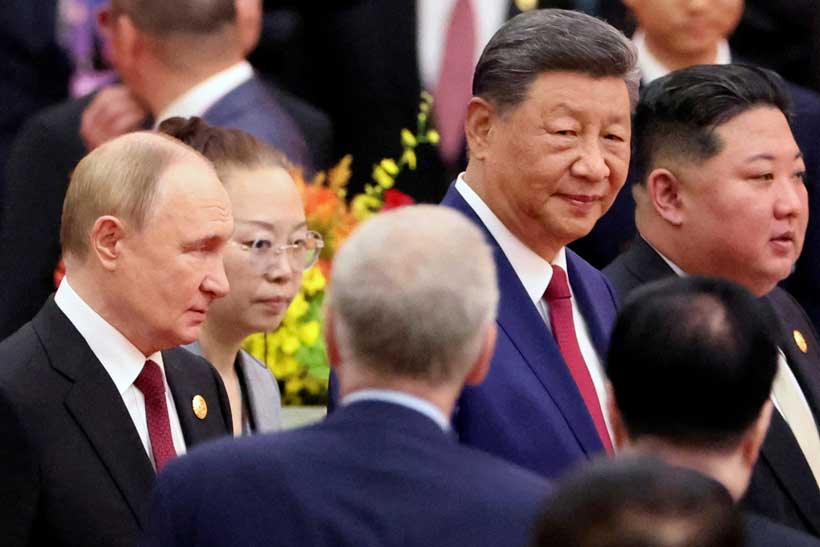
The growing strategic convergence among China, Russia, and North Korea is presenting an uncomfortable paradox to Northeast Asia’s security. Thanks to decades-old institutionalized alliance cooperation, the United States, Japan, and South Korea collectively possess substantial military, technological, and economic capabilities. Yet their defense planning is primarily centered on geographically separated stand-alone contingencies, while authoritarian countries are generating strategic effects that go beyond regional boundaries.
The Russo-Ukrainian war demonstrates such new asymmetry. North Korea’s troop dispatch to the European battlefield and munition supply are supporting Moscow’s warfighting efforts, while Pyongyang is gaining combat experience and a potential opportunity to acquire advanced military technologies in exchange. Meanwhile, cooperation between China and Russia is complicating America’s strategic calculations across Europe and the Indo-Pacific. Although these relationships are not equivalent to the emergence of an integrated military alliance akin to NATO, the complementary impact itself could pose a challenge vis-à-vis the existing regional security order.
These turns of events resemble some elements of 1930s Europe. Despite France and Britain collectively having considerable military and economic resources, they could not effectively respond to Nazi Germany’s expansion on the European continent. The immediate lesson for Northeast Asia is not that another conflagration is inevitable. Rather, it is that military superiority alone would not be sufficient if strategic preparation does not align with how adversaries actually behave.
The Failure of Europe’s Interwar Period: Military Power Devoid of Strategic Adaptation
Stay ahead of the geopolitical week.
MD Briefing delivers expert analysis across five global fronts — the Indo-Pacific, energy, geoeconomics, European security, and the Middle East — every Monday morning. Free.
The defeat of France in 1940 remains a notable case that illustrates the gap between material capacity and operational efficacy. At the time, France maintained a large-scale military organization and sophisticated tanks—which included the monstrous Char B1 Bis and SOMUA S35 that were equipped with superior armor and firepower compared with many German tanks. Nonetheless, these technological advantages could not prevent Germany’s swift victory.
France’s strategic thinking was deeply influenced by World War I. The Maginot Line was designed to safeguard France’s industrial core, economize on manpower, and induce Germany’s onslaught toward Belgium. Unlike conventional thought, these fortifications achieved the defensive objective that was originally intended. A bigger problem lay in the fact that France’s operational plan did not demonstrate an adequate level of adaptation when the German mechanized units transited the Ardennes in May 1940.
By integrating its mechanized forces, airpower, communication, and mobility, Germany was able to exploit vulnerabilities in Allied deployment. Although France prepared for another German invasion in a comprehensive fashion after the 1919 Treaty of Versailles, France’s assumptions turned out to be dangerously inaccurate.
The diplomatic fiasco prior to the outbreak of the war also revealed related problems. Irrespective of Czechoslovakia’s capable military, extensive fortresses, and impressive armament industries, it was diplomatically isolated once France and Britain accepted Hitler’s territorial demand at Munich in 1938: the Munich Agreement weakened Prague’s defense posture while reinforcing Berlin’s strategic perspective on the European continent.
Poland’s experience in 1939 revealed another limitation. Britain and France declared war after the German invasion, yet their initial measures could not avert the defeat of Poland. The following Soviet incursion in the eastern Poland more clearly illustrated how cooperation among revisionist countries can profoundly alter the existing strategic environment.
These cases each offer distinctive lessons: France shows the risk of preparing against an insufficiently understood operational threat; Czechoslovakia discloses how gradual territorial concessions could attenuate a broader security order; while Poland demonstrates the very limitations of an external security guarantee that is not backed up by timely military support.
Authoritarian Cooperation Across Strategic Theaters
Today’s China, Russia, and North Korea are vastly different from the spoiler countries that challenged Europe’s interwar order. The former do not have integrated military command systems and pursue aims that are not always identical. Nonetheless, the enlarging cooperation among them is increasingly linking security environments across different geographical areas that were previously divided.
North Korea’s support to Russia is a case in point. Pyongyang has provided military equipment and manpower on behalf of Moscow’s war efforts in Ukraine, receiving operational experience, technological assistance, and political support in exchange. Consequently, further developments on the European battlefield would progressively strengthen North Korea’s military capabilities and could ultimately shift the preexisting balance-of-power on the Korean Peninsula.
Meanwhile, China is contributing from a different dimension. The economic relationship between China and Russia is helping Moscow’s ability to withstand Western pressure, while China-Russia military cooperation—under the framework established by the 2001 Treaty of Good-Neighborliness and Friendly Cooperation—is complicating US and Japanese defense planning. In addition, Moscow remains Pyongyang’s major economic cooperation partner, creating strategic maneuvering room for the latter.
Needless to say, such cooperation trends should not be misunderstood as seamless trilateral coordination among them. China has the incentive to avoid uncontrolled escalation, and the strengthening relationship between Moscow and Pyongyang does not always correspond with Beijing’s interests. However, strategic complementarity among authoritarian states necessitates neither a complete consensus nor a common operational plan.
A more notable development is that activities in one theater could generate advantages elsewhere. The Russo-Ukrainian war would likely enhance North Korea’s military capacity, while increasing tension in Northeast Asia could distract American attention and materiel from Europe to other places. In other words, an opportunity can be created for mutually strengthening pressure without a coordinated decision prior to multiple simultaneous conflicts.
The Democratic Problem: Strong Alliances, Separate Contingencies
Ever since the 1950s, the United States has been maintaining two robust bilateral alliances in Northeast Asia. While the US-Japan alliance is ensuring regional power projection, the US-ROK alliance is playing a pivotal role in deterring North Korea’s full-fledged invasion. A recent series of events—including the 2023 Camp David Trilateral Summit, trilateral real-time missile warning data-sharing, and Freedom Edge exercises—has further strengthened trilateral cooperation.
However, these achievements have not fully addressed the structural disconnections that exist between major regional defense mechanisms. While South Korea’s military plan remains centered on the Korean Peninsula, Japan’s strategic priorities include the East China Sea, the Taiwan Strait, and the broader Indo-Pacific region. Although the existence of OPLAN 5055—a US-Japan joint action operational plan in case of a Korean contingency—functions as a bridge that links Japan and South Korea, the absence of a military pact between the two countries leaves the weakest connection within the US-Japan-Korea mechanism unresolved.
A division of labor between Tokyo and Seoul is understandable, given both countries’ distinctive geographical locations and security obligations. Yet such demarcation becomes problematic when threats transcend the boundaries around which defense planning has traditionally been organized.
Consider a situation where a military conflict breaks out in the Taiwan Strait while North Korea’s military pressure heightens, as illustrated by the Atlantic Council report. The United States could confront competing demands on missile defense interceptors, intelligence-gathering platforms, air tankers, maritime forces, and military logistics. Even in the absence of operational coordination between Beijing and Pyongyang, they could exploit the increasing burden on finite American resources.
Under such a scenario, Japan may have to make uneasy decisions regarding the protection and the use of facilities supporting United States Forces Japan (USFJ). As for South Korea, deterrence against North Korea should be maintained amidst potential competition over US reinforcements: Seoul might even have to fight alone without US assistance for a protracted period. The challenge would likely expand to ammunition production, spare parts maintenance, and industrial backfill.
This is precisely the Maginot Line issue for contemporary Northeast Asia. Similar to France during the interwar period, the three democracies are making an enormous amount of investment to prepare against identifiable threats. However, if the opponent bloc shrewdly exploits the connections across contingencies—to which the defenders have designed separate responses—the preparation would lose its overall effectiveness.
Building a Democratic Division of Labor
To be sure, a meaningful response does not necessarily require a trilateral alliance that is akin to NATO. Instead, Washington, Tokyo, and Seoul should develop a practical mechanism for the division of labor that could translate preexisting strengths into coordinated regional resilience.
For instance, South Korea could assume greater responsibility for sustained support in the field of conventional forces, such as surge production of 155mm artillery munitions, KM-SAM land-based air defense systems, and low-cost Counter-Unmanned Aircraft Systems (C-UAS) including the Cheongwang Block I. Seoul’s substantial defense industrial base could support regional demand while preserving sufficient production capabilities and stockpiles that are necessary for homeland defense.
Meanwhile, Japan could reinforce its role as a regional logistics and maintenance hub. Japan’s advanced maritime infrastructure, industrial capacity, and large-scale deployment of USFJ—54,900 active duty troops, which constitute the largest contingent of US troops based overseas—offer opportunities to expand maintenance capabilities, preposition supplies, and improve the resilience of facilities that support US operations. These measures should be made in accordance with Japan’s legal requirements and political decisions.
As for the United States, it should focus on intelligence integration, coordination of resource allocation across theaters, and deploying advanced military capacities—like the US Army Multi-Domain Task Force (MDTF)—that cannot easily be replaced by regional allies. In addition, Washington should establish a trilateral planning mechanism that explicitly incorporates simultaneous contingencies, instead of treating crises on the Korean Peninsula and in Taiwan as completely separate matters.
Such a mechanism should be validated by joint exercises involving US reinforcements, missile defense interceptors, and competing demands on logistical resources. If this cooperation is institutionalized, vulnerability to changes in domestic political leadership could also be reduced.
Avoiding the Lessons of 1938
To be sure, twenty-first-century Northeast Asia is not 1938 Europe. Elements including nuclear deterrence and the absence of an integrated Russia-China-North Korea military alliance profoundly differentiate today’s strategic environment from that of the interwar period. Nonetheless, historical warnings remain relevant. If the three democracies do not creatively and collectively adapt to the interconnected challenges posed by the opponent bloc, it would perhaps be too late to sustain the existing stability and order in Northeast Asia once they are disrupted.
