The 14 Seats Everyone Pretends Not to Count
Going into Tuesday’s vote, the final polls put Benjamin Netanyahu’s bloc at about 50 of the Knesset’s 120 seats and Gadi Eisenkot’s opposition at 52 to 56, with the two Arab-led parties at 14 to 16 combined. Neither camp reaches the 61 needed to govern. Leaders of both blocs have vowed to keep Arab parties out of their coalitions.
Five days before the vote, Ahmad Tibi of the Joint List published a two-stage plan. Stage one is to bring down Netanyahu. Stage two is to sustain an alternative government from outside the cabinet, in exchange for a list of civic demands. “We will not allow Netanyahu to be caretaker prime minister,” he said. He also said: “We know that the next government will not be a peace government.” That last sentence is the key to the outcome nobody is modelling: an Israeli government at war with Iran that survives on Arab votes.
Two Parties, Two Offers
Stay ahead of the geopolitical week.
MD Briefing delivers expert analysis across five global fronts — the Indo-Pacific, energy, geoeconomics, European security, and the Middle East — every Monday morning. Free.
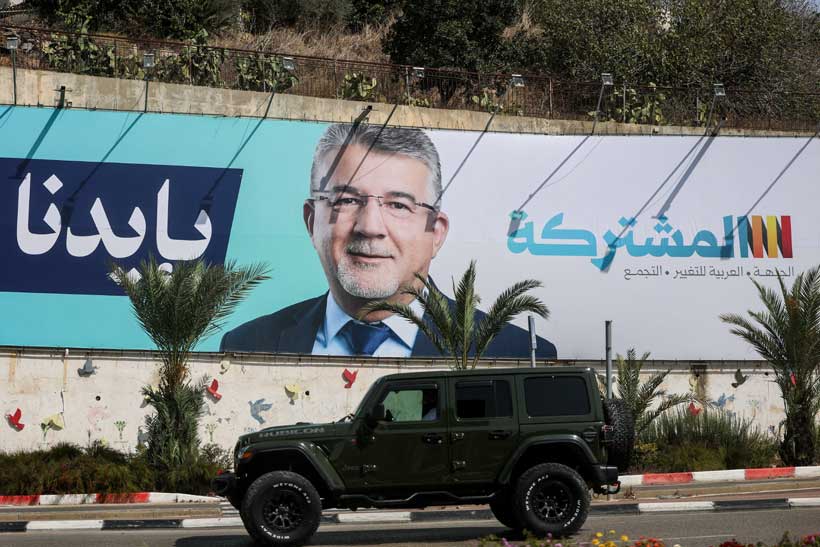
The Arab vote is split in two, and the difference matters. The Joint List (Hadash, Ta’al and Balad), averaging about 8.5 seats, has offered only outside support, a “safety net” against no-confidence votes. It says that would not oblige it to back settlements or stay quiet on Gaza. Ra’am, averaging about 5.5 seats in a four-poll average, is the party that joined the Bennett–Lapid government in 2021. Its leader, Mansour Abbas, calls that experiment a “model that can be developed, improved and upgraded”.
The Zionist opposition’s leaders have boxed themselves in. Naftali Bennett has ruled out relying on Arab parties. Eisenkot has set entry conditions for any partner, including recognising Israel as a Jewish and democratic state and agreeing that Hamas must be dismantled, which no Arab party has accepted. About 70% of Jewish Israelis oppose an Arab party in government. Netanyahu’s campaign has made Eisenkot’s supposed dependence on Arab votes its main attack line. Arab turnout, forecast at up to 69% compared with about 50% recently, could add seats and harden the arithmetic further. For the mechanics of the vote, see MD’s guide to how Israel’s election works.
Why the Veto Lands on Hebron, Not Tehran
Most commentary assumes an Arab-dependent government would be a dovish government, or at least one forced to wind down the war. That gets the mechanics wrong.
Start with the law. Under Basic Law: The Government, decisions to go to war or launch a major military operation belong to the government, and since 2018 they have been permanently delegated to the security cabinet. The Knesset is informed, not consulted. A party supporting a government from outside the cabinet has no seat in the room where strikes on Iran are approved. Its only leverage is the threat to withdraw support on a no-confidence motion or a budget vote. That threat is a blunt instrument, and blunt instruments get used sparingly.
Then look at when Arab partners have actually used that leverage. In April 2022, Ra’am froze its coalition membership over clashes at Al-Aqsa during Ramadan. It did not quit, because Abbas did not want to be blamed for toppling the first government with an Arab party in it, and for Netanyahu’s return. The trigger was Jerusalem, not a military operation, and the response was a protest, not a collapse. Tibi’s list of demands follows the same pattern: crime in Arab towns, home demolitions in the Negev, planning permits, the Kaminitz Law on illegal construction, and the Knesset Speaker. Iran is not on it.
So Iran policy would largely survive. Eisenkot, a former army chief, says he will confront the Iranian threat. MD has already argued that a change of prime minister need not mean a change of Iran strategy. The more serious constraint falls on everything around the Iran war. Netanyahu wants time to “finish the job” and “break Iran’s murderous regime”, and that requires a domestic coalition willing to absorb open-ended escalation: lockdowns in the West Bank like the one ordered last week after the Hebron attack, expanded emergency powers, settlement growth as a reward for coalition partners, and changes to the Temple Mount status quo. Those are the votes an Arab safety net would not provide. A government dependent on it can strike Iran. It cannot easily combine a war with Iran with annexation politics at home.
The strongest objection is that such a government would never form, or would collapse at the first crisis. Eisenkot may prefer another election to the stigma, and 70% opposition among Jewish voters is a real constraint. But consider the alternative. If no one reaches 61, Netanyahu stays on as caretaker, potentially for months, and that is the outcome Tibi says he is organising to prevent. A narrow government with outside Arab support would also have the strongest incentive any Israeli coalition has ever had to keep its security policy unremarkable, because every escalation would test its survival in public.
That changes how Washington reads Israel. Trump endorsed Netanyahu, but his advisers increasingly see opportunity beyond him. Some believe Netanyahu’s pre-war assessments were wrong, and Witkoff and Kushner are frustrated by his reluctance to implement the Gaza plan. Trump still has to decide whether to join another major operation against Iran. An Israeli partner that cannot sell escalation at home makes that decision Washington’s alone, with no Israeli political clock pushing it forward. The Gulf will notice the same thing. Gulf governments did not support starting the war, and they want “policy openings” rather than wholesale change: restraint on settler violence, the Temple Mount status quo and Gaza reconstruction. A coalition that cannot pass annexation-friendly measures gives them exactly that, without a more dovish Israel that Tehran could exploit. It offers the change in branding the Gulf has wanted, with the hawkish security policy kept intact.
Three Ways the Count Could Go
Base case (around 45%): stalemate and a caretaker. No candidate reaches 61. Eisenkot tries for a coalition without Arab support and fails, Arab parties withhold or split their recommendations to President Herzog, and Netanyahu governs as caretaker through the winter while Washington decides on Iran. War policy continues on autopilot, and annexation politics continue too. This is the outcome Gulf capitals should fear most and are least prepared for.
Alternative case (around 30%): a narrow government on an Arab safety net. Eisenkot and Bennett form a minority or narrow government, with Ra’am inside or abstaining and the Joint List voting against no-confidence motions. Iran policy barely changes, but West Bank measures, emergency powers and settlement funding stall. Riyadh and Abu Dhabi quietly reopen public channels. The main risk is the budget: a government that cannot pass one falls automatically, and Ra’am and the Joint List would have leverage over it.
Downside case (around 25%): the interregnum war. A caretaker Netanyahu, with his legitimacy contested, joins or pre-empts a renewed US campaign against Iran during coalition talks. The war then dominates the negotiations, Arab parties come under pressure from their own voters to rule out any arrangement, and the opposition becomes unable to form a government. Escalation while caretaker becomes the route back to power.
Watch the Recommendations, Not the Results
The government Israel is least willing to imagine is the one most likely to make it predictable. It would not be dovish. It would leave Iran policy largely as it is, while putting the West Bank, the Temple Mount and settlement funding back under real parliamentary constraint, which is where Washington and the Gulf most want Israeli restraint.
The signal to watch is the round of recommendations to President Herzog once the final results are certified. If Ra’am recommends Eisenkot, or the Joint List publicly backs him, the minority-government scenario becomes real. If both stay silent, Netanyahu remains caretaker. The 14 seats that decide this election will not be at the cabinet table, but they will decide whether there is a government at all.