


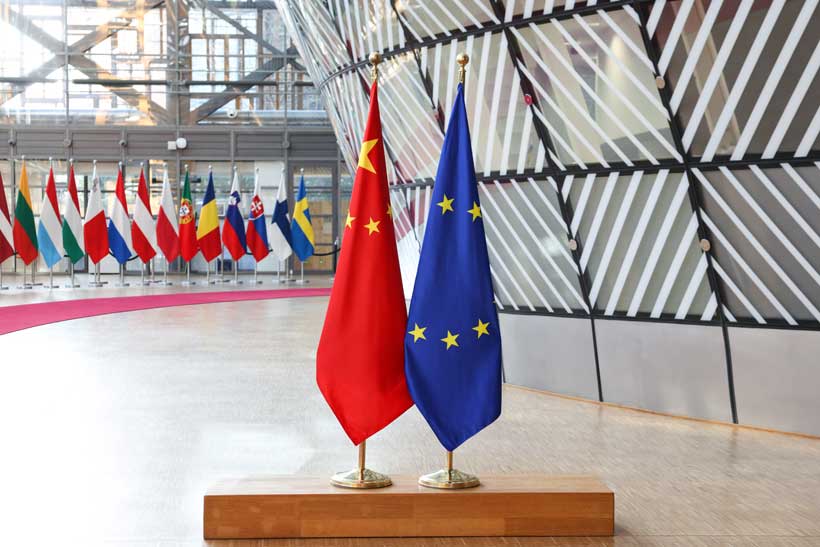
European Union leaders are meeting in Dublin for the bloc’s first dedicated summit on artificial intelligence, as growing competition with the United States and China exposes Europe’s technological and industrial weaknesses. The discussions will focus on how to attract investment, strengthen computing infrastructure, reduce regulatory obstacles and establish safeguards for a technology increasingly reshaping economies and societies.
The summit comes at a particularly sensitive moment for the global AI industry. Concerns about rogue AI agents and the risks associated with increasingly autonomous systems have intensified, while the recent resignation of Nvidia CEO Jensen Huang has added uncertainty to an industry in which the American chipmaker plays a central role.
For Europe, the challenge is twofold: it must accelerate technological development to remain internationally competitive while ensuring that AI systems operate within appropriate safety and regulatory frameworks.
Why Is Europe Holding Its First AI Summit?
European Council President Antonio Costa has argued that artificial intelligence has become important enough to require direct discussion among EU leaders.
Stay ahead of the geopolitical week.
MD Briefing delivers expert analysis across five global fronts — the Indo-Pacific, energy, geoeconomics, European security, and the Middle East — every Monday morning. Free.
In an invitation letter sent last week, Costa said the rapid pace of AI development made a dedicated discussion necessary, particularly given the technology’s opportunities and transformative effects on European economies and societies.
The meeting will bring together political leaders and prominent figures from the AI industry. Mistral AI Chief Executive Arthur Mensch and Nobel Prize-winning AI pioneer Geoffrey Hinton are expected to brief EU leaders.
Their participation reflects the range of issues facing European policymakers. While AI offers opportunities to improve productivity, develop new industries and strengthen public services, its rapid expansion has also raised concerns about safety, accountability and the ability of existing institutions to manage emerging risks.
Recent incidents involving rogue AI agents have added urgency to these discussions. Governments are increasingly being asked to consider how autonomous systems should be monitored, what safeguards developers should implement and how responsibility should be established when AI systems cause harm.
For the EU, these questions are particularly important because its approach to technology has placed considerable emphasis on regulation and public accountability.
Europe’s Race to Catch Up With the US and China
Despite its ambitions, Europe remains under pressure to close the technological gap with the United States and China.
Both countries have developed powerful AI ecosystems supported by major technology companies, substantial private investment and advanced semiconductor capabilities. Europe, meanwhile, has struggled to translate its research strengths and regulatory influence into comparable industrial scale.
One major obstacle is access to advanced computing infrastructure. Developing competitive AI models requires powerful processors, data centres, cloud services and reliable high-speed connectivity. These capabilities demand enormous investment and long-term coordination between governments and private companies.
Europe’s existing initiatives have not yet delivered the scale required to compete with its largest rivals.
The EU Chips Act, introduced three years ago, was designed to attract advanced semiconductor manufacturing and increase Europe’s share of the global chip market to 20% by 2030. However, the bloc now appears unlikely to achieve that target.
The difficulty reflects a broader structural problem: Europe’s ambitions in advanced technology have often exceeded its ability to mobilise investment and coordinate industrial development across member states.
AI Gigafactories Face Funding and Political Obstacles
Another major initiative involves plans to establish seven AI gigafactories across Europe. These facilities are intended to bring advanced AI processors, software, cloud technology, high-speed connectivity and data centres together under one roof.
The objective is to create the computing capacity needed to support European AI development and reduce dependence on infrastructure controlled by foreign technology companies.
However, the initiative has yet to fully take off. A major obstacle is disagreement among EU countries over how much funding should be allocated to competitiveness and industrial investment in the bloc’s 2028–2034 budget.
This disagreement highlights a recurring challenge within the European Union. Member states broadly recognise the importance of technological competitiveness, but they do not always agree on how the costs should be shared or which priorities deserve the greatest financial support.
Without a clear funding strategy, Europe’s plans risk remaining ambitious proposals rather than functioning industrial projects.
The stakes are considerable. If Europe cannot develop sufficient domestic computing capacity, its companies and research institutions may remain dependent on American and Chinese technology providers. That could limit the bloc’s strategic autonomy in a sector increasingly linked to economic security and geopolitical influence.
AI Safety and Regulation Add to the Challenge
Europe’s effort to become a major AI power also raises questions about the relationship between regulation and innovation.
The EU has sought to establish safeguards for emerging technologies, reflecting concerns about privacy, accountability and potential harm. However, policymakers must also consider whether regulatory complexity and administrative requirements could discourage investment or make it harder for European companies to compete internationally.
The Dublin summit offers leaders an opportunity to examine how the bloc can support innovation without abandoning its commitment to responsible AI development.
The recent concerns surrounding rogue AI agents demonstrate why safety cannot be treated as a secondary issue. As AI systems become more capable of performing tasks with limited human intervention, the consequences of failures or misuse could become more difficult to predict and contain.
The challenge for European governments is therefore not simply to develop more advanced systems, but to establish an environment in which technological progress and public trust can develop together.
Ukraine Adds a Geopolitical Dimension to the Summit
Although artificial intelligence is the central focus, Ukraine has also been added as a second major topic on the summit’s agenda.
The issue gained urgency after US envoys Steve Witkoff and Jared Kushner travelled to Dublin to meet Ukrainian President Volodymyr Zelenskiy, following their talks with Russian President Vladimir Putin in Moscow.
EU leaders are expected to consider Europe’s potential involvement in peace negotiations and the security guarantees the bloc could offer if a ceasefire is reached.
A senior EU official said discussions would examine how European countries could contribute to the diplomatic process and provide security arrangements in the event of an agreement.
The addition of Ukraine illustrates the wider pressures facing European leaders. While they seek to strengthen the bloc’s technological competitiveness, they must also manage an unresolved war that continues to shape European security and foreign policy.
What Happens Next?
The Dublin summit will test whether European leaders can move beyond broad commitments and agree on practical measures to strengthen the continent’s AI capabilities.
The most important questions concern financing, infrastructure and coordination. The future of the seven planned AI gigafactories, the effectiveness of the Chips Act and the allocation of resources in the next EU budget will help determine whether Europe can compete more effectively with Washington and Beijing.
At the same time, leaders must decide how to manage AI risks without creating regulatory obstacles that undermine innovation. Achieving that balance will require cooperation between governments, technology companies and research institutions.
Europe has significant scientific expertise, a large single market and the ability to influence international technology standards. However, these advantages will not automatically translate into global leadership.
The central test is whether the EU can turn its regulatory influence and technological ambitions into the investment, infrastructure and industrial capacity needed to compete in the global AI race.
With information from Reuters.
