Two Ceasefires, Eleven Days Apart
On 12 October, Donald Trump announced that Russia and Ukraine had agreed to stop attacking each other’s energy infrastructure. There was no text, no map and no monitor. Within a day, Volodymyr Zelenskyy said Russia had struck at least six Ukrainian energy facilities, and Sergei Lavrov said Moscow would not be “buying into assurances and promises again.”
On 23 October, a far smaller deal was announced. Russia and Ukraine agreed a local ceasefire around Oleshky, an occupied town on the Dnipro’s left bank that has gone months without electricity, heat or running water. The deal has a start time (03:00 Kyiv time on Tuesday 27 October), a sequence (demining, then a needs assessment, then aid, then evacuation), and named owners on each side. One deal was a headline; the other is a work plan. The difference between them is the most useful lesson of four and a half years of war diplomacy.
A Town of 2,000 and a Channel Built on Children
Stay ahead of the geopolitical week.
MD Briefing delivers expert analysis across five global fronts — the Indo-Pacific, energy, geoeconomics, European security, and the Middle East — every Monday morning. Free.
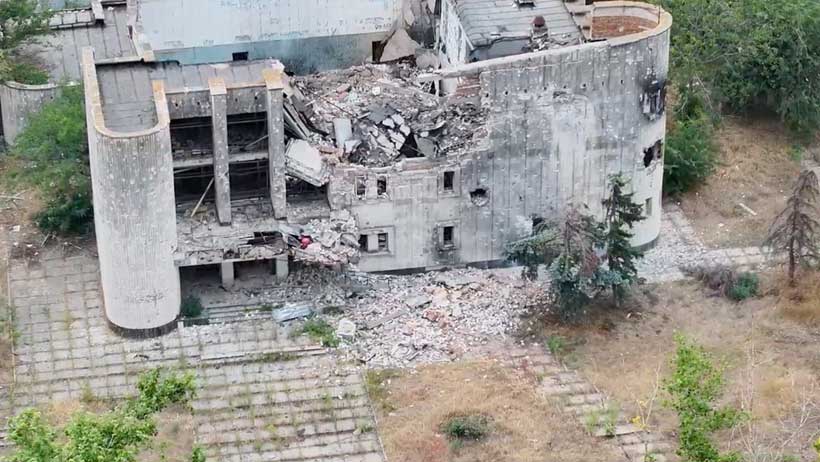
Oleshky had about 24,000 residents before Russia took it in February 2022; about 2,000 remain. Kyiv has asked for months for a pause to evacuate them. The only roads out are mined, and drones hunt anything that moves along the river. A UN inquiry has described that pattern of drone attacks on civilians in the Kherson area, which residents call the “human safari”), as crimes against humanity.
The deal came through the channel Melania Trump has run since 2025. It began with reuniting Ukrainian children separated by the war, through what she called an “open channel” to Vladimir Putin. The people doing the work are not soldiers or diplomats. They are the two countries’ human rights ombudsmen, Dmytro Lubinets and Yana Lantratova, whose offices have long worked on prisoner and civilian exchanges. That matters, because the ombudsmen’s channel is one of the few that has kept working throughout the war. The deal lands alongside the main track: Steve Witkoff has secured Putin’s “in principle” agreement to resume trilateral talks, expected in Abu Dhabi in the first half of November.
What Holds, and Why
Most coverage treats Oleshky as a goodwill gesture before the real talks. That has the hierarchy backwards. Look at the record and a pattern appears: every Russia–Ukraine agreement that has held was small, specific and checkable, and every broad one has collapsed.
The Black Sea Grain Initiative moved 32.8 million tonnes of food in 1,003 voyages over a year because joint teams inspected every ship, both inbound and outbound. The UAE-mediated prisoner exchanges have now run 27 rounds, freeing 8,537 people, including 540 on the same day the Oleshky deal was announced. The IAEA has brokered seven local ceasefires so engineers could repair power lines at the Zaporizhzhia nuclear plant, most recently in September. Set those against the failures. The 30-day energy moratorium of March 2025 quietly expired in a cloud of mutual accusations. This month’s energy ceasefire never got started.
The successes share four features, and the failures lack them. First, the scope is narrow enough that a violation is obvious: a ship either was inspected or it wasn’t, and a prisoner either crossed or didn’t. Second, both sides get a payoff they can count, whether grain revenue, returned soldiers or a nuclear plant that doesn’t melt down. Third, someone outside the two parties owns the process and has a reputation at stake: Türkiye and the UN, Abu Dhabi, Rafael Grossi. Fourth, the people executing the deal are technical or civilian, so it does not depend on generals trusting each other. The energy truces were broad, unverified and owned by nobody. They died accordingly.
Oleshky scores on three of the four. It covers one town for several days, so any shelling of the convoy will be visible within hours. Moscow gets a showcase of Russian “humanitarianism” and a warm word from the White House; Peskov’s public praise for the First Lady was not accidental. Kyiv gets its citizens out. And the mediator has a personal stake in success that no envoy’s memo can match.
The fourth feature, verification, is the weak point. The monitoring role has gone to an unnamed “impartial American media organisation”, not the ICRC or the UN. Evacuees may choose to go to Russia or Ukraine, but nobody has said who confirms the choice was free. In an area where the UN has already flagged possible forcible transfer of civilians, that is the gap that could turn a rescue into a propaganda exercise or worse.
The strongest objection is that micro-deals never add up to peace. The grain deal did not stop the war, and swaps have continued through every escalation. Bottom-up diplomacy cannot settle who controls Zaporizhzhia, and it can lend Moscow a humanitarian gloss while its maximalist territorial demands stay intact. All true. But it misses what these deals produce. Any ceasefire along a front line more than 1,000 kilometres long will need exactly what Oleshky is testing: local deconfliction, a trusted third-party observer, sequenced demining and civilian movement under watch. As Washington rethinks its approach to ending the war, that is the part of the problem a summit cannot shortcut. The machinery for monitoring a ceasefire has to be built somewhere before there is a ceasefire to monitor. Today, it is being built in Oleshky, at the Zaporizhzhia plant and in UAE-run prisoner swaps, and nowhere else.
The 2022 precedent is a warning, not a refutation. When corridors were announced for occupied Kherson that March, aid was blocked within a day. Those corridors had no sequence, no observer and no owner, which is exactly the point.
Three Ways Oleshky Goes
Base case (around 55%): it works, once. The ceasefire largely holds, mines are cleared, aid arrives and several hundred people leave, with a few disputed incidents that each side blames on the other. Both governments claim credit, and then the channel goes quiet. The Abu Dhabi talks open on territory and security guarantees, with no humanitarian working group on the agenda. Oleshky becomes a footnote. The key assumption is that Washington treats the deal as a public-relations success rather than as a design.
Downside case (around 25%): it breaks in a way that poisons the track. A convoy is hit, or evacuees end up routed only into Russian-held territory and their choice cannot be independently confirmed. Kyiv cries forced deportation, and Moscow cries Ukrainian provocation. Arriving in Abu Dhabi, each side holds fresh proof that the other cannot be trusted with anything, and the ombudsmen’s channel, the most productive in the war, is damaged. For European governments funding Ukraine, this would also remove the one cooperative mechanism a future ceasefire would build on.
Upside case (around 20%): it becomes a template. Success in Oleshky produces a second local ceasefire, for other besieged riverside communities or a wider safety zone around the Zaporizhzhia plant. Negotiators also add a standing humanitarian track to the Abu Dhabi agenda, run by the ombudsmen with a named third-party monitor. That would turn the First Lady’s personal channel into an institution, and give the top-level talks a growing body of proof that verified pauses can hold. It is the slowest path to peace, and the only one with a working prototype.
Build From the Town Up
The Oleshky ceasefire is not a sideshow, and it is not yet a template. It is a test of whether the design that has kept grain ships, prisoner swaps and nuclear repair crews moving can be applied to territory, which is the thing the war is actually about. If it holds, the case for a parallel, bottom-up track becomes hard to dismiss, because a summit cannot produce verification machinery and Oleshky can.
The signal to watch comes in the first 72 hours after 03:00 on Tuesday: whether evacuees reach Ukrainian-held territory and whether the observer publishes what it saw. Then check the Abu Dhabi agenda for a humanitarian working group. Big promises have failed every time in this war. Small, checkable deals are the only ones that have held, and peace may have to start there.