


The intelligence and data centers, the Academy of Military Sciences, the Rocket Force, and the intelligence, military, and security apparatus of the People’s Liberation Army of China (PLA) possess a comprehensive strategic view of North Korea’s recent military developments under Kim Jong-un’s leadership, specifically the testing of ballistic and hypersonic missile systems equipped with artificial intelligence (AI) and low-altitude, wave-like trajectories designed to penetrate and disable the air and missile defense systems of North Korea’s adversaries in the Asian region, such as THAAD and Patriot, which are allied with the United States and other adversaries in the region.
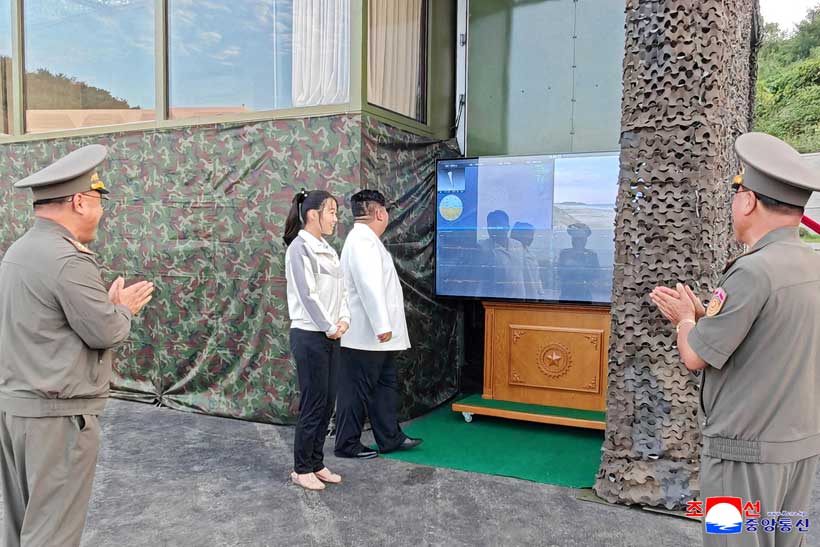
The Chinese Academy of Military Sciences, the Rocket Force, and all Chinese intelligence, military, defense, and security agencies analyzed North Korea’s success on October 3, 2026, in developing an advanced weapon capable of disabling US air defenses. North Korean leader Kim Jong-un personally demonstrated how Pyongyang could disable the US missile defense system and other missile and defense systems of US allies in the Indo-Pacific region surrounding Pyongyang. This was achieved by launching a medium-range ballistic missile equipped with a hypersonic glide vehicle, under Kim Jong-un’s personal supervision. The missile was launched from Wonsan, North Korea, traveled 1,000 kilometers, and accurately struck its target in the Sea of Japan. The projectile followed a unique undulating trajectory. As a result, Japan and South Korea were unable to track its entire path. Seoul initially estimated the distance at 700 kilometers. The new technology allows for the selection of at least four different flight patterns to suit a specific mission. This significantly complicates the operation of enemy radars and missile defense systems. According to Chinese assessments, this may be an upgraded version of the Hwasong-16B system, Hwasong-16B.
Accordingly, Chinese intelligence, military, defense, and security agencies are proceeding with their assessment of the missile test conducted by North Korea on October 3, 2026, based on precise strategic calculations and a combination of military satisfaction and diplomatic caution. Chinese analyses and assessments in this regard confirm the following:
– First: The Chinese technical and military perspective on the North Korean missile launch, which they consider to be the same as the upgraded Hwasong-16B system (Hwasong-16B), confirms for China:
Stay ahead of the geopolitical week.
MD Briefing delivers expert analysis across five global fronts — the Indo-Pacific, energy, geoeconomics, European security, and the Middle East — every Monday morning. Free.
1) Confirmation of North Korea’s technological superiority over US missile defense systems: Chinese military circles view the missile launched from the Wonsan area of North Korea as a significant development based on the technology of the Hwasong-16B missile, equipped with a hypersonic glide vehicle called the HGV (HGV and a solid-fuel engine).
2) Confirmation by Chinese People’s Liberation Army (PLA) military circles of the US and Western intelligence, security, and military failures, and Chinese verification: Beijing accurately observed the confusion in Western assessments and those of Washington’s allies in the Asian region. South Korean and Japanese radars, both allies of Washington, were unable to track the complete trajectory of the North Korean ballistic missile due to its erratic flight path and low-altitude maneuvers (skip-glide). This included changing flight patterns between four different modes. This discrepancy (Seoul estimated the distance at 700 km, while the missile actually traveled 1000 km) proves, from the Chinese perspective, the success of the new North Korean weapon in exposing weaknesses in the tracking and early warning systems of US allies.
– Second: The Chinese Security and Defense Assessment of North Korea’s Defeat of US Defenses, as analyzed by Chinese intelligence, military, defense, and security agencies:
1) North Korea’s Defeat of the US Integrated Deterrence Strategy: Chinese defense agencies believe that this new North Korean weapon represents a crucial tool for disrupting the effectiveness of US missile defense networks in the Pacific, such as the THAAD and Patriot systems and naval vessels equipped with the Aegis system.
2) Confirmation by Chinese military circles of North Korea’s success in neutralizing the forward operating bases of Washington’s allied systems in the region near Pyongyang: The success of this missile signifies, for China, Pyongyang’s ability to strike vital targets and US bases in Japan, Okinawa, and even Guam with high precision and without the possibility of interception. This reduces Washington’s ability to intervene militarily quickly in any regional conflict, a capability that China could exploit with regard to Taiwan.
– Third: The strategic and political dimensions of the impact of North Korea’s new weapon and its superiority in disrupting US air and missile defenses on China. Beijing views this as:
1) An indirect North Korean and Chinese pressure tactic against Washington: Although Beijing does not publicly support North Korea’s nuclear or missile escalation to avoid further sanctions or increased US military buildup, its security apparatus sees this development as a geopolitical advantage. It strains the US defense system and diverts Washington’s military focus between Taiwan, the South China Sea, and the Korean Peninsula.
2) Concerns about the militarization of the region: The cautious aspect of the Chinese perspective lies in the fear that this missile surge by Pyongyang will accelerate the regional arms race and push Japan and South Korea to request the deployment of more US strategic weapons or develop independent missile and offensive capabilities, something Beijing categorically rejects.
Hence, Chinese intelligence, military, defense, and security agencies analyze this situation according to precise strategic dimensions, directly related to the Taiwan issue for China and the confrontation with the United States, through:
– First: Chinese Security and Defense Agencies’ Assessment of North Korea’s New Weapon
1) Confirmation of Operational Effectiveness: Analytical centers affiliated with the Chinese People’s Liberation Army, such as the Academy of Military Sciences and the Rocket Force, believe that North Korea’s integration of artificial intelligence with hypersonic glide vehicles (HGVs) gives its projectiles self-regulation to change course mid-flight. This confounds US radar tracking algorithms in the Pacific region and makes interception virtually impossible.
2) Erosion of the US Nuclear and Defense Umbrella: Beijing believes this weapon breaks Washington’s monopoly on defensive superiority in East Asia and confirms the inability of US systems to provide absolute protection for its allies (South Korea and Japan).
– Second: The Importance of North Korea’s New Weapons for Taiwan and the Chinese Scenario
Pyongyang’s military development represents an indirect geopolitical and military advantage for China in its potential struggle to reclaim Taiwan through three main axes:
1) Distracting and Disrupting US Military Capabilities (Diversion of US Assets):
In the event of any military conflict in the Taiwan Strait, Kim Jong-un’s possession of a weapon capable of striking US bases and disabling their defenses means that Washington will not be able to mobilize its full naval and air power and defense systems to protect Taiwan. The United States will be forced to maintain a significant portion of its missile defense systems, such as THAAD and Patriot, and aircraft squadrons in South Korea, Japan, and Guam to neutralize the sudden North Korean threat.
2) Securing China’s Northern Flank (Protecting the Northern Flank):
North Korea’s nuclear and conventional military represents a strategic buffer protecting Beijing. Pyongyang’s existence as a sophisticated deterrent prevents the United States and its allies from considering opening a northern military front against China while the latter focuses its military operations on Taiwan in the South.
3) Absorbing Intelligence and Logistical Pressure:
North Korea’s continuous tests force US intelligence agencies, such as the Defense Intelligence Agency (DIA) and the National Security Agency (NSA) to expend enormous resources monitoring and tracking Pyongyang’s movements. This gives the People’s Liberation Army (PLA) greater room to maneuver and prepare militarily around Taiwan, away from the full scrutiny of the United States.
– Third: Beijing’s Strategic Position (Tacit Acceptance)
Although China officially does not favor instability, its security apparatus has moved to a stage of tacit acceptance of North Korea as a permanent nuclear and missile power. This is evident in:
1) The Chinese Foreign Ministry’s refusal to condemn Kim Jong-un’s recent missile tests and the removal of demands for the denuclearization of the Korean Peninsula from diplomatic discourse with Pyongyang.
2) Here, Beijing sees this advanced North Korean deterrent as a free and effective tool to drain US defense capabilities and undermine Taiwan’s confidence in the seriousness of the military protection provided by Washington.
Based on the preceding military and strategic analysis, we understand the importance of North Korea developing an advanced military and defense system capable of disrupting US air and missile defenses, both for China and in its confrontation with the United States over Taiwan. North Korea is attempting to capitalize on shared interests with both China and Russia by establishing a relationship with Russia and China similar to the Five Eyes intelligence alliance, an intelligence-sharing network comprising the United States, the United Kingdom, Australia, Canada, and New Zealand. Chinese, Russian, and North Korean cybersecurity experts could collaborate on developing sophisticated software to counter US missile and defense systems, thereby exerting pressure on Washington in the Pacific and Indo-Pacific region. This region is closely linked to the shared interests of China, Russia, and North Korea in their dealings with Washington’s allies, such as Japan and South Korea.
