The Visit That Skipped Ankara
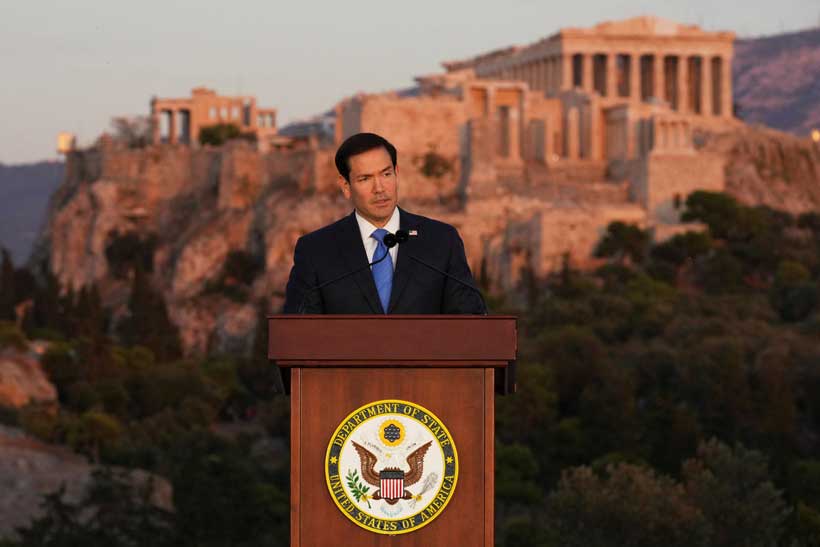
On 7 October, Marco Rubio and Greek Foreign Minister Giorgos Gerapetritis closed the sixth US–Greece Strategic Dialogue in Athens with $4bn in Foreign Military Sales, Stryker armoured vehicles, and Greece’s admission to the US National Guard’s State Partnership Program, paired with Florida. Rubio flew on to Portugal without stopping in Turkey. In 50 years, only two of his predecessors, John Kerry and Mike Pompeo, had skipped Ankara on such a trip.
Two days earlier in Riyadh, Turkey had joined Saudi Arabia and Pakistan in agreeing to move “immediately” to implement their collective defence pact. In the same week, Athens drew closer to Washington and Ankara committed forces to the Gulf. Together those two moves are reshaping the eastern Mediterranean more than any dispute over Aegean airspace.
Two Allies, Two Directions
Stay ahead of the geopolitical week.
MD Briefing delivers expert analysis across five global fronts — the Indo-Pacific, energy, geoeconomics, European security, and the Middle East — every Monday morning. Free.
Greece has been building up its American ties for years. The Mutual Defence Cooperation Agreement, expanded in 2019 and made open-ended in 2021, gives US forces access to Souda Bay in Crete, Larissa and the northern port of Alexandroupolis. It has ordered 20 F-35s, with deliveries expected from 2029. The Iran war made those ties operational.
Turkey’s path has been more transactional. At the NATO summit in Ankara in July, Donald Trump said he would lift sanctions on Turkey and “consider” F-35 sales. Turkey was expelled from the F-35 programme in 2019 over its Russian S-400 missiles. Then on 7 August, Ankara signed the Mecca Joint Defence Agreement with Riyadh and Islamabad, a mutual-defence pact outside NATO. With Houthi missiles now hitting Saudi cities, that pact is being activated.
The Infrastructure Is Moving to Greece
The usual reading of US–Greece–Turkey relations is a weapons scoreboard: who gets which fighter jets, and when. By that measure Washington is hedging, not choosing. It is selling to Athens and dangling F-35s in front of Ankara. But the scoreboard misses what is actually moving. American power in the region depends less on who flies which jet than on where its carriers dock, where its fuel and gas enter Europe, and whose air defences protect its bases. On each of those counts, the answer is increasingly Greek.
Start with the war. When the USS *Gerald R. Ford* needed combat repairs this spring, it went to Souda Bay, which JINSA describes as the only Mediterranean port able to host a carrier strike group, and kept supporting operations from there. US signals-intelligence aircraft flew from Crete. Greek-operated Patriot batteries in Saudi Arabia intercepted two Iranian ballistic missiles on 19 March. In September, Athens moved a Patriot battery from Karpathos to Crete to protect Souda. Greece is now spending its own scarce air defences to protect American forces, which is the clearest sign that an ally has become a platform.
Then energy. US LNG now flows through Alexandroupolis up the “Vertical Corridor” to Ukraine via Bulgaria, Romania and Moldova, with Greece positioned as Europe’s gateway for American gas. ExxonMobil and Chevron are preparing to drill in Greek blocks, including south of Crete, where Libya objects on the strength of its 2019 maritime memorandum with Turkey. US lawmakers are pressing Rubio to back the Crete–Cyprus power cable as part of the India–Middle East–Europe corridor. Each of these projects ties American commercial and strategic interests to Greek maritime claims that Ankara disputes.
Turkey, meanwhile, is pointing its military weight south. According to Middle East Eye, Ankara plans troops and air defences to protect Riyadh, Mecca, Medina and the East-West oil pipeline, plus a command base shared with Saudi and Pakistani forces. Foreign Minister Hakan Fidan insists the pact is “not an offensive agreement”, and parliament has not yet approved it. Even so, MD has asked whether Saudi Arabia’s new allies can contain the Houthis, and the answer matters here too. Every Turkish air-defence battery in the Hejaz is one that is not in the Aegean. And every commitment Ankara makes to Riyadh is one Washington does not control.
The strongest objection is that this is wishful thinking in Athens. Washington never drops Turkey. Ankara controls the straits under the Montreux Convention and has kept them closed to belligerent warships, a point MD made in its analysis of the Black Sea’s spreading shipping war. It has NATO’s second-largest army and leverage over Gaza, Syria and now the Gulf. Trump plainly likes doing deals with Erdoğan. All true, and that is why the F-35 question remains open. But it confirms the argument rather than refuting it. Washington treats Turkey as a broker whose usefulness is renegotiated deal by deal. It treats Greece as a platform. Brokers are paid in jets; platforms get infrastructure. Infrastructure, once built, shapes policy for decades in a way a fighter sale does not.
The $4bn itself contains a caution. One of Washington’s complaints going into the dialogue was that Athens buys too much from European and Israeli suppliers, including a $4.6bn Israeli air-defence package. The arms deal is partly a commercial correction. The State Partnership Program and the Strykers are the more telling details: they bind Greek ground forces into US training and logistics systems. That kind of integration is hard to unwind.
What this does to the Greece–Turkey balance is subtle. Greece doesn’t gain a guarantee: the US still won’t take sides on the Aegean, Libya or Cyprus. What it gains is the US as a stakeholder. When Turkish warships stopped cable surveys south of Kasos in July 2024, Athens was alone. The next time, the waters will carry American energy contracts, an American-backed corridor and a cable Washington’s own lawmakers have endorsed. That raises the cost of Turkish naval pressure more than any extra squadron would.
Three Ways the Bet Plays Out
Base case: platform and broker (about 55%). Washington keeps both tracks running. Greece absorbs the FMS package and the Florida partnership and becomes the default US logistics hub between Italy and the Gulf. Turkey’s F-35 path stalls in Congress, where a 2020 law requires certification that Ankara no longer holds the S-400 and bipartisan opposition is already organised. Ankara’s Gulf role grows. The Aegean stays tense but quiet. The key assumption is that Erdoğan doesn’t force the S-400 question.
Downside for Athens: the Kasos test (about 25%). Greece issues the navigation notice needed to resume cable surveys south of Kasos, possibly as early as October, and Turkish warships turn up again. Washington responds with a neutral call for “dialogue”. That would expose the limit of the platform strategy: the US invests in Greek territory but won’t defend Greek claims. It would also push Athens back toward Paris, already the cable’s new financial backer. Investors in the cable and the Crete drilling blocks should price this risk now.
Alternative: Ankara cashes in the Gulf (about 20%). Turkish air defence proves effective against Houthi missiles at a moment when Trump has promised not to strike Iran before the 3 November midterms. Washington needs Turkey more and rewards it: the CAATSA sanctions are lifted and an F-35 certification process starts. The terms of the debate change, because Greece’s edge would rest only on infrastructure while Turkey regains parity in the air.
Probabilities reflect the author’s analytical judgment based on currently available information and are not statistical forecasts.
Platforms Outlast Deals
Washington hasn’t picked Athens over Ankara. It has picked Greek geography for the things that matter most and that last longest: carrier repairs, gas pipelines, power cables and air-defence cover for its bases. Meanwhile Turkey has sent its military weight into a Saudi alliance that Washington doesn’t control. That changes the Greece–Turkey balance more than any dispute over islets or airspace, because it changes what the United States has to lose in the waters between them.
The signal to watch is the navigation notice for the Crete–Cyprus cable surveys south of Kasos. If Athens issues it and Washington says more than “dialogue”, the bet is paying off. If Washington goes quiet, Greece has bought arms, not alignment.
Ankara still has the better deals. Athens is getting the bases, pipelines and cables, which last longer.