Two Weeks, One Oilfield
On 29 September, Javier Milei gave Britain two weeks to halt the Sea Lion oil project north of the Falkland Islands, or face proceedings under the UN Convention on the Law of the Sea, beginning with a request for emergency measures at the international tribunal in Hamburg. He called the project the “illegal plundering of our resources” and said Argentina “will not stand idly by.” London rejected the arbitration the next day and, for the first time, questioned “Argentina’s reliability as a partner.”
This is the same Milei who in 2024 called Margaret Thatcher brilliant and acknowledged that the islands were in British hands. What changed is not Argentina’s legal position. Two things changed around it: oil went above $100 a barrel, and on 31 August Donald Trump, asked whether the US was reviewing its position on the islands, replied: “I always review every position.”
A Frozen Dispute, an Oilfield and a Neutral America
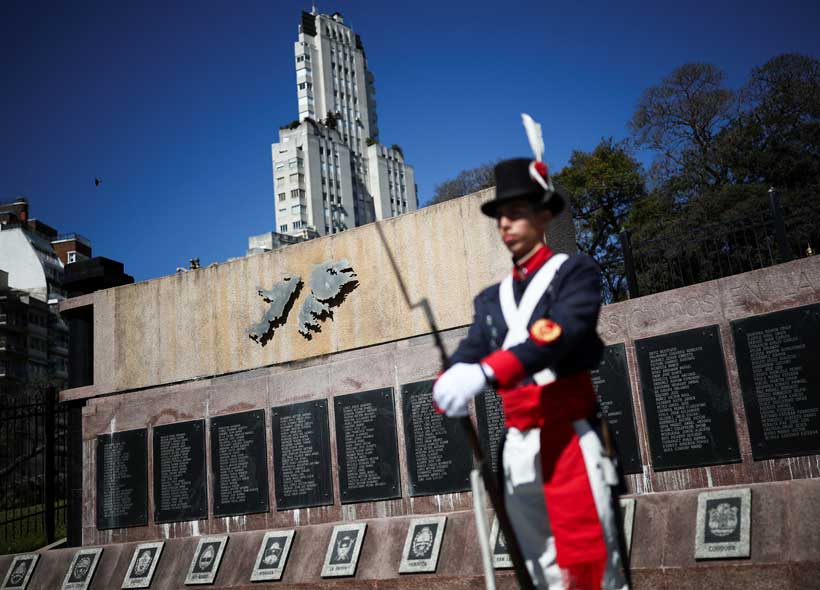
Britain has held the Falklands since 1833. Argentina invaded in 1982 and was defeated in a 74-day war that killed 649 Argentine and 255 British servicemen. In a 2013 referendum, 99.8% of islanders voted to remain British. Since then the dispute has been frozen: Argentina presses its claim diplomatically, while Britain keeps a garrison at Mount Pleasant.
Stay ahead of the geopolitical week.
MD Briefing delivers expert analysis across five global fronts — the Indo-Pacific, energy, geoeconomics, European security, and the Middle East — every Monday morning. Free.
Through all of this the United States has kept a careful line. It backed Britain militarily in 1982 and recognises British administration, but takes no position on sovereignty. Sea Lion is what tests that line now. Rockhopper Exploration and Israel’s Navitas Petroleum took a final investment decision in December 2025: $2.1 billion for a first phase producing about 50,000 barrels a day from early 2028, backed by $1 billion of senior debt. The field is estimated to hold 1.7 billion barrels in total. On 21 September the islands’ government extended the licences by five years.
The Real Target Is Washington, Not Hamburg
The coverage treats the ultimatum as a legal threat. As law, it is weak. As politics, it is well timed.
Start with the law. The Convention covers maritime zones, not who owns land, and both countries have excluded certain sea-boundary disputes from compulsory proceedings. Britain added that exclusion in 2020. In the 2015 Chagos arbitration, a tribunal declined to rule on a sovereignty dispute dressed as a law-of-the-sea case. To win emergency measures in Hamburg, Argentina must show a tribunal would likely have jurisdiction and that the harm is urgent — hard for a field not due to produce until 2028. A legal analysis published the day of the ultimatum concluded that it “does not itself halt the project.” Buenos Aires knows this. It won a quick ruling in Hamburg in 2012, freeing its seized frigate Libertad in Ghana, but that case did not touch sovereignty.
Now look at the economics. Rockhopper valued the first phase assuming Brent at $70. At $100, a project that was viable becomes highly profitable, and the planned second phase, aiming for around 180,000 barrels a day by 2030, becomes far more attractive. For the islanders, that means a revenue stream large enough to change the economics of the territory. For Argentina, it means a British-licensed oil province growing off its coast at the moment oil is scarcest. High prices make Sea Lion worth fighting over for both sides.
The real leverage, though, lies in Washington. Trump’s remark came after reports that the Pentagon had considered dropping support for Britain’s position to push London to spend more on defence. A week later he suggested the US might not help Britain if Argentina used force, noting the islands were “a long way away,” and asked why Britain had not sent “a couple of ships” to the Iran war, Newsweek reported. Milei, Trump’s closest Latin American ally and the beneficiary of a $20 billion US swap line that Trump openly tied to Milei’s performance at the polls last year, read that as an opening. Within days he announced sanctions on oil companies in the area and spoke of “winds of change.”
That shows what the ultimatum is really for. Argentina is not trying to win in Hamburg. It is trying to make the Falklands a live issue that the Trump administration has to take a position on — and to reward Washington’s ambivalence with a loyal ally’s gratitude. Milei’s government already shapes the hemisphere around Trump’s priorities, as Modern Diplomacy noted when Trump launched his Shield of the Americas initiative. Now it is collecting.
The pressure that matters is commercial. In mid-September Argentina sent around 180 warning notices to firms in 30 countries and filed three criminal complaints, and it has proposed tightening its 2011 sanctions law to reach shareholders and suppliers. A $1 billion debt package, insurers, contractors and a chartered production vessel are all exposed to that. A shift in Washington — even just a refusal to say what US firms should do — would make that pressure far more effective.
The strongest objection is that none of this changes the facts on the ground. Britain’s garrison makes a repeat of 1982 unthinkable; Trump’s comments are words, not policy, and experts note there has been no formal change in the US position. Milei faces a presidential election next year, and the Falklands is always popular at home. All fair. But the dispute is no longer about the military balance. It is about financing, licensing and diplomatic cover, and in those arenas US neutrality is worth a great deal. Britain has relied on it for 44 years without having to ask for it. It now has to ask.
Three Ways the Ultimatum Plays Out
Base case (around 55%) — a legal defeat, a political gain. The deadline passes around 13 October and Argentina asks Hamburg for emergency measures. The tribunal declines or orders only minimal steps, citing the sovereignty problem. Sea Lion stays on track for 2028. Argentina steps up sanctions on suppliers, and Trump keeps US policy ambiguous without formally changing it. Milei claims a moral victory at home ahead of next year’s election; London pays a higher political price for the project, and contractors price in a modest Argentine risk premium. The key assumption is that Washington’s ambiguity stays verbal.
Downside case (around 25%) — Washington tilts. The administration formally calls for UK-Argentine sovereignty talks, or tells US firms and banks to steer clear of Sea Lion. Lenders and insurers pull back, and the second phase stalls. The rift between Washington and London widens at a moment when Britain is already stretched, and the islanders face a real economic threat for the first time since 1982. Other territorial claimants, from Spain over Gibraltar to Mauritius over Diego Garcia, would read the shift as proof that American neutrality is now for sale.
Upside case (around 20%) — a quiet trade. London raises its defence spending, Trump drops the subject, and Britain offers Argentina a face-saving gesture, such as reviving the 1995 UK-Argentine framework for cooperation on offshore oil. Argentina tones down its legal campaign without abandoning its claim. Sea Lion survives, but Washington will have shown that its neutrality can be used as leverage over an ally.
Oil Turned a Symbol Into a Stake
The Falklands dispute thawed because of two things Argentina did not control: $100 oil, which makes Sea Lion worth fighting over, and an American president who treats long-standing commitments as bargaining chips. Milei’s legal case will probably fail. His political bet — that Washington’s neutrality can be moved — may not.
Watch the US State Department after the deadline around 13 October. If it restates the standard line — US recognition of British administration, neutrality on sovereignty — Milei has gained headlines and little else. If it says anything new, the Falklands become a test of the “special relationship,” not just of the law of the sea.
For 44 years, the islands’ security rested on two things: a British garrison and American silence. The garrison is still there.