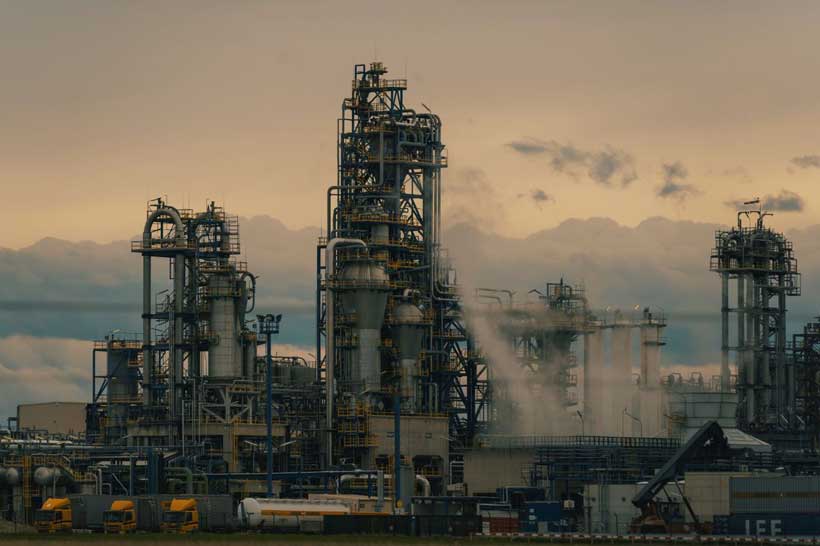
Crude Came Back. Diesel Didn’t.
This week, seven months after the Iran war shut the Strait of Hormuz, crude oil finally returned to normal. Around 13.5 million barrels a day are again leaving the Gulf through the strait, matching the prewar baseline. Refined fuel tells a different story. Shipments of diesel, jet fuel and other products through the same waterway are running at about 677,000 barrels a day, against 3.6 million before the war — less than a fifth of normal.
The prices show it. Brent sits in the high $90s, well below its March peak. Yet European diesel hit a record €2.24 a litre this week, and Washington is openly debating a ban on diesel exports. The oil shock is easing. The fuel shock is not. That gap is the most important lesson of 2026: energy security is now decided at the refinery gate and in the product-tanker lanes, not at the wellhead.
Two Wars, One Bottleneck
The war began on 28 February. Within days, flows through Hormuz fell to less than 10% of prewar levels, prompting the International Energy Agency’s largest-ever emergency release of 400 million barrels. The Gulf, though, is not only a crude exporter. Over the past fifteen years it built giant export refineries that became the world’s swing supplier of diesel and jet fuel. Several were hit: Bahrain’s 380,000 barrel-a-day Sitra refinery declared force majeure, and Qatar’s Pearl gas-to-liquids plant was damaged at Ras Laffan. Gulf refinery runs fell from 9.9 million barrels a day before the war to 7.3 million in August, and a full recovery is not expected before the second quarter of 2027.
Stay ahead of the geopolitical week.
MD Briefing delivers expert analysis across five global fronts — the Indo-Pacific, energy, geoeconomics, European security, and the Middle East — every Monday morning. Free.
A second war compounded the first. Ukrainian drone strikes have cut Russian refinery output from roughly 5.5 to 3.5 million barrels a day, and Moscow banned diesel exports for most of July before extending the ban. Europe, meanwhile, entered the crisis having closed more than 370,000 barrels a day of its own refining capacity in 2025 alone, including Shell’s Wesseling plant in Germany and Grangemouth in Scotland.
Barrels Are Interchangeable. Refineries Are Not.
Energy security has long been measured in reserves: who holds the oil, and who can stop it flowing. That framework, inherited from the 1973 embargo, explains this year’s crude market well. It explains almost nothing about what is hurting economies now. As Nikhil Agarwal of the trading house Globestar Energy put it: “Crude is surplus globally, but there is no refining capacity available to refine it and bring it to market.”
The IEA’s September Oil Market Report puts numbers on it. Gulf net exports of diesel and gasoil were just 390,000 barrels a day in August, a quarter of prewar levels, and US diesel prices broke $200 a barrel, 94% above where they stood before the war. Crude has a dozen ways around a blockade: today 40% of Gulf crude bypasses Hormuz through pipelines, up from 17% before the war. Refined products have far fewer. A barrel of diesel needs a specific refinery, configured for the right crude, with capacity to spare. Nobody builds a new one in a crisis, and almost no spare capacity is left. American refineries were running at 97.4% of capacity in late August, the highest in nearly eight years.
So who holds the power? Raw capacity is concentrated: China (18.8 million barrels a day) and the United States (18.2 million) together account for more than a third of the world’s 103.8 million, followed by Russia, India, South Korea and Saudi Arabia, according to the Energy Institute’s Statistical Review. But capacity is not the same as leverage. Leverage belongs to countries that refine more than they use and can choose where the surplus goes. In 2026 that is a short list. The US Gulf Coast has shipped more than 1.5 million barrels a day of distillates for weeks on end, even as domestic stocks fell to their lowest seasonal level since 1996. India’s Reliance loaded 4–5 million barrels of diesel for Europe in July from its Jamnagar complex. South Korean cargoes are travelling 19,000 kilometres to reach north-west Europe. China is the swing refiner that has barely swung.
Here is what most coverage misses: every one of these suppliers has treated refined fuel as an instrument of national policy. Crude is traded under market rules and OPEC quotas. Diesel, this year, has been governed by export licences. Beijing ordered refiners to stop signing new export contracts, then allowed only 800,000 tonnes in July and 2.7 million in August. Russia imposed its ban. India raised export duties on diesel and jet fuel. And on 22 September, President Trump told reporters: “I said let’s not send out the diesel.” The US supplied about half of the EU’s diesel imports in August, which is why a ban would, as Modern Diplomacy has argued, hit America’s allies harder than it hits Iran.
Shipping routes amplify the problem. Products move in smaller tankers on longer journeys, and the alternative routes into Europe now run past a second chokepoint. The Houthis’ capture of Perim island in September gives them effective control of the Bab el-Mandeb, through which around 11% of seaborne oil normally passes. Diverting round the Cape of Good Hope adds more than 20 days.
Inventories are the last line of defence, and they are held in the wrong form. Most strategic reserves, including all of America’s, are crude. A crude barrel in a salt cavern cannot fuel a lorry or an aircraft until a refinery with spare capacity processes it — and there isn’t any. Global observed stocks have fallen by 507 million barrels since February, while diesel stocks in the Amsterdam-Rotterdam-Antwerp hub sank to a four-year low of about 12 million barrels in late August. Before the war, nearly 60% of OECD Europe’s jet fuel imports from outside the region came from the Middle East.
The strongest objection is that this is a wartime anomaly: Gulf refineries will be repaired by mid-2027, Russia will patch its plants, and the old order will return. The repairs will come. The lessons will not be unlearned. Refineries have become military targets in two separate wars this year. Europe’s refining capacity is still shrinking. And the governments of the world’s surplus refiners have now shown, one after another, that they will hoard fuel when it is scarce. Markets will price that risk long after the shortage ends.
Three Paths Through the Winter
Base case (around 55%) — tight but managed. Crude flows stay near normal and Gulf refineries climb slowly back toward prewar runs by spring. Washington stops short of a formal ban and settles for “voluntary” restraint by refiners. IEA members, led by the EU, coordinate a second stock release over the winter, as Energy Commissioner Dan Jørgensen signalled this week. Diesel keeps an unusually large premium over crude, and rationing appears only in import-dependent economies such as the Philippines and Bangladesh. The key assumption is that no further Gulf or Russian refineries are knocked out.
Downside case (around 25%) — two supply lines cut at once. The White House imposes even a partial restriction on diesel exports before the 3 November midterms, while Houthi attacks extend to product tankers in the Red Sea. Europe would lose its largest supplier and its main alternative route in the same month. Expect formal rationing in more EU states (Slovenia already capped private motorists at 50 litres a day in March), winter flight cuts and freight surcharges feeding straight into inflation.
Upside case (around 20%) — China opens the tap. Iran is reviewing a US ceasefire counterproposal; a deal with credible guarantees for Hormuz shipping, combined with a large fourth-quarter Chinese export quota, would bring diesel margins down quickly. But note the twist: relief would arrive largely on Beijing’s terms, making China the decisive swing refiner for Europe’s winter — a dependency of a different kind.
Count Refineries, Not Reserves
The 2026 crisis has redrawn the map of energy power. It no longer runs mainly through the countries that sit on oil, but through the few that can turn it into fuel and are willing to sell it: the United States, India, South Korea and, potentially, China. Crude reserves told us whether there would be oil. They no longer tell us whether there will be diesel.
Watch one decision above all: whether the White House turns its diesel-export threat into formal restrictions before the 3 November midterms. If it does, Europe’s fuel security will be set in Washington’s domestic politics rather than in the Gulf.
In 1973 the world learned that whoever controls the wells can hold an economy hostage. In 2026 it is learning that whoever controls the last refinery with capacity to spare can do the same — and that list is short, and getting shorter.