


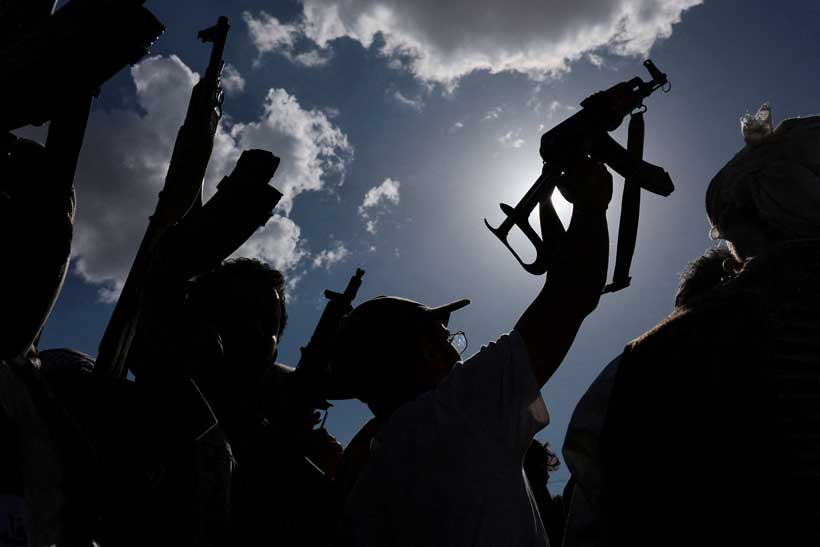
Yemen’s civil war has returned to the centre of a much wider regional conflict. In September, the Iran-aligned Houthis launched a rapid offensive along Yemen’s Red Sea coast, overrunning forces aligned with the internationally recognised government. They captured the port of Mokha before advancing farther south and seizing Perim Island, which sits directly inside the Bab el-Mandeb Strait. The group has since consolidated control over Yemen’s Red Sea coastline, placing one of the world’s most important shipping routes under renewed pressure (Reuters, 2026a).
The offensive has been accompanied by attacks beyond Yemen. The Houthis have intensified strikes against Saudi Arabia, while three pumping stations on the kingdom’s East-West oil pipeline were damaged in a drone attack originating from Iraq. The pipeline had become particularly important because it allowed Saudi oil to bypass the increasingly dangerous Strait of Hormuz and reach export terminals on the Red Sea (Reuters, 2026b).
Saudi Arabia has responded with airstrikes against Houthi positions, while the renewed fighting has already displaced more than 112,000 people inside Yemen (Reuters, 2026c). But the consequences of the Houthi advance extend beyond another phase of Yemen’s civil war. The territory they have captured overlooks the southern entrance to the Red Sea, through which ships travelling between the Indian Ocean and Suez must pass.
That makes the question much larger than who controls Yemen’s coastline. A non-state armed group now possesses territorial leverage over one of the world’s most important maritime chokepoints.
Stay ahead of the geopolitical week.
MD Briefing delivers expert analysis across five global fronts — the Indo-Pacific, energy, geoeconomics, European security, and the Middle East — every Monday morning. Free.
Controlling a maritime chokepoint does not require physically blocking every ship that passes through it. Sometimes the threat is enough. The Bab el-Mandeb is only around 30 kilometres wide at its narrowest point, separating Yemen from Djibouti and Eritrea.
Passing ships can continue north through the Red Sea toward the Suez Canal, making the strait part of one of the shortest maritime routes between Asia and Europe (EIA, 2025).
There is another route, but it is a long way around. Ships avoiding the Bab el-Mandeb must travel around the Cape of Good Hope in southern Africa, adding thousands of kilometres to some journeys. More distance means more fuel, higher insurance and freight costs, and longer waits for cargo to arrive. The Houthis have already shown how quickly companies can make that calculation. Beginning in late 2023, the group launched missiles and drones at commercial vessels in the Red Sea, initially saying it was targeting ships connected to Israel over the war in Gaza. Major shipping companies began sending vessels around Africa instead, while traffic through the Suez Canal fell sharply (UNCTAD, 2024).
The Houthis did not have to sink every ship or completely close the strait to achieve that. They only had to make the shorter route dangerous enough that taking the long way around started to look safer. Their latest territorial gains potentially give them even greater leverage, because Houthi-controlled territory now sits directly alongside the strait itself.
For Saudi Arabia, the timing could hardly be worse. The kingdom has long had a way of reducing its dependence on the Strait of Hormuz: The East-West Pipeline.
Running roughly 1,200 kilometres across the country, it carries oil from fields in the east to the Red Sea port of Yanbu. Instead of sending every barrel through Hormuz, Saudi Arabia can move part of its exports overland and put them onto tankers on the other side of the Arabian Peninsula. That escape route has become increasingly important as conflict has made Hormuz more dangerous.
The East-West Pipeline was recently carrying around 4 to 5 million barrels per day, equivalent to roughly 4% to 5% of global oil supply. Then the alternative route was hit as well. A drone attack originating from Iraq damaged three pumping stations along the pipeline, forcing a temporary shutdown and disrupting crude loadings from Yanbu (Reuters, 2026b).
This leaves Saudi Arabia facing pressure at both ends of its export system. Hormuz remains risky, while oil sent west to avoid it eventually reaches a Red Sea whose southern exit now runs past Houthi-controlled territory. Bab el-Mandeb itself was carrying 8.1 million barrels of crude and petroleum products per day in the second quarter of 2026, almost twice the level recorded a year earlier (EIA, 2026).
None of this means Saudi oil has suddenly been trapped. Riyadh still has alternatives, and markets have already calmed somewhat as Saudi Arabia moves additional crude through Oman and works to restore pipeline capacity (Reuters, 2026d). But the events expose the weakness of simply moving dependence from one chokepoint to another. A pipeline can bypass Hormuz. It cannot make the Red Sea safe.
Iran is the obvious beneficiary of this situation, but describing the Houthis simply as an Iranian proxy can make the relationship look more straightforward than it really is. Yes, Tehran has provided the movement with weapons, technology and other forms of support for years, helping it develop the missiles and drones that made its Red Sea campaign possible (Reuters, 2026e). The Houthis, however, have their own leadership, territorial ambitions and reasons for fighting inside Yemen. Iranian support does not mean every decision made in Sanaa is dictated from Tehran.
The distinction matters because Iran does not need direct control over the Houthis to benefit from their position. The Strait of Hormuz already gives Tehran considerable leverage over shipping entering and leaving the Persian Gulf. An allied armed movement capable of threatening vessels at the opposite end of the Arabian Peninsula creates pressure somewhere else entirely. Saudi Arabia and its partners therefore must think about the security of two maritime routes rather than one.
That leverage also comes relatively cheaply for Iran. Tehran does not need to deploy its own forces to Bab el-Mandeb or openly blockade international shipping. The Houthis can impose costs themselves through missiles, drones and the threat of further attacks, while Iran retains some distance from their actions. At the same time, that distance limits Tehran’s control. A Houthi decision that escalates the conflict may benefit Iran, but it could also drag Tehran into a confrontation it did not necessarily choose.
This is what makes the latest offensive more significant than another shift in Yemen’s front lines. The Houthis have gained something that military strength alone cannot manufacture: geography. Their relationship with Iran gives that geography regional consequences, but it does not make the group interchangeable with Iran itself.
The Houthi advance does not mean that Bab el-Mandeb is closed, nor does it give the group complete control over every ship that passes through it. It does, however, change the risks surrounding one of the world’s most important maritime routes. The experience of the Red Sea since 2023 has already shown that ships do not need to be physically blocked before companies begin looking for another route.
That is what makes the latest territorial gains so important. The Houthis now possess greater leverage over a chokepoint whose importance extends far beyond Yemen, while their relationship with Iran adds another layer to an already wider regional conflict.
The geography has not changed. Who can exploit it has. And sometimes, controlling a chokepoint is less about closing the gate than making everyone think twice before passing through it.
