A Phone Call, a Denial, and a Meeting in Brussels
On the evening of 23 September, Energy Secretary Chris Wright reportedly told energy executives that a 90-day ban on US diesel exports could come “within days”. The White House denied it. The President did not: a day earlier he had said, “I’ve called for it”, and promised a decision “fast, one way or another.” In Brussels, the European Commission’s deputy chief spokesperson, Olof Gill, called the idea “a very bad idea” and reminded Washington that close partners consult each other before acting on markets they share. The EU’s Oil Coordination Group, which assesses supply risks across member states, meets on Tuesday, 29 September to work out how exposed its members are.
In Washington, the debate is about Iowa farmers and the midterms. Abroad, it is being read as a question of whether the US can be relied on as a supplier.
How America Became Everyone’s Diesel Tank
Stay ahead of the geopolitical week.
MD Briefing delivers expert analysis across five global fronts — the Indo-Pacific, energy, geoeconomics, European security, and the Middle East — every Monday morning. Free.
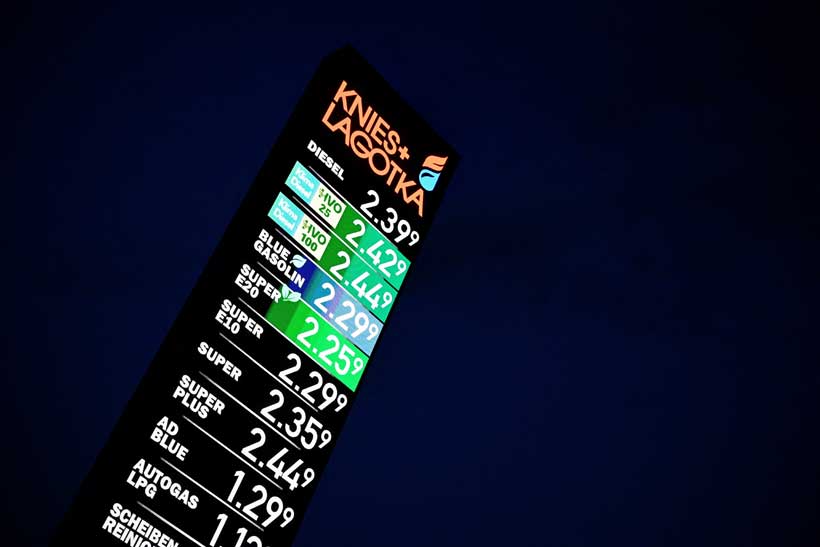
With Gulf refineries cut off by the Hormuz closure and Indian exports falling, the US Gulf Coast has become the world’s swing supplier of diesel, the source other buyers turn to when supply elsewhere fails. US diesel exports reached a record 1.6 million barrels a day in August, according to Kpler, up from about 1 million in February. The American Petroleum Institute puts the US share of globally traded diesel at about 20%.
The dependence is concentrated. The US supplies about 32% of the EU’s diesel imports this year, up from 17% in 2025, and 57% in northwest Europe. France takes 36% of its imports from the US and the UK 26%. Mexico is the single largest buyer. Its diesel stocks fell from about 11 days of supply at the end of 2024 to under six days by April. At home, US diesel has hit a record $6.53 a gallon, which is why a ban appeals to farm-state Republicans and why Trump now backs it, despite Wright saying earlier that “the blunt tool of banning diesel exports definitely doesn’t work.”
Iran Can’t Choose Who It Hurts. Washington Can.
Most coverage, including MD’s own look at the domestic trade-offs, asks whether a ban would lower American pump prices. Most economists say it would do so briefly, then push them back up within four to six weeks as refiners cut production they can no longer sell abroad. That question matters, but it misses how the ban would change who bears the shock.
The Hormuz closure is a price shock. Oil products trade in a single global market, so every importer pays roughly the same higher price, from Lagos to Lyon. Iran cannot choose who suffers. A US export ban works differently. It keeps American barrels at home, gives US consumers a temporary discount, and leaves countries that built their supply around the US Gulf Coast short of fuel, not just paying more for it. That is how the 1973 Arab oil embargo worked: its power came from choosing who went without. Washington would be making the same choice, and the countries left short would be its partners, not its adversaries.
Look at who is most exposed. Mexico would be hit first and hardest. With less than a week of stocks, a cut-off would be felt within days. Diesel supplies two-thirds of the energy used by Mexican agriculture, and nearly all of Mexico’s farm exports reach the US by truck. A Mexican diesel crisis would come back across the border as higher food prices. In South America, the governments most exposed are Peru, Ecuador and Chile, whose copper mines alone burn about 40,000 barrels a day. They belong to the bloc of countries that used this week’s UN General Assembly to stress their alignment with Washington. In Europe, the most exposed are France and the UK, which have the two navies any Hormuz operation would rely on.
Now look at what Washington needs from them. Since March, the US has pressed allies to secure the Strait, and they have repeatedly hesitated. The minesweeping and escort mission planned by 38 countries was designed for after a ceasefire, not during a war. Any lasting settlement with Iran will need European enforcement of oil sanctions, patrols against Iran’s fleet of shadow tankers, and diplomatic cover at the UN. A diesel ban would give every reluctant government a ready answer. No French or British minister will find it easy to send frigates to reopen Gulf oil routes for a country that has just stopped shipping diesel to their hauliers.
There is also a longer-term cost. In the 2025 trade deal, the EU pledged $750 billion in US energy purchases. Washington’s pitch was reliability: buy from a friend, not from Russia or Qatar. A ban would be the first US curb on energy exports since the crude export ban was lifted in 2015. It would show that American supply comes with conditions attached, which is exactly why Europe stopped relying on Russia. Interior Secretary Doug Burgum made a related point on 15 September, warning that a ban could provoke retaliatory export restrictions that would hurt import-dependent parts of the US, such as California.
The strongest objection is that dependence gives Washington leverage. Europe has few alternatives: Indian diesel shipments to Europe have fallen from 163,000 to about 50,000 barrels a day, China exports almost nothing, and Russia has banned its own diesel exports through October. On this view, allies with nowhere else to go will complain and then cooperate. But that confuses dependence with support. Leverage is useful only if you use it to get something. A ban designed for voters in Iowa asks nothing of Paris or Mexico City in return. It simply makes them short of fuel and then expects their help at sea. It also creates an opening for Moscow. When Russia’s export ban lapses, Russian diesel will be the obvious substitute for Latin American buyers and a growing temptation in Europe. That would weaken the sanctions Washington says it wants enforced.
Three Ways the Tap Turns
Base case (around 50%): no formal ban, but lasting doubt. The Wright–Burgum camp prevails, and the White House settles for pressuring refiners and easing shipping rules instead of banning exports. The threat alone has changed buyer behaviour, however. European and Latin American importers pay more to secure supply from elsewhere, and Brussels speeds up its own emergency stock planning. Allies stay in the Iran coalition but commit less. The key assumption is that the economic advisers outweigh the midterm strategists before 3 November.
Downside (around 30%): a full 90-day ban before the midterms. Northwest European diesel spikes past September’s record of $1,642 a tonne. Mexico faces shortages at the pump within a week, and cross-border trucking through Laredo slows. France and the UK quietly freeze planning for any Hormuz mission, and the EU calls an emergency energy council. When Russia’s export ban lapses at the end of October, Russian diesel finds willing buyers in the Americas. The sectors to watch are logistics, agri-food and mining, along with any supply contract where a force majeure clause might be invoked.
Alternative (around 20%): a partial ban with exemptions for allies. Bessent has already said a partial ban is being considered. A version that exempts USMCA partners and NATO allies would take the edge off the damage to alliances, but it would also make diesel an explicit tool of diplomacy: fuel for allies who line up. That would change the terms of the debate entirely. Exemptions could be tied to contributions to a Hormuz mission or to sanctions enforcement, and every future US energy contract would carry a political condition.
Closing a Strait Versus Closing a Tap
A diesel ban is not a domestic price measure with some fallout abroad. It is a foreign-policy decision disguised as one. It would turn a war-driven price spike that everyone shares into shortages concentrated on the countries whose navies, sanctions and votes Washington needs to settle the Iran war. It would also undercut the reliability pitch on which the US energy trade with Europe depends.
Watch two things. First, what the EU’s Oil Coordination Group concludes on 29 September about member states’ exposure. Second, whether any US decision, when it comes, includes exemptions for allies. Exemptions would show that Washington understands the foreign-policy stakes. A ban without them would show it does not.
Iran closed a strait and raised everyone’s bill. Washington would be closing a tap and choosing who goes without.