Surviving a coup attempt is not a near-miss for Sahel juntas — it is the mechanism of entrenchment itself: each failed attempt hands the ruler grounds to purge rivals and deepen his personal dependence on Russia’s Africa Corps, a cycle now visible in Niger, Mali and Burkina Faso alike, which is making these regimes steadily harder to remove from within even as their hollowed-out armies lose the actual counter-jihadist war they were built to win.
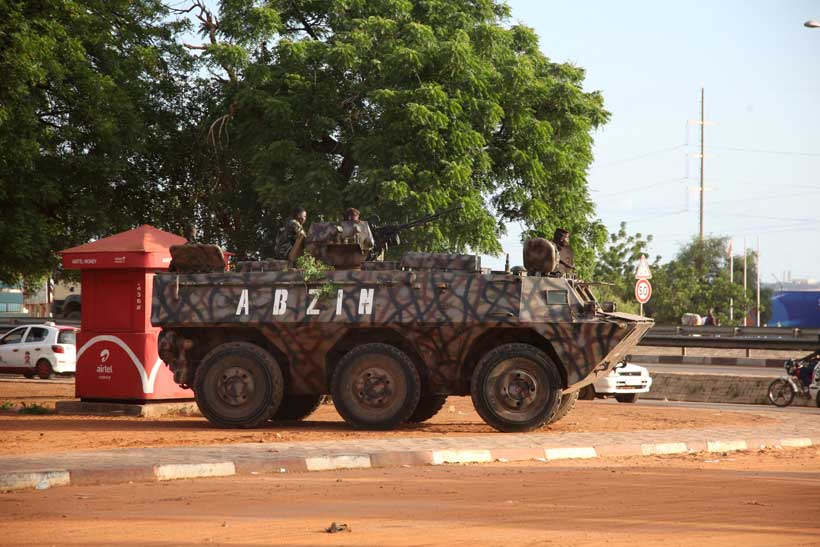
On the night of August 28, young soldiers at Niamey’s Base 101 opened fire on their own barracks, took hostages, and pushed toward Niger’s presidential palace and state broadcaster. By Sunday morning the mutiny was over — not because Niger’s army alone crushed it, but because Russia’s Africa Corps, garrisoned at that same base, provided “ground and air cover” to loyalist troops retaking it, according to Moscow’s own ambassador. General Abdourahamane Tiani, who seized power in a 2023 coup, survived a coup attempt against himself using the foreign force his own coup had originally invited in. That is not an isolated near-miss. It is the fourth time in three years a Sahel junta has beaten back its own soldiers — and each time, survival has made the man in charge harder to remove, not easier.
THE CONTEXT
Niger, Mali and Burkina Faso are run by juntas that seized power in 2023, 2020–21 and 2022 respectively, each justified as a faster route to defeating jihadist insurgencies than the elected governments they replaced, and each pivoting from French-led security cooperation to Russian support once in office. All three quit the West African bloc ECOWAS by early 2025 to form their own confederation, the Alliance of Sahel States — a formal break with the regional order that has let them coordinate diplomatically and militarily rather than face pressure to restore civilian rule individually.
Stay ahead of the geopolitical week.
MD Briefing delivers expert analysis across five global fronts — the Indo-Pacific, energy, geoeconomics, European security, and the Middle East — every Monday morning. Free.
All three have since faced multiple coup attempts from within their own ranks: Mali in May 2022, with fresh purges over an alleged plot as recently as October 2025; Burkina Faso’s Ibrahim Traoré surviving attempts in September 2023, January 2024, April 2025 and January 2026; Niger’s Tiani now joining them after August 2026. None of these attempts succeeded. Each was followed by a purge of the officer corps and a deeper security relationship with Moscow.
THE ARGUMENT
The instinctive read on a coup attempt is that it signals weakness — a government too shaky to trust its own soldiers. Score the last three years in the Sahel by that logic and Niger’s General Tiani, Burkina Faso’s Ibrahim Traoré and Mali’s Assimi Goïta should all be gone by now. Instead, all three are more firmly in power than when they seized it, and each got there via the same mechanism: surviving an attempt on his rule, then using that survival to entrench.
The mechanism has two parts, and they reinforce each other. The first is the purge. A foiled coup gives a junta leader a legally unimpeachable reason to remove anyone he was already suspicious of, reorganize the chain of command around personal loyalty rather than rank, and elevate the units that stayed loyal — typically the presidential guard — above the regular army. Mali’s junta dismissed a fresh round of officers in October 2025 over an alleged coup plot, on top of the wave that followed its 2022 counter-coup. Burkina Faso’s Traoré has now run this cycle four times — September 2023, January 2024, April 2025, January 2026 — each announced as a foiled plot, each followed by arrests. Niger’s Tiani, after Base 101, is expected to do the same: analysts at the Egmont Institute note the coming purge will concentrate power further around Tiani’s own Presidential Guard, the unit that put down the mutiny.
The second part is patronage. Each purge widens the trust gap between the ruler and his own army — precisely the gap Russia’s Africa Corps has been paid to fill. In Niger, that stopped being theoretical on August 29: Africa Corps units stationed at Base 101 did not advise from the sidelines, they fought, and Moscow’s ambassador said the mutineers were “neutralized particularly thanks to” that intervention. In Burkina Faso, roughly 100 Africa Corps personnel arrived in January 2024 explicitly to protect Traoré himself, operating out of a new base in Loumbila outside Ouagadougou. Each survived coup attempt, in other words, does not just remove rivals — it deepens the ruler’s personal dependence on a foreign security guarantee that has every incentive to keep him exactly where he is.
The objection worth taking seriously is that this reads the pattern backwards: political science on coup-proofing generally finds that one coup attempt raises the odds of another, not that it inoculates a regime. That is true of the underlying risk — repeated attempts mean a wider and angrier pool of officers has now been purged, arrested or sidelined, which is not a stable equilibrium forever. But it describes a different variable than the one that determines each individual ruler’s survival odds this year. The purge-and-patronage cycle does not lower the total number of coup attempts a junta will face over its lifetime; it lowers the odds that any single attempt succeeds, by removing the specific people capable of leading the next one and outsourcing the oversight function to a foreign force with no domestic political ambitions of its own. Frequency and durability are rising together here, not trading off against each other — a genuinely unusual, and unstable-looking, equilibrium.
What it costs is the thing these juntas were founded to deliver. Coup-proofing works by promoting political reliability over competence and by concentrating capable units around the capital rather than the frontline, and the Global Terrorism Index’s 2026 update shows the bill coming due in a specific, non-obvious way: attack counts in Burkina Faso actually fell by roughly 45% year-on-year, but the index’s authors describe militant groups like JNIM shifting from hit-and-run attacks to holding territory outright — taxing, policing and governing areas the state has effectively ceded. Fewer attacks is not the same as less jihadist control; it can mean the army has simply stopped contesting ground it no longer has the cohesion to hold. That is the trade each of these regimes has now made three or four times over: a more coup-proof presidency, running a less capable army, against an enemy that is patiently converting from insurgency into alternative government.
THE SCENARIOS
Base case (~55%): the pattern holds through 2027. Niger’s purge proceeds much as Mali’s and Burkina Faso’s did, Tiani’s Presidential Guard and Africa Corps presence both grow, and all three AES juntas stay in power — more insulated from their own officer corps, but continuing to lose contested rural ground to JNIM and Islamic State Sahel Province.
Downside case (for the juntas): the purge-and-patronage cycle eventually exhausts its own supply of loyal officers, or Africa Corps itself is degraded — as it already has been in Mali, where the force abandoned Kidal in April 2026 after helicopter losses and attacks by the Azawad Liberation Front — at the moment a new coup attempt happens. A future attempt succeeds not because a junta is weak in the abstract, but because the specific pillar propping it up, a loyal Presidential Guard or a functioning Russian security guarantee, fails at the same time. That risk is currently highest in whichever state has purged deepest for longest, which today is Burkina Faso.
Upside or alternative case: regional or negotiated pressure forces a genuine political transition rather than another coup cycle — an ECOWAS- or AU-brokered election timeline the juntas have so far avoided — made more plausible if Africa Corps’ own battlefield setbacks, like Kidal, make continued patronage look like a bad bet to Moscow and cool its willingness to keep underwriting regimes that cannot secure their own territory. A cash-strapped Kremlin, already stretched by Ukraine, choosing to scale back rather than reinforce a failing bet in one Sahel state would be the clearest signal that the patronage half of the entrenchment mechanism has a ceiling.
THE TAKEAWAY
Niger’s mutiny will fade from headlines within days, the way Ouagadougou’s and Bamako’s did before it. That is exactly the mistake: each of these incidents is not noise around a stable trend, it is the trend — the mechanism by which Sahel juntas are becoming harder to dislodge from within even as they become less able to hold their own territory from without.
Watch what Niger’s promised purge actually does to army deployments in Tillabéri and Diffa over the next two to three months: if capable units get pulled back toward Niamey to reinforce the Presidential Guard, that is the entrenchment mechanism working exactly as it worked in Bamako and Ouagadougou — and it is the surest early sign of where the next stretch of ungoverned territory will open up.