


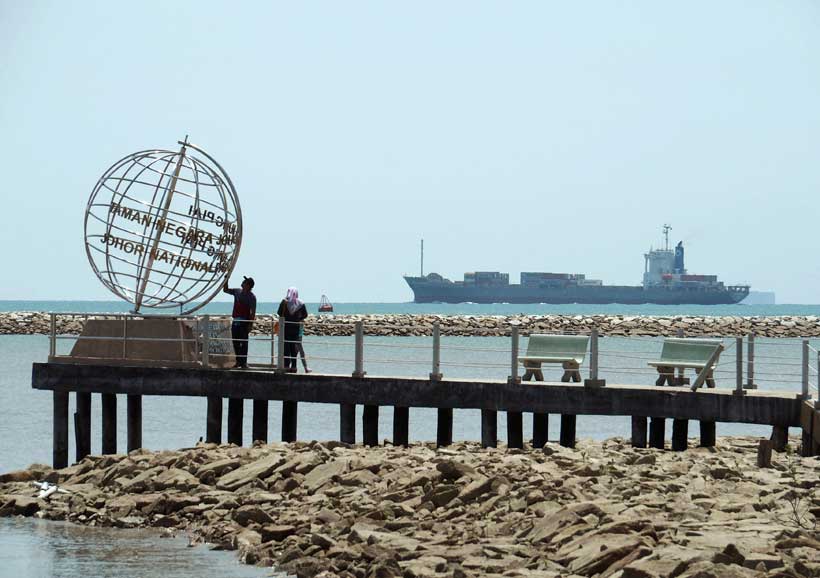
The idea of the Malacca Dilemma was first presented in 2003 by Hu Jintao, then China’s president, to illustrate a major strategic issue facing the country. Since most of China’s imports of energy and its exports in the form of container cargo go through the Strait of Malacca, a narrow waterway spanning 2.8 kilometers and lying between Malaysia, Singapore, and Indonesia. China is neither in a position to control nor to easily defend this route. About 80 percent of China’s imported crude oil and a large part of its container trade with Europe, the Middle East, and Africa are transported via this strait. Thus, anyone who controls the Strait of Malacca, particularly the United States Navy given its strong presence in Singapore, can exert considerable influence over China’s economy in the event of a major conflict.
How China Has Been Hedging
China’s answer to the Malacca Dilemma has never been just one project. Instead, it follows a strategy called ‘corridor-hedging,’ which means building several partial alternatives rather than relying on a single replacement. This approach shows that China is focused on reducing risk rather than completely removing its vulnerability. However, no overland route can match the capacity of major sea lanes like Malacca or the Suez Canal. The main parts of this strategy are
China has a strategic petroleum reserve of about 1.4 billion barrels, which gives it a strong buffer against short-term supply shocks like the 2026 Hormuz crisis. PetroChina’s chairman Dai Houliang said that by 2026 only about 10% of the company’s operations depended on imports through Hormuz, reflecting the results of years of diversification. China gets crude oil from various countries, and no single top-five supplier provides more than 20% of the total. During the crisis domestic oil prices were much less volatile than international prices. China avoided the panic buying and shortages that hit Vietnam and other nearby countries. At the same time, China’s fast adoption of electric vehicles and renewable energy is slowly reducing its reliance on imported oil.
Stay ahead of the geopolitical week.
MD Briefing delivers expert analysis across five global fronts — the Indo-Pacific, energy, geoeconomics, European security, and the Middle East — every Monday morning. Free.
Beijing has built oil and gas pipelines from Myanmar, Kazakhstan, and Russia, which together can carry about 12-13 percent of oil. This is significant but still much less than the 80 percent of oil that usually comes to China through the Strait of Malacca. By early 2026, Russia was China’s largest crude oil supplier, providing nearly a fifth of total imports and helped by discounted oil due to Western sanctions. During the 2026 crisis, Russian Foreign Minister Sergey Lavrov told Xi Jinping that Russia could fully make up for any shortfall from Iran. China also relied more on rail links to Iran through Kazakhstan, which were set up in 2025.
The China–Pakistan Economic Corridor and Gwadar remain the most symbolically important overland alternative route. This lets Chinese goods and energy bypass the Indian Ocean chokepoints entirely by moving overland through Xinjiang. In practice, progress has been slow and uneven. But it has taken momentum in 2026 during a May visit by Pakistani Prime Minister Shehbaz Sharif to Beijing, where both governments announced CPEC 2.0, focused on further developing Gwadar into a regional connectivity hub, upgrading the Karakoram Highway and Khunjerab Pass, and opening the corridor to third-party investment. It is real progress, but Gwadar remains a regional logistics node rather than a substitute for Malacca-scale volumes.
China’s other overland energy lifeline runs through Myanmar. Here is the Kyaukphyu deep-sea port on the Bay of Bengal and pipelines that carry crude and natural gas directly into Yunnan province, alongside the Muse–Mandalay railway project. This route lets a portion of Middle Eastern and African crude skip the Malacca and South China Sea legs of the journey entirely. Its capacity, however, is constrained by both pipeline throughput and Myanmar’s continuing internal instability since its 2021 coup, which limits how far Beijing can rely on it as a dependable substitute.
The most concrete infrastructure achievement of 2026 is the Pinglu Canal in Guangxi, China’s first new river-to-sea canal in more than fifty years. The 134-kilometer, roughly $10.4 billion waterway links the Xijiang River system to the Beibu Gulf (Gulf of Tonkin). This provides landlocked southwestern provinces Guangxi, Yunnan, and Guizhou a direct route to the sea and to Southeast Asian markets and cuts about 560 kilometers off the previous route via Guangdong’s ports. The canal achieved full-channel water connectivity in June 2026, and the canal is due to open formally at the China–ASEAN Expo in September 2026, months ahead of its original end-of-year target. This achievement aligns with China’s broader strategy of building partial workarounds to maritime chokepoints, as seen in its pipeline development and diversification efforts supporting the country’s focus on risk mitigation rather than complete elimination of vulnerability.
China–Thailand discussion on the Kra Canal, which would cut across Thailand’s Kra Isthmus and connect the Andaman Sea directly to the Gulf of Thailand. This will eliminate the Malacca chokepoint and reduce travel by roughly 1,200 kilometers. But at an estimated $25–30 billion, it faces entrenched Thai political resistance and fierce opposition from Singapore, whose economy depends heavily on Malacca transshipment traffic. However, this project remains, as of 2026, a recurring talking point rather than a funded undertaking.
Limits of De-Risking Malacca
Despite this multi-decade, multi-billion-dollar effort, none of these alternatives comes close to replacing Malacca’s importance. The combined pipeline capacity from Myanmar, Kazakhstan, and Russia, roughly 1.5 million barrels a day, is nothing compared to the 11.6 million barrels a day that transited the strait toward China. This gap is not only quantitative but also structural. Pipelines and railways are inherently limited by their geographical and geopolitical instability. Because it requires extensive logistical support, operational and technical capacity, and absence of these, which collectively constrains its practicality. The persistence of these structural limitations highlights not only the logistical but also the strategic challenges facing any attempt to significantly reduce reliance on the Strait of Malacca.
That’s why Beijing’s strategy should be understood as hedging rather than replacement. The goal is not to eliminate reliance on Malacca but to add enough alternative and diversified suppliers that no single chokepoint can paralyze the Chinese economy. The 2026 Hormuz crisis was the first real stress test of this strategy, and by most measures China passed it better than its neighbors did. China controls prices at the domestic level through rapid diplomatic negotiations with Russian and Central Asian suppliers. However, this success does not resolve the debate about whether China’s approach is sufficient in the long term. China’s prioritizing multiple partial alternatives over achieving full redundancy creates overlapping disruption for itself due to the interconnectedness of global supply chains. If multiple chokepoints are attacked, as Hormuz, China’s strategic reserves could be threatened. Furthermore, reliance on overland routes through geopolitically unstable regions such as Central Asia and Myanmar may introduce new vulnerabilities rather than effectively minimizing risk. This unclear picture pushed China towards renewable energy adoption and strategic infrastructural upgradation to deal with energy requirements.
However, this outcome highlights that structural chokepoint vulnerabilities push states to adopt layered and multi-pronged strategies to enhance resilience but fall short of achieving complete autonomy. The Chinese case thus offers a salient example of the endless tension between mitigation and elimination of strategic risk. This suggests that even sophisticated diversification efforts tend to reinforce a state’s capacity for adaptation rather than deliver true self-sufficiency.
