


In the old town of Gori, Georgia, well-known as the birthplace of Joseph Stalin, stands a modest museum dedicated to his life. It remains a reliable source of income for an otherwise economically depressed region, drawing a steady stream of curious travelers. On the ground floor, tucked away in an informal exhibition, is a striking photograph: a tall, slender intellectual in a military uniform, wearing wire-rimmed glasses, awkwardly holding an old-fashioned revolver.
He is unmistakably an intellectual, yet he is also a member of the Cheka, the Soviet secret police organization. Caught in the crushing currents of his era, he drifted wherever the ideological tide pulled him.
Intellectuals of that era were caught in the currents of their time, drifting along with the tide. That was an era when left-wing and right-wing social tides clashed fiercely. War, upheaval, conflict, casualties, and destruction brewed page after page of history books. Yet those books often represent only one facet of these ideological clashes. Because authors typically carry their own views and biases, reading them rarely lets us see a full view. Chances are we might even be guided to form the conclusions, often subconsciously, without ever quite realizing it.
Today, we are watching that same dynamic play out with unsettling familiarity.
Stay ahead of the geopolitical week.
MD Briefing delivers expert analysis across five global fronts — the Indo-Pacific, energy, geoeconomics, European security, and the Middle East — every Monday morning. Free.
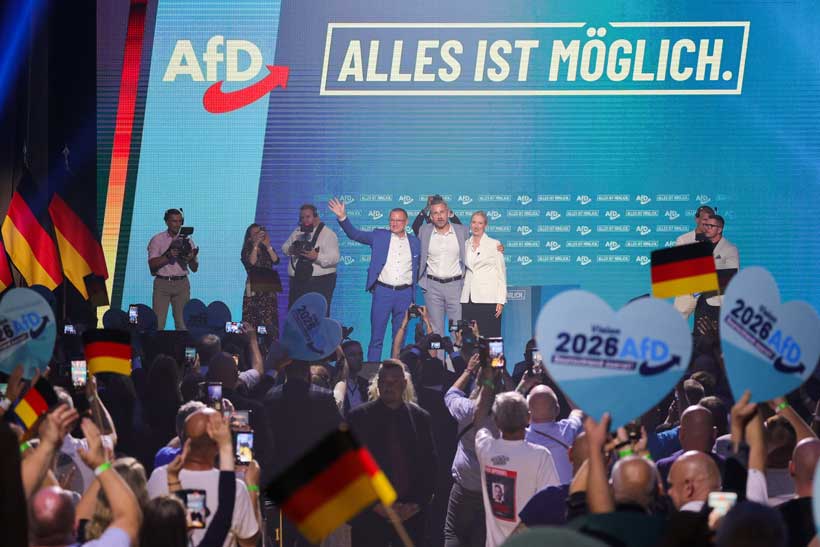
Across the globe, the political pendulum swings with renewed vigor. In Germany, the right-wing Alternative for Germany (AfD) has surged in regional elections, while the Christian Democratic Union (CDU), long the anchor of the established political order, faces unprecedented voter desertion. France tells a similar story, that the right-wing National Rally has steadily built formidable power, securing historic ground in the Senate and dominating local mayoral races.
Brazilian presidential elections too have long been marked by intense left-right political rivalry, as demonstrated in 2022 when left-wing leader Luiz Inácio Lula da Silva narrowly defeated incumbent far-right president Jair Bolsonaro with 50.9% of the vote against 49.1%. This fierce contest has resurfaced in 2026, as Lula unexpectedly fell behind his right-wing challenger in the first round on 4 October, leaving the outcome to be decided in a second-round runoff scheduled for 25 October.
From the old photograph at the Stalin Museum in Georgia to the recurring cycles of social thought we see today, there is an obvious trend.
Intellectuals and literary figures tend to lean towards left-wing ideology, as they are often inclined towards contemplation, value prestige, and excel at debate. Their focus is frequently directed towards wealth disparity, with political maneuvering centered on the redistribution of wealth through spending. However, when financial resources become insufficient, coercive measures may be employed, often leading to dictatorship and intense social pressure. Such systems rely heavily on powerful organizational structures to maintain control. Over time, errors and failures begin to accumulate, resulting in increased suppression, while wealth disparity gradually ceases to be the paramount concern. Instead, the capacity to maintain control becomes increasingly crucial, even as wealth, environmental resources, and resource reserves approach exhaustion. At this stage, the right begins to rise, emphasizing production, efficiency, and the restoration of conservatism. Through reproduction and the revitalization of economic activity, wealth is recreated and accumulated, leading to growing prosperity. However, as society becomes wealthier, wealth inequality gradually resurfaces as a pressing issue, renewing the focus on wealth disparity and once again deepening the ideological divide between the left and the right.
In this cyclical pattern, neither the left nor the right ever fully resolves the fundamental complexities of human society, but their perpetual friction maintains a fragile equilibrium.
International politics already features numerous theoretical attempts to interpret shifts in social currents through a cyclical lens. One prominent example is the political pendulum theory, which posits that political forces shift from left to right and back again in a pendulum-like motion. Its underlying logic relies on a feedback mechanism: when the left holds power for too long, society may prioritize equality, welfare, and government intervention. If these policies trigger fiscal strain, economic inefficiency, or a loss of freedom, the public may pivot toward the right, which champions free markets, order, and personal responsibility. Conversely, if right-wing policies widen wealth inequality and erode social safety nets, support swings back to the left. That said, this does not dictate a rigid alternation of power. Policy outcomes, institutional frameworks, economic crises, and leadership performance can all cause the pendulum to stall on one side or reverse direction unexpectedly.
The self-correcting model of left-wing and right-wing currents mentioned above actually goes beyond this. Its true focus lies in examining the relationship between social change and the individuals within that society, which is where the model’s true significance rests. In other words, while society may experience dramatic structural changes on the surface, its underlying framework remains largely unchanged for the people living within it. For most individuals, social movements rarely alter their fundamental social status or class position in any meaningful way.
Ultimately, individuals must rely on their own efforts to overcome their personal challenges, rather than expecting social movements or the dramatic swings between left-wing and right-wing forces to resolve them. For most people, this is the simple yet profound lesson conveyed by that vintage photograph in the Stalin Museum in Georgia.
