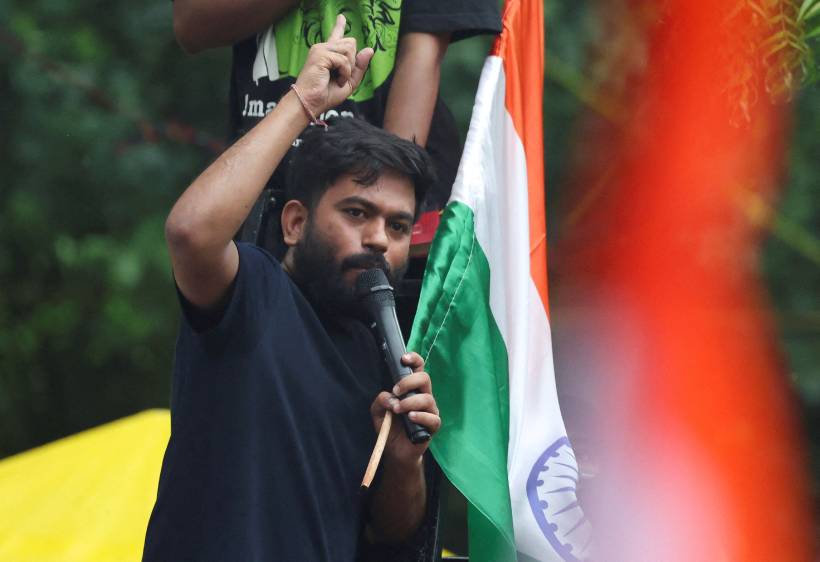
Back in May, India’s Chief Justice Surya Kant likened the country’s unemployed youth to cockroaches. The targeted generation, perhaps more politically adept than Mr. Kant had assumed, was able to seize the insult, quickly turning it into a rallying cry. In a matter of days, thousands of protesters, mainly students, took to the streets and, by embracing the insult, a movement formed: the Cockroach Janta Party, also known as CJP (its initials echoing the ruling BJP’s by no accident). The movement, launched by Abhijeet Dipke on digital platforms, quickly amassed over 20 million followers on Instagram and, without ever registering as a party or building any hierarchy, forced the resignation of Dharmendra Pradhan, the education minister. India-specific as this looks, what happened in Delhi is increasingly hard to treat as an isolated national episode. It is only the most recent manifestation of a supranational pattern that has already toppled governments in Nepal and Bangladesh and shaken others across the region, one that must be understood through the common causes that animate it.
If one looks closely at the youth movements throughout these countries, a clear absence seems to stand out. Disillusionment with the establishment has driven young people away from classic parties but also from the one-size-fits-all ideological frameworks that dominated political discourse in the past, giving way to a new form of political mobilization. One whose nature is much more driven by specific causes, or even, sometimes, merely one concrete cause, as seen in India. Seemingly, the fact that these youths have become alienated from the establishment has led them to reject not only mainstream parties but also, more broadly, any type of sweeping ideological architectures, which were dropped as animating elements in favor of specific grievances. One might object that these movements often seem ideological, leaning visibly to the left. But a deeper look at that very pattern illustrates that, more so than ideological in nature, youth support correlates strongly to which party or movement seems the most capable vehicle for advancing a given felt cause.
It is this cause-based politics that shapes how the Gen-Z protests actually unfold. Some single event or clip, meme-like, gathers the scattered frustrations of a generation into one shareable image, whether it is the exam leaks in India or the footage of political families living in plain opulence in Nepal, and social media does the rest, carrying it far enough and fast enough to become a mass movement within days.
And it seems to be precisely because we now live in a more post-ideological, cause-driven era of politics that social media has become so central to these movements. An algorithm calibrated to capture attention always will give preference to emotionally charged content, to media that provokes a visceral response in its users, be it through shock or outrage, as this in turn drives further engagement on the platform. As such, a symbiotic relationship arises between the algorithm and the users. As more pieces of content circulate, more and more people are exposed to them and drawn in, creating a feedback loop that stokes further protest and confrontation. An almost organic network of highly engaged, highly motivated people can thus emerge wholly online. This organic emergence of networks is also what allows the Gen-Z protests to take on far more grassroots, bottom-up structure than the youth movements of the past, dispensing with the hierarchies of classic partisan protest. That decentralization then attains a sort of double nature, becoming both descriptive, a fact about how these youth movements are set up, and prescriptive, as it is read as a virtue in its own right, a central pillar of what sets these movements apart from the establishment. This same decentralization also carries the added benefit of making them harder to suppress since there is no single command center for a government to crack down on or decapitate.
Stay ahead of the geopolitical week.
MD Briefing delivers expert analysis across five global fronts — the Indo-Pacific, energy, geoeconomics, European security, and the Middle East — every Monday morning. Free.
Beyond making each national protest more resilient, the digital, online nature that undergirds Gen-Z protests also makes them contagious in a way we have not quite seen before. The reasons why are twofold.
On the one hand, the spread of viral videos showing young people standing up to the police, often to openly violent repression, travels across borders and lands with viewers of roughly the same age, who recognize themselves in it. That recognition in turn stokes a type of in-group solidarity that makes resistance across countries seem a part of the same struggle. As such, even if the videos pertain to a different country, the threshold for collective action in one’s own country is lowered. Seeing peers elsewhere take to the streets makes the prospect of doing the same less daunting, and each new wave that succeeds lowers that bar a little further for the next.
On the other hand, there is a cultural element. These movements increasingly have a shared vocabulary, with the One Piece flag flying over demonstrations being the most legible instance of this. First raised at the Jakarta demonstrations, it spread within weeks to Nepal, then to the Philippines, Madagascar, Morocco, and beyond, adapting at each stop to local grievances, to be sure, but present, nevertheless. The very aesthetic of these protests, from the flag to the placards, has an unmistakably Gen-Z register that serves to flatten national and cultural differences. Whatever divides these protests on the ground, the aesthetic they share online makes them look like one phenomenon, arguably even more unified than, on closer inspection, they really are.
But the very qualities that carry these movements across borders are what strand them once they arrive, making their flexibility a double-edged sword. While social media may be an irreplaceable tool for mobilization and the very means by which the decentralization so characteristic of these movements is made possible, it also makes it harder for political transformation to come about. Precisely because social media makes hierarchy and party-like structures dispensable, these movements often lack anyone capable of sitting across the table from political elites and bargaining on their behalf. To be clear, dealmaking and compromising with the very people the protesters define themselves against is never easy, and it is easily understood how that can be viewed rather unfavourably by the masses. And yet, it remains a sine qua non on the path to lasting change. This problem brings us back to cause-politics. In India, for example, criticism over exam leaks is something virtually all protesters agree on, but when a movement coalesced around said criticism and tries to address problems like economic stagnation, unemployment, climate, government reform, or something else entirely, the cracks start to show and thwart the transition into a unified front that can enact lasting reforms. A certain grievance or outrage, justified as it may be, will struggle to have the depth required to bridge broader political differences and to cohere the movement around demands that may actualize real political reform beyond the toppling of a government figure or of the government as a whole.
None of this is to say the protests are somehow lesser or that they lack legitimacy. In some ways, all of these observations are proof of how successful Gen-Z protests have been. This generation has shown it can force governments, or at least the ministers who front them, to back down, and that it can do so is a sign of a healthy political society rather than a decaying one. That is why its limitations are worth taking seriously. Gen-Z has built something close to a perfect weapon for tearing governments down but has yet to build much of anything to put in their place. What seems hard to deny, at this point, is that the generation so often written off as politically apathetic may turn out to be the main force behind a reshaping of politics in Asia.