


When Money Stops Being Enough
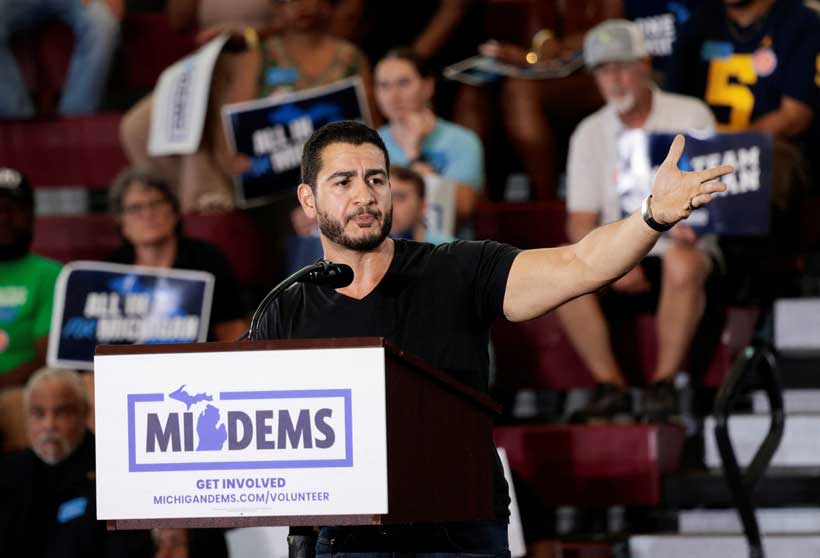
Abdul El-Sayed’s victory in Michigan should be read carefully. It does not prove that the Democratic Party has turned against Israel, nor that money has suddenly lost its power in American elections. El-Sayed won a close race, but the result is difficult to dismiss.
El-Sayed was hardly vague about where he stood. He wanted U.S. military aid to Israel brought to an end, and he was just as willing to talk about the money shaping American politics. Much of his case came down to a question that is becoming harder for Democrats to avoid: why keep asking Americans to finance wars abroad when many of them are already questioning Washington’s priorities at home? His campaign platform made that connection explicit, linking foreign military spending with the broader influence of big donors over political choices.
Stevens, by contrast, was backed by much of Michigan’s Democratic establishment, including Gov. Gretchen Whitmer and outgoing Sen. Gary Peters, among the figures listed by her campaign.
Stay ahead of the geopolitical week.
MD Briefing delivers expert analysis across five global fronts — the Indo-Pacific, energy, geoeconomics, European security, and the Middle East — every Monday morning. Free.
Then came the spending. Outside groups supporting Stevens spent more than $60 million, according to the Associated Press. A Federal Election Commission filing from United Democracy Project, the super political action committee affiliated with the American Israel Public Affairs Committee (AIPAC), showed more than $30.2 million in independent expenditures in the Michigan Senate primary. El-Sayed won anyway.
That does not make AIPAC irrelevant. It makes Michigan an uncomfortable test case. What happens when the spending itself becomes part of what voters are reacting against?
New York Made Michigan Harder to Dismiss
If Michigan stood alone, it would be easy to explain away. Its large Arab American population and deep anger over Gaza made it easy to treat the result as exceptional. But Michigan did not stand alone.
Weeks earlier in New York, Brad Lander defeated Dan Goldman, Claire Valdez won the Democratic nomination in the 7th Congressional District, and Darializa Avila Chevalier defeated Adriano Espaillat, according to the state’s official election results. In the Lander-Goldman contest, Gothamist reported that Israel and Gaza were central dividing lines.
A few years ago, taking a hard line on U.S. military support for Israel could make a Democrat nervous about getting through a primary. That calculation is changing. The party’s own voters have changed with it. Pew found unfavorable views of Israel among Democrats and Democratic-leaning independents at 80 percent this year. It was 69 percent only a year ago and 53 percent in 2022. Those numbers do not tell Democrats what policy to adopt. They do tell candidates that the political ground under this issue is no longer where it used to be.
That does not mean 80 percent favor ending the U.S.-Israel alliance. But Congress is reflecting the same tension. On July 15, 103 House Democrats joined Republican Thomas Massie in supporting an amendment that would have removed $3.3 billion in proposed assistance to Israel. The official House roll call recorded 104 votes in favor, while Rep. Sam Liccardo’s office outlined what the amendment would have cut.
The amendment failed, but the vote showed how far the debate had moved.
The question is whether that divide is becoming electorally durable.
Gaza, Iran, and the Domestic Price of Foreign Policy
That question is harder to separate from the war with Iran.
Opposition to U.S. support for Israel and opposition to another Middle Eastern war are not identical. The two issues are not the same, but they are starting to blur in the political debate. By late July, a Reuters/Ipsos poll showed support for the Iran war stuck at roughly one in three Americans. More strikingly, 69 percent said Trump had never really made clear what the United States was trying to achieve. The effects are also being felt well beyond Washington. The U.S. Energy Information Administration has tied higher fuel prices to the fighting in the Middle East and the disruption of shipping through the Strait of Hormuz. Once foreign policy reaches household budgets, anti-war arguments gain force.
For Democrats, that creates an opening: criticize Trump’s management of the war while leaving the assumptions of American intervention untouched, or allow a deeper argument over war, military aid, and presidential power to move into the party’s mainstream.
Missouri’s Warning
Missouri shows why none of this should be exaggerated.
Former Rep. Cori Bush tried to reclaim the St. Louis-area seat she lost to Wesley Bell in 2024. She failed. Bell, again supported by AIPAC, emphasized his local record and presented himself as a more pragmatic representative, according to the Associated Press.
Criticising Israel is not a campaign strategy by itself. Neither is opposing AIPAC. Candidate quality, incumbency, organization, turnout, and local concerns still matter. A trend is not yet a rule.
Nor does El-Sayed’s victory prove that pro-Israel political organizations have lost their influence. Missouri shows the opposite. The narrower conclusion is that in some Democratic electorates, heavy pro-Israel spending no longer guarantees victory and may even help challengers turn campaign finance itself into an issue.
Florida and the Politics of Who Gets to Speak
Florida now offers the next test.
Ahead of the state’s August 18 primary, listed by the Florida Division of Elections, a Fort Lauderdale venue withdrew from hosting a rally featuring Rep. Rashida Tlaib in support of Angie Nixon, Elijah Manley, and Oliver Larkin.
Michael Gottlieb, a Democratic lawmaker in Florida, had called the gathering “anti-Jew,” and the controversy quickly spilled beyond the campaign itself. The Fort Lauderdale venue eventually decided not to host it, citing security concerns. Tlaib and the candidates did not cancel; they took the event somewhere else. Progressive Democrats saw something more troubling in what had happened, arguing that anti-Muslim sentiment had played a part as well. Reuters covered the dispute on August 15.
The episode shows that the Democratic argument over Israel now also concerns the boundaries of legitimate political speech.
Criticism of Israel can cross into antisemitism, and genuine antisemitism should never be minimised. But if the accusation becomes so broad that opposition to Israeli government policy is itself treated as suspect, democratic debate narrows. Florida will not settle that argument. November may.
November Is the Real Test
El-Sayed still has a harder race ahead of him. In November, he will be running against Republican Mike Rogers across a state that Trump won two years ago. Michigan Democrats were willing to take a chance on his message in the primary; the question now is whether voters outside that Democratic base will do the same. A poor showing would give the party’s centrists plenty of ammunition. They would say Michigan proved something much narrower than progressives hoped: a candidate can win a Democratic primary on these positions, but that does not mean he can win Michigan. If he wins — or even proves these positions do not prevent him from competing seriously statewide — the implications will reach beyond one Senate seat.
The Democratic Party is not abandoning Israel. AIPAC has not ceased to matter. But an old assumption is under pressure: support military assistance, avoid confronting the lobbying and donor networks that support it, treat each Middle Eastern escalation as a separate crisis, and assume foreign policy will remain secondary at election time.
New York weakened that assumption. Michigan weakened it further. Missouri showed its limits. Florida will test its reach. November will test whether it can survive outside a Democratic primary.
For years, opposition to that consensus lived mostly at the edge of Democratic politics. In 2026, candidates carrying that message have begun winning consequential primaries.
Whether it can begin reshaping the party is the question that comes next.
