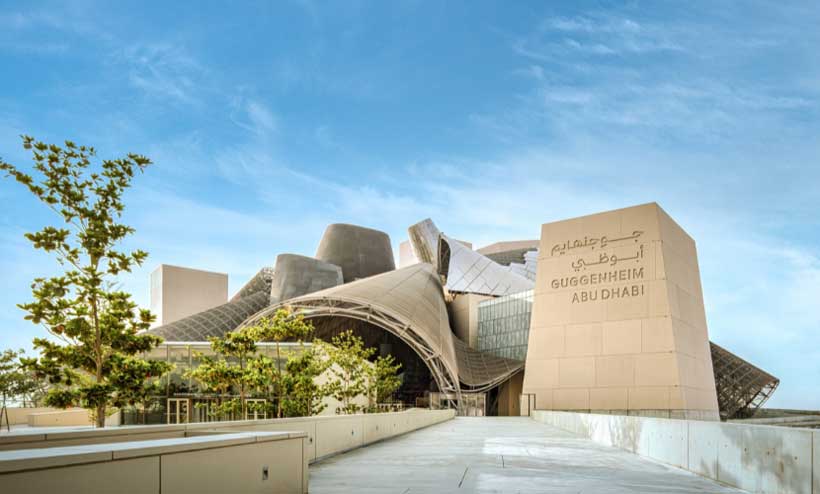
On 11 December, Frank Gehry’s nine metallic cones will open to the public on the western tip of Saadiyat Island, twenty years after the Guggenheim Foundation first announced it would build here. The museum has cost roughly $1 billion to construct: about 125,000 square feet of gallery space arranged around a central atrium, plus another 250,000 square feet of outdoor exhibition ground, ventilated by the same layered geometry that made Gehry’s Bilbao building famous in 1997. Construction started in 2011, stalled, and resumed in 2019. Whatever else it is, the building has already outlasted several of the predictions made about it.
The date, this time, appears to be real — Abu Dhabi’s Department of Culture and Tourism confirmed it this summer after earlier targets, including 2023, slipped. The museum has also finally disclosed what will actually hang inside: works by Yayoi Kusama, Dan Flavin, the Iranian sculptor Monir Shahroudy Farmanfarmaian and the Indian artist Bharti Kher, alongside Gulf and international modernism the foundation is still assembling. Director Mariët Westermann calls the collection “uniquely local and global.” The building, in other words, has stopped being the story. What it will contain, and what it can borrow, is.
The nearest comparison sits a few hundred metres away. Louvre Abu Dhabi opened in 2017 under a deal that paid Paris roughly $520 million for the use of its name alone, plus a licence — since extended to 2047 — covering rotating loans from French national collections. It has since drawn more than five million visitors, and in 2017 it bought Leonardo’s Salvator Mundi for $450 million, the most expensive painting ever sold at auction. That painting has not been shown publicly since 2019; nobody outside a small circle knows exactly where it currently is. The gap between what a Gulf museum can buy and what it can actually put in front of visitors, or lend onward to peers, is the precedent the Guggenheim now has to answer to — not Bilbao’s.
Bilbao is the comparison everyone reaches for anyway, and it mostly doesn’t hold. Gehry’s 1997 building worked because it filled a genuine vacuum: a mid-sized, post-industrial Basque city with no comparable draw, backed by regional government funding invested in exactly one landmark. Abu Dhabi has built an entire district instead — Louvre Abu Dhabi, the Zayed National Museum, teamLab Phenomena, and now the Guggenheim, all within walking distance on Saadiyat. The new museum isn’t filling a vacuum; it’s the fourth or fifth major venue competing for the same visitors, sponsors and touring shows inside one master-planned peninsula.
Stay ahead of the geopolitical week.
MD Briefing delivers expert analysis across five global fronts — the Indo-Pacific, energy, geoeconomics, European security, and the Middle East — every Monday morning. Free.
It also isn’t competing only with Paris or London. In February, Art Basel opens its first Middle East edition in Doha, spread across the M7 creative hub and the Design District beside the National Museum of Qatar — a fair that instantly imports dealers, collectors and press without Qatar having to pour a single foundation. Doha is backing it with a Lusail Museum and an Art Mill Museum still in development, but the fair alone does more to signal relevance to the international art world, this year, than a fifth building on Saadiyat does. If there is a rivalry the Guggenheim’s opening actually settles, it may be a Gulf one before it is a transatlantic one.
The building also reopens a grievance that architecture alone won’t settle. The Gulf Labor Coalition has campaigned since 2010 over conditions for the migrant workers who built it, pushing the Guggenheim Foundation to guarantee fair wages, no recruitment-fee debt and independent grievance channels. The foundation negotiated with the coalition from 2015, agreed to one demand — external monitoring — and broke off talks in 2016, calling the group’s requirements a moving target. Some artists have continued to decline association with the institution on those grounds ever since. A December opening does not resolve a fifteen-year-old dispute; it simply gives it a fixed date to reappear around.
What actually earns a museum the standing to rival the Pompidou or the National Gallery isn’t a building or an acquisitions budget — it’s decades of reciprocal lending relationships, curatorial trust, and an academic apparatus that other institutions want to borrow from as much as lend to. The Guggenheim name buys Abu Dhabi a faster start than Louvre Abu Dhabi had: an existing global network across New York, Bilbao and Venice, and curators who already know which collectors answer their calls. But early exhibitions will likely lean on the foundation’s own holdings before they lean on loans from institutions with no obligation to send their best pieces to the Gulf.
The test, then, isn’t opening week — ticket sales and press coverage are close to guaranteed. It’s whether, three or four years in, the Guggenheim Abu Dhabi is lending major works outward as often as it borrows them in, and whether the coalition still protesting its construction has anything left to protest by then.