


“The enemy is the unphilosophical spirit which knows nothing and wants to know nothing of truth.”- Karl Jaspers, Reason and Anti-Reason in Our Time (1952)
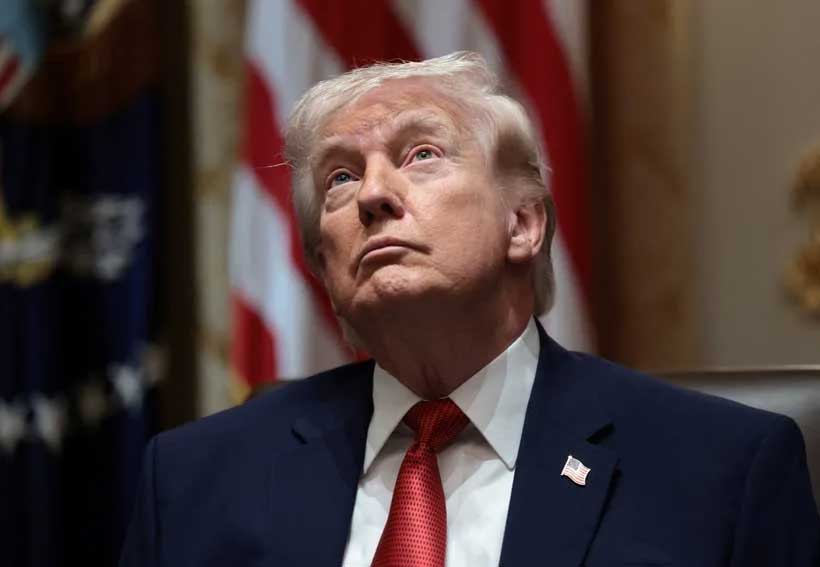
It’s no longer an absurd suggestion. Whether one looks at Donald Trump’s war against Iran or his declaration that an Iranian nuclear attack against two California cities could be welcome, one conclusion is glaringly obvious: This US president “knows nothing” and “wants to know nothing” about nuclear war or nuclear deterrence.[1] As for his viscerally-compliant subordinates (including the Vice President and “Secretary of War”), they are enthusiastically transforming strategic incoherence into Orwellian truth.
To clarify, there are multiple particulars, many of them intersecting. Among the subsidiary expressions of his “unphilosophical spirit,”[2] Trump assumes, without tangible evidence[3] or logical argument,[4] a direct and invariant correlation between the magnitude of American nuclear threats and the likelihood of successful dissuasion. Inter alia, this assumption ignores the plausible counter-argument that US threat credibility could vary inversely with US threat destructiveness.[5]
There is more. Donald Trump’s explicit threats at the UN General Assembly (September 2026) to “annihilate” Iran were not “merely” genocidal under international and national law. They were starkly injurious to America’s national security.By any logic-based assessment, the US president’s lawless declaration will encourage new military operations against the United States[6] and further enlargements of ongoing conflicts.
Stay ahead of the geopolitical week.
MD Briefing delivers expert analysis across five global fronts — the Indo-Pacific, energy, geoeconomics, European security, and the Middle East — every Monday morning. Free.
There are more particulars. The absence of logic-based US military policies under Trump signifies a nation’s witting embrace of anti-reason.[7] Today, at an historical moment when proliferating nuclear weapons[8] coincide with the spread of autonomous superintelligence and recursive AI self-improvement, this delusionary embrace could produce irremediable harms. Among other things, we are living at a moment when traditional military decision making could be “AI-impaired.”
For Washington, it’s not just about “obliterating” Iran.[9] North Korea remains on a determinedly belligerent trajectory with the United States.[10] Though militarily inferior to the US, the “hermit kingdom still represents an unpredictable and potentially fearsome adversary.
How might a US-North Korea war actually begin? One compelling scenario would engage active North Korean military support for an Iran battered by continuous Trump attacks. In a discernibly worst case scenario, North Korea would act as Tehran’s nuclear proxy, a galvanizing stance that could produce irreversible American losses (suddenly or incrementally) during any mutual (US-North Korea) struggle for “escalation dominance.”[11]
To provide more meaningfully-precise clarifications, history deserves pride of place. At the Singapore Summit on June 12, 2018, Donald Trump promised Americans that North Korea was no longer a nuclear war threat. This was the case, reassured the first-term president, because he and Kim Jung Un had “fallen in love.” In other words, Trump had reasoned openly, “attitude is more important than preparation.”[12]
The still-dissembling Trump presidency reveals rising risks of military confrontation between Washington and Pyongyang and also between Washington and other adversaries.[13] Whether or not such confrontations would result in a nuclear war, however, cannot be calculated scientifically. In logic and mathematics, determinations of probability always depend on the ascertainable frequency of pertinent past events. Prima facie, there have been no such events.
Incontestably, that’s a good thing. Nonetheless, the United States still needs to render informed judgments on the plausibility of a nuclear war in this and other potential theatres of military conflict. To a significant but indeterminable extent, these judgments will depend on whether the belligerent risks arise from deliberate or inadvertent military actions and escalations.
For the American president, though there will be variously consequential nuances, it is unlikely that he or his designated counselors would ever recognize and acknowledge them. To wit, only in implausibly optimistic circumstances would Trump et al understand that an inadvertent nuclear war with North Korea could be the result of decision-maker miscalculation, enemy hacking, IA-related computer intrusion or mechanical/electrical/computer accident. While such risks could be traceable expressions of individual leadership personality,[14] they are most apt to stem from generically corrosive competitions for “escalation dominance.” In part, at least,these risks would reflect the continuously “Westphalian” structure of world politics,[15] an inherently-unstable 17th century foundation (1) that could at any point descend into an unprecedented chaos;[16] and (2) that could coincide with a previously unimaginable “equalizer” capacity. Most worrisome for the United States would be bestowals of this capacity on non-nuclear adversaries such as Iran. Not to be ignored is that even a militarily weakened Iran could inflict grievous harms on the United States by disabling American financial and utility infrastructure (e.g. water supply controls.)
In facing still-emergent strategic threats, it is high time for candor. President Donald J. Trump’s expansive military policy misunderstandings are already setting the stage for future and unique nuclear crises with North Korea and other adversaries.[17] Here, expressions of adversarial “uniqueness” will lie in the “weaker” state’s ability to offset the “stronger” state’s nuclear advantage. Such ability, in turn, will stem from a new capacity for AI-enhanced intrusions that could (3) compromise American command and control communications and/or (4) immobilize US power grids, pandemic-related medical systems and/or interlocking information networks.
Not a Time for False Bravado or Empty Witticism
During upcoming crisis negotiations with North Korea, Iran, China or other adversary, Trump should take scrupulous care not to exaggerate or overstate America’s military risk-taking calculus. In part, such diplomatic caution would derive from the absence of analytically-comparable nuclear crises. In world politics, as in every other topic of human interaction, meaningful probability judgments can never be derived ex nihilo, out of nothing.
This does not mean, however, that Trump’s senior strategists ought to steer clear of dispassionate assessments regarding nuclear costs and risks. It does mean that such analytic assessments should be drawn systematically from constantly shifting geopolitical trajectories. Such hard-to-decipher trends would include variously-complex considerations of nuclearization. Though set back tangibly by US and Israeli strikes, Iran has quietly recommitted to certain modified forms of nuclear weapons development.[18] Nuclear conflict could also become plausible via surrogate nuclear enhancements (e.g., if Tehran decided to call upon Pyongyang as its belligerent nuclear proxy), but Iran could reveal persuasive power even without nuclear weapons or nuclear doctrine.
Among other things, such revelation would owe to the Islamic Republic’s capacity to inflict AI-enhanced harms on the United States. This means an “equalizing” capacity. Significant harms could involve biological warfare attacks on American cities and would likely include resistant forms of plague, anthrax or other pathogen. In certain science-based scenarios, the human and material outcomes would be as devastating or more devastating than they were during naturally-occurring medieval pandemics.
System and Strategy
There is more. In all complex assessments, the geo-strategic world will need to be examined as a system. For Trump policy-planners focused on Iran, North Korea or even China, there will be fixed obligations to consider, including future intersections between Pyongyang’s nuclear threats of escalation and Tehran’s clandestinely-restarted nuclearization. Moreover, these obligations could shape potentially synergistic intersections. In such force-multiplying intersections, the “whole” of any particular conflict would be greater than the sum of its “parts.”
Many-sided strategic issues ought never to be approached from the obfuscating perspectives of American domestic politics. In further clarification, some component problems and crises would emerge as more complicated and problematic than others. In securing essential intellectual advantages,[19] world security processes should always be approached by Washington as a totality.After all, what is happening or taking form in such far-flung places as India-Kashmir; China-Taiwan; Russia-Ukraine; Saudi Arabia-Iran-Yemen (Houthi proxies); Israel-Lebanon (Hezbollah proxies); Iraq; Pakistan, Syria and Turkey (aligned with Saudi Arabia) and Afghanistan could at some point produce “spillover effects” in Asia and beyond.[20] These effects could be of highest possible importance, especially if they were to coalesce into a regional or still-wider war.
Morality and Intentionality
In one form or another, military threats from already-nuclear North Korea remain substantive and “robust.”[21] President Donald Trump’s metaphors notwithstanding, the fact that his nuclear “button” is “bigger” than Kim’s is anything but meaningful. In strategic deterrence relationships, a condition of relative nuclear weakness by one of the contending adversarial states need not imply a corollary diminution of military power. Plainly enough, even the presumptively weaker party in asymmetrical dyads could deliver “unacceptable damage” to the stronger.
Though bewildering by definition, complexity will always be crisis-defining. President Trump will need to bear in mind that many of Asia’s continuously transforming military developments could be impacted by quickly changing US-NATO relationships. Regarding Russia’s war of aggression against Ukraine, it has long been apparent that Trump is more sympathetic to dictator Vladimir Putin than victim Volodymyr Zelensky.[22] In this connection, nothing was changed by Trump’s September 24, 2026 agreement to Patriot missile licensing for Ukraine.
There are related issues. Important here will be Trump’s willingness to acknowledge the consequential limits of “expert” military advice. Widely unseen, these limits are not based on any presumed US intellectual inadequacies, but on the irrefutable knowledge that no person has ever fought in a nuclear war. In scientific terms (i.e., from the standpoint of disciplined probability theory), this bit of knowledge ought never to be underestimated or disregarded.
Going forward with time-urgent considerations of Iran, North Korea, Russia, China, Pakistan et al.,[23] American strategic calculations will be fraught with uncertainties. Still, it is necessary that Donald Trump and his designated counselors will remain able to offer best available war estimations. Among prospectively causal factors – some of them overlapping, interdependent or “synergistic”[24] – the risks of a nuclear war between Washington and certain adversaries will ultimately depend on whether the conflict is intentional, unintentional or accidental. In principle, this tripartite distinction could prove vitally important to any hoped-for success in US nuclear war prediction and prevention.
There is more. In facing future Iranian, North Korean, Russian and Chinese negotiations, it will be necessary for US policy analysts to capably examine all foreseeableconfigurations of nuclear war risk. Expressed in the game-theoretic parlance of formal military planning, shifting configurations in the “state of nations”[25] would present themselves singly (one-at-a-time, the expectedly best case for Washington); suddenly (unexpectedly, with apparent “diffusiveness”) or in dynamically-overlapping “cascades” of strategic complexity.
Strategic Challenges of “Mind”
What is to be done? To properly understand such dense scenarios will require properly-honed, well-developed and formidable intellectual skills. This will not be a task for half-educated politicians or the intellectually faint-hearted. It will require, instead, sharply-refined combinations of historical acquaintance, traditional erudition and a demonstrated capacity for advanced dialectical thinking. Clarifying elucidations of such disciplined thinking go back to the dialogues of Plato and the ancient but timeless awareness that reliable analysis calls for the continuously sequential asking and answering of interrelated questions.
This will be a challenging task. Indeed, nothing could be more daunting. It will require American strategic thinkers who are as comfortable with the classical prescriptions of Plato and Descartes as with the more technical elements of modern military theory. Consequently, it will have to be tackled by the “few,” not by the “many.”[26]
Not all nuclear wars would have the same origin. It is conceivable that Washington, Pyongyang, Moscow and Beijing are currently paying insufficient attention to the residual risks of unintentional nuclear war. To this point, each posturing president would seem to have assumed the others’ decisional rationality.[27] If there were no such reciprocal calculation, it could make no ascertainable sense for any one side to negotiate further security accommodations with the others.
Viable nuclear deterrence (not “denuclearization”) should be the overriding US strategic goal vis-a-vis North Korea, but this complicated objective is contingent on basic assumptions concerning enemy rationality. There is also an antecedent question: “Are such assumptions realistic in the case of a potential war between two already-nuclear powers?”
If at some point President Donald Trump should fear enemy irrationalityin Pyongyang, issuing calibrated threats of US nuclear retaliation would no longer make strategic sense. At that opaque and unprecedented stage, American national security could come to depend on presumptively optimal combinations of missile defense and defensive first strikes. In any event, determining such dense combinations would lack decisional input from quantifiable historical data and from “wise counsel.”[28]
In a still-imaginable worst-case scenario, the offensive military threat could require either a situational or comprehensive preemption – a defensive first strike by the United States[29] – but at that stage all previous hopes for bilateral reconciliation would have become moot. Inter alia, there would then exist no “ordinary” circumstances wherein a preemptive strike[30] against a North Korean nuclear adversary could be considered “rational.”[31] What then? Whatever the answer, this question should always be approached as an intellectual problem, not a political one.
There is more. None of these referenced strategic decisions should be reached casually. With the expanding development of drones, EMP ordnance and “hypersonic” nuclear weapons, figuring out optimal US military policy combinations from one security crisis to another would quickly become overwhelming. Though counterintuitive amid prominently intersecting complications, the fact that one “player” (the US) was recognizably “more powerful” than the other (e.g., North Korea) could prove effectively irrelevant. In the “real world,” let us be candid, threatening a “bigger button” would represent little more than conspicuous buffoonery.
Strategy and Law
In all foreseeable circumstances, there will be overlapping issues of law and strategy. Under international law, which remains an integral part of US law,[32] the option of launching a selective or comprehensive defensive strike might at some point be correctly characterized as “anticipatory self-defense.” But this would be the case only if the American side could argue persuasively that the security “danger posed” by North Korea or other specific adversary was “imminent in point of time.”
Such discernible “imminence” is required by the authoritative standards of international law;[33] that is, by the formal criteria established after an 1837 naval incident famously called “The Caroline.”[34] Presently, offering aptly precise characterizations of “imminence” could prove confusingly abstract and operationally problematic.[35]
For the moment, it seems reasonable that Kim Jong Un would value his own personal life and the survival of his nation above every other conceivable preference or combination of preferences. Despite his occasional bluster, Kim does appear to be visibly and technically rational, and should therefore remain subject to credible US nuclear deterrence.[36] Still, going forward, it could become important for a negotiating American President to distinguish between authentic instances of enemy irrationality and instances of contrived or pretended irrationality.[37] This challenging prospect adds yet another layer of complexity to the subject at hand, and could at some stage include force-multiplying synergies.
Throughout history, wars have often been the result of leadership miscalculation. Though neither side here would likely seek a shooting war, either Kim or Trump could commit various errors in the course of rendering strategic calculations. At times, such consequential errors could represent the unintended result of jointly-competitive searches for “escalation dominance.“[38] Prima facie, these errors are more apt to occur in circumstances where one or both presidents first decided to reignite threatening and hyperbolic rhetoric.
Even in reassuringly calm periods of polite diplomatic discourse, major miscalculations, accidents or “cyber-confusions” could accumulate. Not only might such ill-fated accumulations be hastened by the effects of a widespread disease pandemic, the tangible likelihood of another pandemic could be made greater by superintelligent AI interventions and recursive AI self-improvements.
In certain worst case scenarios,[39] negotiations gone wrong could result in a nuclear war.[40] This largely unpredictable prospect ought never to be downplayed or overlooked. In the obvious but necessary words of Swiss playwright Friedrich Durrenmatt, “The worst does sometimes happen.”[41]
Inadvertent and Accidental Nuclear War
An inadvertent nuclear war between Washington and Pyongyang or Washington and a different adversary (even a non-nuclear Iran) could take place not only as the result of misunderstanding or miscalculation between rational national leaders, but also as the unintended consequence (singly or synergistically) of (1) mechanical, electrical, computer malfunctions; and/or (2) “hacking”-type interventions. In turn, these interventions could include clandestine intrusions of “cyber-mercenaries” and/or autonomous AI “aggressions.”
While an accidental nuclear war would necessarily be inadvertent, certain forms of inadvertent nuclear war would not be caused by mechanical, electrical or computer accident. These difficult to anticipate but still-consequential forms of an unintentional nuclear conflict would represent the unexpected result of specific misjudgment or miscalculation, whether by (3) singular decisional error of one or both sides to a two-party nuclear crisis escalation; or (4) still-unforeseen synergies arising between singular miscalculations.[42]
In an upcoming crisis between Washington and Pyongyang or between the United States and another enemy, each side would strive to maximize two critical goals simultaneously: (5) to dominate the dynamic and largely unpredictable process of nuclear crisis escalation; and (6) to achieve “escalation dominance” without sacrificing overriding national security interests. Ipso facto, this second objective would mean preventing one’s own state and society from suffering catastrophic or existential harms.
In such increasingly plausible circumstances, having a “bigger button” (Trump’s earlier metaphor) could quickly become a source of weakness rather than strength. Nuclear “size” would matter, but only in unexpected or counter-intuitive ways. Already during Trump’s first term, several of North Korea’s nuclear test firings had expressed yields at least 16x larger than the Hiroshima bomb. The 14KT WW II bomb (a “small” nuclear weapon by today’s ordnance standards) produced almost 100,000 immediate fatalities.
Vital understandings about nuclear “button size” would continue as long as Kim Jung Un’s “inferior” nuclear arms seemingly remained invulnerable to American preemptions and capable of penetrating missile defenses in the United States, Japan and South Korea. Because of the extraordinary harms generated by “low-yield” nuclear weapons, even a small percentage or tiny fraction of Kim’s “inferior” nuclear arsenal could produce “unacceptably destructive” outcomes in Washington, Tokyo or Seoul. Also worth noting is that in all such venues of strategic competition, the only reality that would figure in adversarial calculations would be perceived reality.
When Strategic Risks are Unique or Sui Generis
The bottom line of informed assessments concerning a US-involved nuclear war is that all underlying issues of contention and calculation would be starkly complicated and potentially indecipherable. Faced with endlessly challenging layers of complexity, both operational and legal,[43] the United States should now proceed warily, in a fashion that is recognizably risk-averse. Though such prudent counsel could at first appear contrary to meeting US obligations of “escalation dominance,” any future Trump-involved nuclear crises would take place in “uncharted waters.”
There is more. Any aggressive over-confidence (or what the ancient Greeks called “hubris” in tragic drama) by President Trump ought strenuously to be avoided. While everything at some upcoming negotiation might initially appear simple and calculable, history should call to mind Prussian strategist Carl von Clausewitz’s classical observation about “friction.” Succinctly, this ubiquitous fly-in-the-ointment references the differences between “war on paper” and “war as it actually is.”
To avoid intolerable crisis outcomes between the United States and North Korea or other adversary, a prudent, science-based[44] and informed nuclear posture should be fashioned, not with silly and self-destructive clichés but with refined intellect and cultivated erudition. The ancient Greeks and Macedonians already understood that war planning should be treated as a disciplined matter of “mind over mind,” not of “mind over matter.”[45] Going forward, any purposeful assessment of America’s nuclear posture should include the potential impact of AI derangements.
Science and “Nightmare”
It would be best for the United States to plan carefully for all strategic eventualities and not stumble into a nuclear war – whether deliberate, unintentional or accidental. The fact that any such “stumble” could take place without adversarial ill will or base motive should provide little science-based consolation. In essence, an ounce of diplomatic prevention will be well worth avoiding strategic nightmare.
Nightmare. According to the etymologists, the root is niht mare, or niht maere, the demon of the night. Dr. Johnson’s famous Dictionary claims this corresponds to Nordic mythology, which identifies all nightmare as some unholy product of demons. This would make it a play on the Greek ephialtes or the Latin incubus. In all of these fearful interpretations of nightmare, the idea of demonic origin is integral and indispensable.
But America’s current security worries are of a different and more secular sort. Now there are inherent complexities in problem solving that must be accepted, understood and suitably overcome. At a time when our planet is imperiled by variously intersecting threats of nuclear war, there is no reasonable alternative to proper analytic emphases.
The risks of a nuclear war between the United States and assorted adversaries should be assessed in solid intellectual terms.[46] Whatever the relevant adversary, an American president should always focus explicitly on creating a viable system of mutual deterrence. Though such a seemingly “egalitarian” focus might first appear demeaning for a Trump-era “Great Power” United States, national security policy should always be founded on rigorously-accurate theoretical assumptions and a correlatively apparent national “will.”[47]
Summing up, both an “inferior” nuclear power such as North Korea and a pre-nuclear power like Iran could create unacceptable security harms for the United States.[48] In any final reckoning, the security harms of a nuclear war with North Korea could be quasi-existential for the United States and be impacted by coinciding nuclear crises involving Russia, China, India, Pakistan or Iran. In worst case scenarios, synergistic interactions between seemingly-separate crises could generate harms that are sui generis and no longer subject to human oversight. As superintelligence becomes more and more autonomous, the outcomes of recursive self-improvement will become unknowable.[49]
In large measure, the expanding threat of nuclear war lies in certain national leaderships that could at some point favor presumptive political benefit over science-based truth. At the present historical moment, an especially dangerous threat lies in various further escalations of US presidential incoherence. Adapting the wisdom of 20th century German philosopher Karl Jaspers to this existential prospect, the authentic “enemy” lies not in any particular geopolitical adversary (e.g., Iran, China, North Korea), but in an “unphilosophical spirit which knows nothing and wants to know nothing of truth.”
[1] See for example, by this author:Louis René Beres at Harvard National Security Journal: https://harvardnsj.org/wp-content/uploads/2020/04/Beres_Complex-Determinations_v2.pdf and Louis René Beres, Air and Space Operations Review, USAF (Pentagon): https://www.airuniversity.af.edu/Portals/10/ASOR/Journals/Volume-1_Issue-1/Beres_Nuclear_War_Avoidance.pdf
[2] This illuminating phrase of philosopher Karl Jaspers has unambiguous roots in the writings of Friedrich Nietzsche.
[3]This absence is explained by the fact that a nuclear war has never taken place; i.e., it has no historical precedent. By definition, therefore, it would be sui generis and not directly subject to empirical explanations.
[4] Recalling classical strategic thinker Anatol Rapoport: “Formal decision-theory does not depend on data…. The task of theory is confined to the construction of a deductive apparatus, to be used in deriving logically necessary conclusions from given assumptions.” (Strategy and Conscience, 1964).
[5] In game-theoretic terms, threat-destructiveness or magnitude is often referenced as “disutility.”
[6] Such operations would likely include actions against the United States or US allies by assorted armed forces (both state and sub-state) allied to Iran. In this connection, North Korea, China and Pakistan should come most readily to mind. Regarding Pakistan, that Islamic nuclear state has routinely supported jihadi terrorist organizations and exported nuclear technologies to Libya and Syria. Always hostile to (US ally) Israel, Pakistan signed a mutual defense treaty with Saudi Arabia in September 2025. That pact was effectively implemented in March 2026, when Pakistani troops were deployed in Saudi Arabia to help counter missiles and drones launched by Iran and Houthi surrogates. Also, US President Donald Trump should continuously bear in mind a pertinent Pakistan-China connection: Pakistan is a partner in China’s “Belt & Road Initiative,” a project which aims at enhancing China’s position as the third and prospectively co-equal superpower.
[7]For philosophical background, see Karl Jaspers, Reason and Anti-Reason in our Time (1952).
[8] Though such proliferation includes electromagnetic pulse weapons, there are also non-nuclear forms of EMP. For a recent article that deals authoritatively with these issues, see William J. Broad, “How Top Trump Officials Stoked Fears of a Nuke Threat that Could Fry the Power Grid,” New York Times, 14 October 2026:
[9] In this connection, during October 2026, President Donald Trump expanded his earlier request for non-nuclear massive ordnance, especially the GBU-43/B MOBB. Presumably, this request stems from his wish to destroy existing highly enriched uranium stockpiles allegedly being secreted in Iran.
[10] See, by this author, Louis René Beres: https://mwi.usma.edu/theres-no-historical-guide-assessing-risks-us-north-korea-nuclear-war/
[11] For a related argument (and conceptual background) by this author, see Louis René Beres (BESA/Israel):https://besacenter.org/wp-content/uploads/2024/09/207ENGweb-Beres-Israel-Escalation-Dominance-Iran-1.pdf
[12] We should be reminded here of a generic insight by Spanish existentialist philosopher Jose Ortega y’Gasset: “The mass-man has no attention to spare for reasoning. He learns only in his own flesh.” Though US president, Donald Trump is Ortega’s mass-man par excellence. Without embarrassment, he admits that he neverreads. See, by this writer, Louis René Beres, at JURIST (2021): https://www.jurist.org/commentary/2021/12/louis-rene-beres-natural-law-us-constitution/
[13] Regarding Washington and Beijing, nothing substantial was changed by the September 24-25 2026 meetings between Donald Trump and Xi Jinping. China continues to assist Iran on multiple levels (economic and military) and to target its long-range nuclear weapons on the United States.
[14] Reminds Sigmund Freud: “Fools, visionaries, sufferers from delusions, neurotics and lunatics have played great roles at all times in the history of mankind, and not merely when the accident of birth had bequeathed them sovereignty. Usually, they have wreaked havoc.”
[15] This historical referent here is the Peace of Westphalia (1648), a treaty which concluded the Thirty Years War and created the continuously anarchic “state system.” See: Treaty of Peace of Munster, Oct. 1648, 1 Consol. T.S. 271; and Treaty of Peace of Osnabruck, Oct. 1648, 1., Consol. T.S. 119, Together, these two treaties comprise the Peace of Westphalia. For the authoritative sources of international law, see art. 38 of the Statute of the International Court of Justice: STATUTE OF THE INTERNATIONAL COURT OF JUSTICE, Done at San Francisco, June 26, 1945. Entered into force, Oct. 24, 1945; for the United States, Oct. 24, 1945. 59 Stat. 1031, T.S. No. 993, 3 Bevans 1153, 1976 Y.B.U.N., 1052
[16] See by this author, Louis René Beres, at Modern Diplomacy: https://moderndiplomacy.eu/2025/11/15/calamity-truth-and-silence-america-and-world-system-chaos/
[17] According to a recent book on US foreign policy and North Korean nuclearization (Joel S. Wit, Fallout: The Inside Story of America’s failure to Disarm North Korea; Yale University Press, 2025): “Unlike Hillary Clinton, Trump wasn’t a seasoned foreign policy hand. He had a short attention span, didn’t know that Korea had been divided into two countries and wasn’t interested in detail.” (p.6). Already at the start of Barack Obama’s presidency, North Korea’s nuclear arsenal was able to lay waste to South Korea, Japan and even certain American cities.
[18] See, on deterring a prospectively nuclear Iran, Louis René Beres and General John T. Chain, “Could Israel Safely deter a Nuclear Iran? The Atlantic, August 2012; and Professor Louis René Beres and General John T. Chain, “Israel; and Iran at the Eleventh Hour,” Oxford University Press (OUP Blog), February 23, 2012. Though dealing with Israeli rather than American nuclear deterrence, these articles clarify common conceptual elements. General Chain was Commander-in-Chief, U.S. Strategic Air Command (CINCSAC).
[19] “It must not be forgotten,” warns Guilaume Apollinaire, “that it is perhaps more dangerous for a nation to allow itself to be conquered intellectually than by arms.” See The New Spirit and the Poets (1917).
[20] In jurisprudential terms, these effects could involve the crime of aggression under international law. Derivative from earlier criminalizing codifications at Nuremberg’s 1945 London Charter and the 1928 Pact of Paris, aggression has nothing to do with the particular nature of weaponry employed, whether conventional or unconventional. See: Resolution on the Definition of Aggression, Dec. 14, 1974, U.N.G.A. Res. 3314 (XXIX), 29 U.N. GAOR, Supp. (No.31) 142, U.N. Doc. A/9631, 1975, reprinted in 13 I.L.M. 710, 1974.
[21] See Nadia Helmy, “North Korea’s New Missile Threat,” Modern Diplomacy, 11 October 2026: https://moderndiplomacy.eu/2026/10/11/north-koreas-new-missile-threat-what-it-means-for-china-taiwan-and-us-defenses/
[22] A recent and tangible example is Trump’s deal to buy diesel fuel from Putin.
[23] Importantly, these four states present not just singular threats for the United States and certain American allies, but also interrelated and potentially synergistic threats.
[24] See, by this writer, at Harvard Law School: Louis René Beres, https://harvardnsj.org/2015/06/core-synergies-in-israels-strategic-planning-when-the-adversarial-whole-is-greater-than-the-sum-of-its-parts/ See also, by this writer, at West Point: Louis René Beres https://mwi.usma.edu/threat-convergence-adversarial-whole-greater-sum-parts/
[25] Seventeenth-century English philosopher Thomas Hobbes notes that although the “state of nations” is in the anarchic “state of nature,” it is still more tolerable than the condition of individuals in nature. With individual human beings, he instructs, “…the weakest has strength enough to kill the strongest.” But with the continuing advent of nuclear weapons, there is no persuasive reason to believe that the state of nations remains more tolerable. Now, nuclear weapons are bringing the state of nations closer to the true Hobbesian state of nature. See, in this connection, David P. Gauthier, The Logic of Leviathan: The Moral and Political Theory of Thomas Hobbes (Oxford: Oxford University Press, 1969), p. 207. As with Hobbes, philosopher Samuel Pufendorf argues that the state of nations is not quite as intolerable as the state of nature between individuals. The state of nations, reasons the German jurist, “lacks those inconveniences which are attendant upon a pure state of nature….” In a similar vein, Baruch Spinoza suggests “that a commonwealth can guard itself against being subjugated by another, as a man in the state of nature cannot do.” See, A.G. Wernham, ed., The Political Works, Tractatus Politicus, iii, II (Clarendon Press, 1958), p. 295.
[26] On this distinction, see classical writings by Spanish philosopher Jose Ortega y’Gasset, especially The Revolt of the Masses (1930); and by this author, Louis René Beres at Yale Global (2020): https://archive-yaleglobal.yale.edu/content/call-intellect-and-courage
[27] In world politics, rationality and irrationality have very specific meanings. More precisely, an “actor” (state or sub-state) is presumed to be rational to the extent that its leadership always values national survival more highly than any other preference or combination of preferences. Reciprocally, an irrational actor would not display such a determinable preference ordering.
[28] “For by wise counsel, thou shalt make thy war.” (Proverbs: 24, 6).
[29] For early scholarly commentary by this author on anticipatory self-defense under international law, with special reference to Israel, see: Louis René Beres and (COL./IDF/Res.) Yoash Tsiddon Chatto, “Reconsidering Israel’s Destruction of Iraq’s Osiraq Nuclear Reactor,” TEMPLE INTERNATIONAL AND COMPARATIVE LAW JOURNAL, Vol. 9., No. 2., 1995, pp. 437 – 449; Louis René Beres, “Preserving the Third Temple: Israel’s Right of Anticipatory Self-Defense Under International Law,” VANDERBILT JOURNAL OF TRANSNATIONAL LAW, Vol. 26, No. 1., April 1993, pp. 111- 148; Louis René Beres, “After the Gulf War: Israel, Preemption and Anticipatory Self-Defense,” HOUSTON JOURNAL OF INTERNATIONAL LAW, Vol. 13, No. 2., Spring 1991, pp. 259 – 280; Louis René Beres, “Striking `First:’ Israel’s Post-Gulf War Options Under International Law,” LOYOLA OF LOS ANGELES INTERNATIONAL AND COMPARATIVE LAW JOURNAL, Vol. 14, Nov. 1991, No. 1., pp. 1 – 24; Louis René Beres, “Israel and Anticipatory Self-Defense,” ARIZONA JOURNAL OF INTERNATIONAL AND COMPARATIVE LAW, Vol. 8, 1991, pp. 89 – 99; and Louis René Beres, “After the SCUD Attacks: Israel, `Palestine,’ and Anticipatory Self-Defense,” EMORY INTERNATIONAL LAW REVIEW, Vol. 6, No. 1., Spring 1992, pp. 71 – 104. For an examination of assassination as a permissible form of anticipatory self-defense by Israel, see, Louis René Beres, “On Assassination as Anticipatory Self-Defense: The Case of Israel,” HOFSTRA LAW REVIEW, Vol. 20, No. 2., Winter 1991, pp. 321 – 340. For more general assessments of assassination as anticipatory self-defense under international law by this author, see: Louis René Beres, “The Permissibility of State-Sponsored Assassination During Peace and War,” TEMPLE INTERNATIONAL AND COMPARATIVE LAW JOURNAL, Vol. 5, No. 2, 1991, pp. 231 – 249; and Louis René Beres, “Victims and Executioners: Atrocity, Assassination and International Law,” CAMBRIDGE REVIEW OF INTERNATIONAL AFFAIRS, Winter/Spring, 1993.
[30] In law, there is an important distinction between preemptive attacks and preventive attacks. Preemption is a military strategy of striking an enemy first, in the expectation that the only alternative is to be struck first oneself. A preemptive attack is launched by a state that believes enemy forces are about to attack. A preventive attack, however, is launched not out of concern for any imminent hostilities, but rather for fear of a longer-term deterioration in some vital military balance.
[31] See, by this author, Louis René Beres: https://thehill.com/blogs/pundits-blog/foreign-policy/344750-rationality-cant-be-assumed-in-potential-north-korea
[32]. For early decisions on the US “incorporation” of authoritative international law (by Chief Justice John Marshall) see: The Antelope, 23 U.S. (10 Wheat.) 66, 120 (1825); The Nereide, 13 U.S. (9 Cranch) 388, 423 (1815); Rose v. Himely, 8 U.S. (4 Cranch) 241, 277 (1808) and Murray v. The Schooner Charming Betsy, 6 U.S. (2 Cranch) 64, 118 (1804).
[33] These actions were egregious violations of both international law and US domestic law. International law is always an integral part of US law. Onn this incorporation, see especially art. 6 of the US Constitution (“The Supremacy Clause”) and the Pacquete Habana (1900). In the words used by the U.S. Supreme Court in The Paquete Habana, “International law is part of our law, and must be ascertained by the courts of justice of appropriate jurisdiction, as often as questions of right depending upon it are duly presented for their determination. For this purpose, where there is no treaty, and no controlling executive or legislative act or judicial decision, resort must be had to the customs and usages of civilized nations.” See The Paquete Habana, 175 U.S. 677, 678-79 (1900). See also: The Lola, 175 U.S. 677 (1900); Tel-Oren v. Libyan Arab Republic, 726 F. 2d 774, 781, 788 (D.C. Cir. 1984) (per curiam) (Edwards, J. concurring) (dismissing the action, but making several references to domestic jurisdiction over extraterritorial offenses), cert. denied, 470 U.S. 1003 (1985) (“concept of extraordinary judicial jurisdiction over acts in violation of significant international standards…embodied in the principle of `universal violations of international law.’
[34] See Beth Polebau, National Self-Defense in International Law: An Emerging Standard for a Nuclear Age, 59 N.Y.U. L. REV. 187, 190-191 (noting that The Caroline transformed the right to self-defense from an excuse for armed intervention into a customary legal doctrine).
[35] For example, under international law, the question of whether or not a condition of war exists between states is often unclear. Traditionally, a “formal” war was said to exist only after a state had issued a formal declaration of war. The Hague Convention III codified this position in 1907. This Convention provided that hostilities must not commence without “previous and explicit warning” in the form of a declaration of war or an ultimatum. See Hague Convention III on the Opening of Hostilities, Oct. 18, 1907, art. 1, 36 Stat. 2277, 205 Consol. T.S. 263. Presently, a declaration of war could be tantamount to a declaration of criminality because international law prohibits “aggression.” See Treaty Providing for the Renunciation of War as an Instrument of National Policy, Aug. 27, 1948, art. 1, 46 Stat. 2343, 94 L.N.T.S. 57 (also called Pact of Paris or Kellogg-Briand Pact); Nuremberg Judgment, 1 I.M.T. Trial of the Major War Criminals 171 (1947), portions reprinted in Burns H. Weston, et. al., INTERNATIONAL LAW AND WORLD ORDER 148, 159 (1980); U.N. Charter, art. 2(4). A state may compromise its own legal position by announcing formal declarations of war. It follows that a state of belligerency may exist without formal declarations, but only if there exists an armed conflict between two or more states and/or at least one of these states considers itself “at war.” In the matter of North Korea, Kim Jong Un considers his country to be “at war” with the United States.
[36] Even before the nuclear age, ancient Chinese military theorist, Sun-Tzu, counseled, inThe Art of War:“Subjugating the enemy’s army without fighting is the true pinnacle of excellence.” (See: Chapter 3, “Planning Offensives”).
[37] Expressions of decisional irrationality in US dealings with North Korea could take different or overlapping forms. These include a disorderly or inconsistent value system; computational errors in calculation; an incapacity to communicate efficiently; random or haphazard influences in the making or transmittal of particular decisions; and the internal dissonance generated by any structure of collective decision-making (i.e., assemblies of pertinent individuals who lack identical value systems and/or whose organizational arrangements impact their willing capacity to act as a single or unitary national decision maker).
[38] On this concept, see, by this author: Louis René Beres, at The War Room, US Army War College, Pentagon: https://warroom.armywarcollege.edu/articles/nuclear-decision-making-and-nuclear-war-an-urgent-american-problem/
[39] Such scenarios resonate with a warning offered by Hermann Hesse in Steppenwolf (1927): “This world, as it is now, wants to perish….” See also the fearful metaphors of Pierre Teilhard de Chardin’s the Phenomenon of Man: “A rocket rising in the wake of time’s arrow, that only bursts to be extinguished; an eddy rising on the bosom of a descending current – such then must be our picture of the world.”
[40] There is now a substantial literature that deals with the expected consequences of a nuclear war. For representative works by this author, see, for example: SURVIVING AMID CHAOS: ISRAEL’S NUCLEAR STRATEGY (Rowman & Littlefield, 2016/2018); APOCALYPSE: NUCLEAR CATASTROPHE IN WORLD POLITICS (Chicago: The University of Chicago Press, 1980); MIMICKING SISYPHUS: AMERICA’S COUNTERVAILING NUCLEAR STRATEGY (Lexington Books, 1983); REASON AND REALPOLITIK: U.S. FOREIGN POLICY AND WORLD ORDER (Lexington, MA: Lexington Books, 1984); and SECURITY OR ARMAGEDDON: ISRAEL’S NUCLEAR STRATEGY (Lexington, MA: Lexington Books, 1986).
[41]In history, this ‘worst” has often stemmed from a presumptively life-preserving identification of individual human beings with the fate of their respective countries. In his posthumously published lecture on Politics (1896), German historian Heinrich von Treitschke observed: “Individual man sees in his own country the realization of his earthly immortality.” Earlier, German philosopher Georg Friedrich Hegel opined, in his Philosophy of Right (1820), that the state represents “the march of God in the world.” The “deification” of Realpolitik, a transformation from mere principle of action to a sacred end in itself, drew its originating strength from the doctrine of “sovereignty” advanced in the sixteenth and seventeenth centuries. Initially conceived as a principle of internal order, this doctrine underwent a specific metamorphosis, whence it became the formal or justifying rationale for international anarchy – that is, for the global “state of nature.” First established by Jean Bodin as a juristic concept in De Republica (1576), sovereignty came to be regarded as a power absolute and above ordinary law. When it is understood in terms of modern international relations, this doctrine encouraged the corrosive notion that states lie above and beyond legal regulation in their various interactions with each other. Concerning “ordinary law,” however, it is always subordinate to “Natural Law.” This Natural Law is based upon the acceptance of certain principles of right and justice that prevail because of intrinsic merit. Eternal and immutable, they are external to all acts of human will and interpenetrate all human reason. The core idea and its attendant tradition of human civility runs continuously from Mosaic Law and the ancient Greeks and Romans to the present day. For a comprehensive and far-reaching assessment of the Natural Law origins of international law by this author, see Louis René Beres, “Justice and Realpolitik: International Law and the Prevention of Genocide,” The American Journal of Jurisprudence, Vol. 33, 1988, pp. 123-159. See also, by Professor Beres (2021) at JURIST: https://www.jurist.org/commentary/2021/12/louis-rene-beres-natural-law-us-constitution/
[42] Regarding strategic “spillovers” from the Middle East, see Louis René Beres, Israel’s Nuclear Strategy and America’s National Security, Tel-Aviv University, Yuval Ne’eman Workshop for Science, Technology and Security, December 2016: https://sectech.tau.ac.il/sites/sectech.tau.ac.il/files/PalmBeachBook.pdf. This monograph has a special postscript by General (USA/ret.) Barry McCaffrey.
[43]For legal background, see: AGREEMENT FOR THE PROSECUTION AND PUNISHMENT OF THE MAJOR WAR CRIMINALS OF THE EUROPEAN AXIS POWERS AND CHARTER OF THE INTERNATIONAL MILITARY TRIBUNAL. Done at London, August 8, 1945. Entered into force, August 8, 1945. For the United States, Sept. 10, 1945. 59 Stat. 1544, 82 U.N.T.S. 279. The principles of international law recognized by the Charter of the Nuremberg Tribunal and the judgment of the Tribunal were affirmed by the U.N. General Assembly as AFFIRMATION OF THE PRINCIPLES OF INTERNATIONAL LAW RECOGNIZED BY THE CHARTER OF THE NUREMBERG TRIBUNAL. Adopted by the U.N. General Assembly, Dec. 11, 1946. U.N.G.A. Res. 95 (I), U.N. Doc. A/236 (1946), at 1144. This AFFIRMATION OF THE PRINCIPLES OF INTERNATIONAL LAW RECOGNIZED BY THE CHARTER OF THE NUREMBERG TRIBUNAL (1946) was followed by General Assembly Resolution 177 (II), adopted November 21, 1947, directing the U.N. International Law Commission to “(a) Formulate the principles of international law recognized in the Charter of the Nuremberg Tribunal and in the judgment of the Tribunal, and (b) Prepare a draft code of offenses against the peace and security of mankind….” (See U.N. Doc. A/519, p. 112). The principles formulated are known as the PRINCIPLES OF INTERNATIONAL LAW RECOGNIZED IN THE CHARTER AND JUDGMENT OF THE NUREMBERG TRIBUNAL. Report of the International Law Commission, 2nd session, 1950, U.N. G.A.O.R. 5th session, Supp. No. 12, A/1316, p. 11.
[44] “Science,” says philosopher Jose Ortega y’Gasset in Man and Crisis (1958) “by which I mean the entire body of knowledge about things, whether corporeal or spiritual, is as much a work of imagination as it is of observation…The latter is not possible without the former.”
[45] See: F.E. Adcock, The Greek and Macedonian Art of War(Berkeley and Los Angeles: University of California Press, 1962), p. 63.
[46] “Scholars build the structure of peace in the world.” (Babylonian Talmud, Order Zera’im, Tractate Berakoth, IX).
[47] Modern philosophic origins of “will” lie in the writings of Arthur Schopenhauer, especially The World as Will and Idea (1818). For his own inspiration, Schopenhauer drew freely upon Johann Wolfgang von Goethe. Later, Nietzsche drew just as freely and perhaps even more importantly upon Schopenhauer. Goethe was also a core intellectual source for Spanish existentialist Jose Ortega y’Gasset, author of the singularly prophetic work, The Revolt of the Masses (Le Rebelion de las Masas (1930). See, accordingly, Ortega’s very grand essay, “In Search of Goethe from Within” (1932), written for Die Neue Rundschau of Berlin on the occasion of the centenary of Goethe’s death. It is reprinted in Ortega’s anthology, The Dehumanization of Art (1948) and is available from Princeton University Press (1968).
[48] This is a core conclusion of Joel S. Wit’s Fallout: The Inside Story of America’s Failure to Disarm North Korea (Yale University Press, 2025). Wit, a former US State Department official, recounts almost four decades of US efforts to halt Pyongyang’s work on nuclear weapons and ballistic missiles. In essence, Fallout is a comprehensive and authoritative history of North Korean nuclearization and Kim Jong Un’s capacity to exploit his country’s formidable nuclear capacity. At this moment of global anarchy and impending chaos, Wit’s well-documented book offers a refined starting point for US military thinkers to identify and rank-order residual strategic options. Among other things, Donald J. Trump’s named posture of belligerent nationalism – “America First” – will render meaningful diplomatic progress with Kim Jong Un and all other concerning adversaries unlikely.
[49] In pertinent self-improvement scenarios, autonomous systems capable of upgrading their own capabilities could shift the balance of control between human decision-making and AI. Such shifts could be dramatic, irremediable and irreversible.
