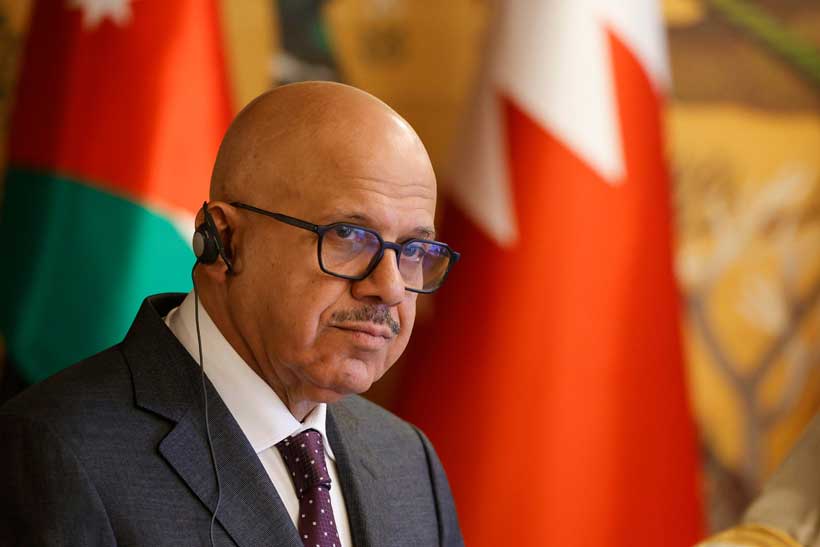
The Gulf is the region’s most serious security crisis in decades, Bahrain’s Foreign Minister Dr. Abdullatif bin Rashid Al Zayani said during his address to the 81st UN General Assembly. However, it should have been a wake-up call to all the others. Other theaters of conflict have monopolized global attention for months, and the constant degradation of maritime security in the Gulf, the Strait of Hormuz, Bab Al-Mandab, the Gulf of Aden, and the Red Sea has been considered background noise instead of the systematic problem that it is. This is a scale that Bahrain described cannot be overstated.
The latest series of incidents blamed on Iranian and regional groups has led to the seizure of some 2,000 merchant vessels, the damage of 72 merchant ships, and the loss of life of at least 22 sailors on shipping routes in the Gulf, according to figures cited by the UN. These are not numbers in a report by an insurance company or shipping company’s newsletter. They are an attack on one of the world’s single largest economic routes, on which a substantial portion of the world’s energy supplies and trade transits every day.
The remarkable aspect of Bahrain’s intervention is not just the harshness of the language, however, but the standpoint from which the language was spoken. Bahrain is currently the Chair of the Gulf Cooperation Council and is one of the top voted states for election to the UN Security Council (2026-2027) with 186 votes. Not a voiceless state! It’s a small kingdom that knowingly acted to push the unwilling international community to take on the responsibility for Gulf maritime security as a shared or collective issue, instead of a regional pestilence.
Gulf security and UN credibility on a test case
Stay ahead of the geopolitical week.
MD Briefing delivers expert analysis across five global fronts — the Indo-Pacific, energy, geoeconomics, European security, and the Middle East — every Monday morning. Free.
But one thing in particular stands out about Al Zayani’s framing: He said that the disruption of waterways in the Gulf is not just a “security issue” for coastal states but an attack on an “artery of development” through which food, medicine, and energy for whole nations travel. This is an important point and one that is frequently overlooked from the Western perspective about the Gulf crisis. The standard scenario portrays the Strait of Hormuz crisis as an energy-price issue, one that oil traders and central banks will figure out the inflation risk. The minister instead called it a humanitarian and development one, noting that the price of disruption is being paid by the common people of other nations, not even on the borders of the Gulf.
This rephrasing is a diplomatic issue. It moves the debate away from a myopic regional conflict between the Arab states in the Gulf and Iran to a universal principle that should bring together the whole of the UN membership: Freedom of navigation, which is safeguarded under the UN Convention on the Law of the Sea. This is a precedent that eats away at the foundation of rights in the busiest waterway in the world, and there’s nothing more fundamental. It has conveyed to all maritime choke points that international law can be negotiated if the military pressure is enough, from the South China Sea to the Bosphorus.
The submission of the draft Security Council resolution by Bahrain to implement Chapter VII of the UN Charter, which aims to safeguard commercial navigation, hold perpetrators to account, and provide compensation for damage, is precisely the argument the Bahrainis have tried to put forward. The selection of the chapter is important. Unlike Chapter VI resolutions for peaceful dispute resolution, Chapter VII resolutions have binding enforcement power, in principle. Bahrain is essentially asking the Security Council to take the crisis in the Strait of Hormuz seriously, as a threat to international peace and security and not just a regional issue, that can be dealt with diplomatically at arm’s length.
The resolution’s limits, where no implementation exists.
However, Al Zayani himself provided the straightest answer regarding the reasons for why this may still be a losing strategy. In his closing remarks to the UN, he said what is needed is “not more resolutions, but a greater capacity to implement them. It’s an unusual admission from a current foreign minister, and it’s a quiet criticism of the failures of the Security Council in the region in several recent efforts. After all, the GCC’s experience in the region’s security has already been recognized by the Council in a presidential statement, and resolutions have been penned before, such as Resolution 2817 (2026).
The gap that has always existed, however, is not in terms of a legal framework but rather in political will or enforcement. Whereas, the lack has always been in political will or enforcement capacity where a permanent member’s interest, or an ally’s, is complicated by consensus. The uncomfortable secret hidden under the current crisis in the Gulf is that there is plenty of international law to allow anyone to declare an attack on commercial shipping to be unlawful, but little that can force an actor that is determined to use maritime disruption as a weapon to comply. Sanctions have not proven to be a strong deterrent. Naval escort missions, although they may trivialize the tactical situation, won’t settle the issue of “basis of the conflict” underlying the attacks. However well-intentioned and robustly structured the Security Council’s resolution might be, it is worth nothing if its member nations are not prepared to follow through on any of its sanctions against a party with whom they are simultaneously negotiating on another track, nuclear arms control or de-escalation talks in their region, for example.
Arkansas’s economic problems are not confined to the Gulf. The economy of Arkansas is not limited to the Gulf. Often the conundrum of Gulf security is viewed as something that occurs regularly in the region (serious but manageable, and someone else’s problem). This complacency is unwarranted for the following reasons: First, the economic exposure truly is global. Disruptions to the shipping lanes through the Persian Gulf and Red Sea are not just a regional affair but affect global energy pricing, shipping insurance, and food security calculations for import-reliant countries well away from the Gulf, such as in South Asia and sub-Saharan Africa.
Second, Bahrain’s correlation between the traditional security issues of the sea and “emerging challenges” (which officials have not specified but likely refers to threats to port infrastructure and navigation systems via cyber means) points toward a changing threat landscape that traditional international laws and instruments don’t necessarily cover.
Third, and most significant, the ‘precedent question’ is not to be overlooked. The international community should not be able to negotiate the right of access to its most highly used and legally clear waters or weaken the norms of maritime law everywhere else it is tested. Bahrain’s foreign minister ended his speech to the UN by not only issuing a warning but also a self-revelation, too.
The credibility of the whole multilateral system is being tested, not only the security architecture of one region. If the Security Council acts in the manner in which Chapter VII suggests, or if it issues yet another statement of concern with no capacity to implement, it will tell a great deal about the future of the post-war international order’s ability to protect the principles upon which it was established.