Two Documents, One Winter
On 25 September, EU Energy Commissioner Dan Jørgensen wrote to every member state warning of “a price crisis linking to a supply crisis”. His remedies read like a 2022 revival: keep injecting gas into storage, shave electricity use at peak hours, cool public buildings, and switch off unnecessary public lighting at night. Three days earlier, Donald Trump had said he backs a ban on US diesel exports: “I’ve called for it.” Treasury is studying a full or partial ban, and the President promised a decision “fast, one way or the other.”
Only one of those two documents describes Europe’s real problem this winter. It is not the letter from Brussels.
One Fuel Then, Three Pressure Points Now
Stay ahead of the geopolitical week.
MD Briefing delivers expert analysis across five global fronts — the Indo-Pacific, energy, geoeconomics, European security, and the Middle East — every Monday morning. Free.
Europe’s 2022 crisis had one cause and one fuel. Russia cut pipeline gas; Brussels answered with a storage-filling mandate, a voluntary 15% gas demand cut and, later, joint purchasing. It worked. EU gas consumption fell 17.7% between August 2022 and March 2023, and the continent got through without rationing.
The 2026 shock is wider. Since US and Israeli strikes on Iran on 28 February, the Strait of Hormuz has been largely shut, a story MD has tracked as it flipped the energy security debate. Iran’s March strike on Ras Laffan took out 17% of Qatar’s LNG capacity for up to five years. The Houthis have closed the Bab el-Mandeb, the southern exit of the Red Sea, to Saudi tankers. Brent closed last week at $104. Gas is dear, but the sharpest pain is in diesel: the northwest European benchmark hit a record $1,642 a tonne on 15 September.
Right Playbook, Wrong Fuel
The instinct in Brussels is to treat this as 2022 with a different villain. That is the mistake. The 2022 tools were built for a volume problem in one fuel, caused by one supplier who could be replaced. None of those three conditions holds now, and each tool fails for a specific reason.
Storage targets now bid against Asia. EU gas storage was 65.4% full on 1 September, the lowest for that date since records began in 2011, and the Commission has already quietly accepted an 80% goal instead of the usual 90%. Pushing injections harder in a market that has lost a sixth of Qatar’s output does not create gas. It raises the price Europe pays to take cargoes from Japanese, Korean and Chinese buyers. In 2022, weak Chinese demand during lockdowns left spare LNG for Europe to buy. This year it doesn’t exist.
Demand restraint targets the wrong molecules. The 15% gas cut worked because industry and power plants could switch fuels or idle, and households could turn down thermostats. Diesel does not bend like that in the short run. Lorries, tractors, construction sites and backup generators cannot use less without doing less. The Commissioner’s letter does not mention diesel at all. Where governments have tried to manage fuel prices directly, it has backfired: Slovenia’s price caps drew in cross-border buyers until the government imposed a 50-litre daily limit on motorists in March.
Joint buying has no one to negotiate with. Even for gas, the Oxford Institute for Energy Studies found no evidence that AggregateEU secured lower prices; it matched buyers and sellers, and that was all. Refined oil products trade in a deep, global market priced off public benchmarks. A European buyers’ club would simply bid up the same cargoes Latin America and Africa need. And the swing supplier is not a hostile state to be replaced but a friendly one that may stop selling.
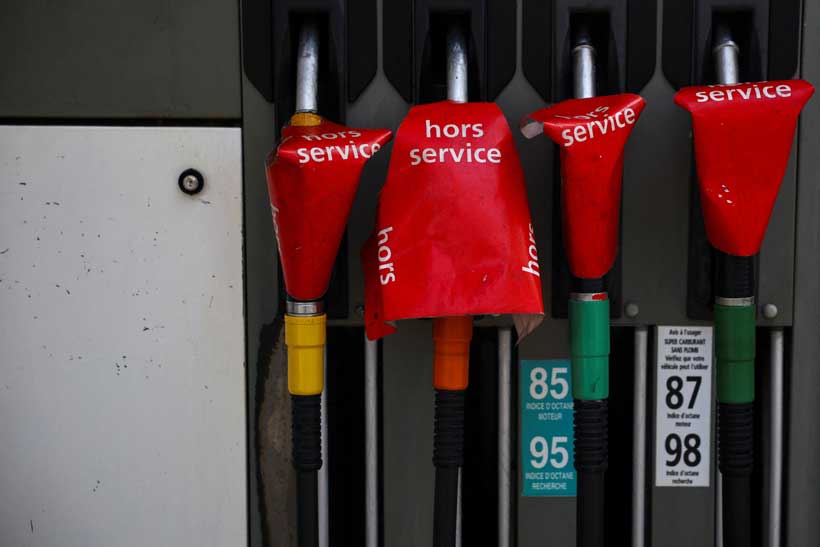
That is the heart of the problem. Europe is structurally short of diesel. It lost more than 370,000 barrels a day of refining capacity in 2025 alone, stocks in the Amsterdam-Rotterdam-Antwerp hub are at a four-year low of about 12 million barrels, and Russia has extended its diesel export ban through October. With Gulf and Indian cargoes cut off from the Suez route, Europe’s nearest swing supplier is the US Gulf Coast. A ban there would, as analysts told Axios, lower US prices briefly and raise them almost everywhere else, from Mexico to Germany.
The strongest objection is that gas, not diesel, is the bigger threat to households and industry. TTF, the main European gas price, is at €72/MWh with analysts warning of €100 in a cold snap. But governments can soften gas bills with regulated tariffs and targeted support, as they did in 2022. Diesel works differently: it runs through freight, food and farming into everything else. Energy inflation in the euro area reached 14.3% in August, pushing headline inflation to 3.2%. Gas prices are set by a global LNG market Europe cannot fix alone. Diesel is the one market where Europe has a direct lever of its own.
The lever is Europe’s own emergency oil stocks. EU rules require countries to hold at least 90 days of net imports or 61 days of consumption. In March, IEA members in Europe committed 107.5 million barrels to the agency’s record 400-million-barrel release, and 72% of the global total was crude. Crude is the wrong medicine for a continent short of refineries. What Europe needs now is a pre-announced, diesel-heavy release drawn mainly from industry-held stocks and phased over December to February. Announcing it matters as much as the barrels: the ARA diesel crack, the premium over crude, stood at $85 a barrel in mid-September because traders are pricing a winter scramble. A credible release schedule takes that premium out of the price. It is also the only tool on the list that does not depend on Tehran, the Houthis or Washington.
The obvious risk is running down the buffer if Hormuz stays shut into 2027. But the stocks exist for exactly this kind of known, seasonal peak, and the Commission is already rewriting the oil stocks rules, with a proposal due in Q4 2026. That rewrite is the place to require replenishment and a higher share of refined products.
Three Ways the Winter Breaks
Base case (around 55%): an expensive winter without shortages. Hormuz talks grind on with a partial reopening by year-end, and Washington stops short of a full diesel export ban, perhaps settling for licensing or partial limits. Brent holds between $95 and $110, European diesel stays above $1,400 a tonne and TTF trades between €70 and €90. Europe avoids physical shortage but pays for it in sticky inflation, leaving the ECB little room to cut. The key assumption is that US restrictions remain partial.
Downside (around 25%): the swing supplier disappears. Trump imposes a full diesel export ban before the 3 November midterms, while the Houthis keep the Bab el-Mandeb closed to Saudi cargoes, a threat MD has examined in its analysis of whether Saudi Arabia’s new allies can contain the Houthis. Mediterranean and northwest European diesel spike well past September’s record, Slovenia-style limits spread, and hauliers and farmers protest. Without a stock plan in place, governments reach for fuel-tax cuts that add demand to a market already short of supply. Logistics, agri-food and chemicals would feel it first.
Upside (around 20%): a Gulf deal that fixes crude but not diesel. A US–Iran round in Oman produces a deal within weeks, Hormuz reopens and Brent falls below $90. Even then, diesel lags: the refining deficit and Russia’s export ban do not disappear with the tankers. The upside is cheaper crude, not cheap diesel, which is why a product-heavy stock release is the right move in all three scenarios.
The Tank That Matters
Europe is preparing to fight the last war with the last war’s tools. Storage mandates, demand pledges and joint buying beat a single hostile gas supplier in 2022. This winter they will mostly bid against Asia, ask the wrong consumers to cut back, and look for a negotiating partner who does not exist. The shortage that will hurt is diesel, and Europe holds the one instrument that can blunt it: its own emergency stocks, released in products rather than crude, and announced before the market panics rather than after.
Watch for Trump’s decision on diesel exports, which he has promised will come “fast.” If a ban lands before European capitals have committed to a stock plan, this argument will be tested in the worst possible way.
In 2022, Europe won by storing gas. This winter, the fuel that matters is sitting in diesel tanks the Commissioner’s letter never mentioned.