For decades, the assumption underpinning global diplomacy was simple and that was when great powers clash, smaller and mid-sized states eventually have to pick a side. But this assumption is breaking down. From Jakarta to Riyadh, from Brussels to New Delhi, governments are openly rejecting the binary of Washington versus Beijing and instead building foreign policies designed around one goal which is flexibility. This flexibility is strategic autonomy, and it is no longer the preserve of a few non-aligned holdouts. It is fast becoming the default posture of the international system.
The Data Behind the Shift
The clearest evidence of strategic autonomy is visible in Southeast Asia, a region sitting directly in the crosshairs of US-China rivalry. The ISEAS-Yusof Ishak Institute’s State of Southeast Asia 2026 survey found that most respondents across the region do not want to be forced into choosing between major powers Around 24.1 percent of total respondent supports the position of not siding with any of the superpower while only 6.3 percent believes in choosing a side. They even acknowledged that maintaining this balance is becoming harder every year.
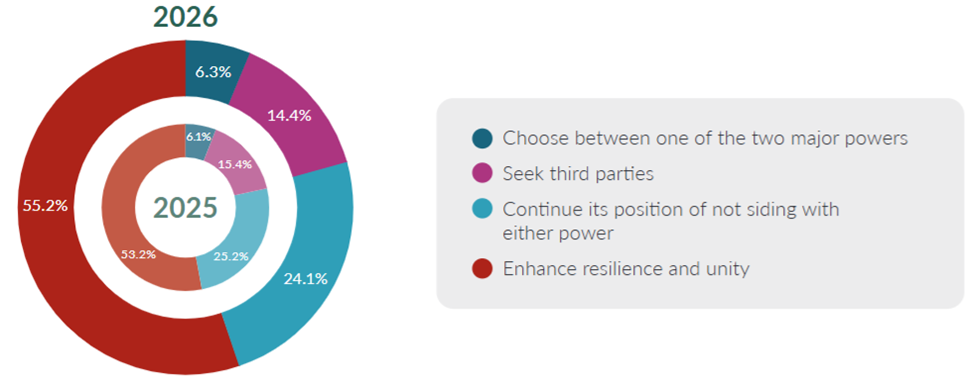
Source: ISEAS-Yusof Ishak Institute
Stay ahead of the geopolitical week.
MD Briefing delivers expert analysis across five global fronts — the Indo-Pacific, energy, geoeconomics, European security, and the Middle East — every Monday morning. Free.
A companion finding from the same institute’s research shows just how volatile allegiance has become. Trust in China rose by 11.8 percentage points in a single year. Still, slightly more than half of ASEAN-10 respondents expressed more distrust than trust in China.
This is not confined to Southeast Asia. A January 2026 analysis by the Institute for Economics & Peace examined how middle powers such as Indonesia and Saudi Arabia are deepening economic ties with China while deliberately avoiding full realignment. Indonesia illustrates this well as between 2014 and 2023 it received 149 military systems from China, including missiles, drones, and radar technology, and in 2025 it agreed to buy 45 fighter jets from China, its first major non-Western defense procurement. On the other hand it has continued receiving nearly two dozen separate arms packages from the United States since 2014. That is diversification, not defection.
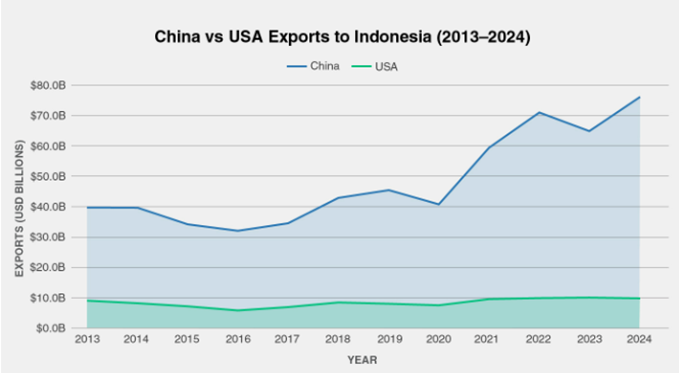
Source: Vision of Humanity
Middle Powers are Building Coalitions, Not Just Hedging Bilateraly
What distinguishes this new wave of strategic autonomy from older forms of non-alignment is that middle powers are no longer hedging in isolation, they are hedging together. Asia Society’s 2026 policy analysis notes that Japan, Australia, South Korea, Indonesia, and India have built new intraregional cooperation mechanisms largely as insurance against both American retrenchment and Chinese assertiveness. The same analysis points to British Prime Minister Keir Starmer’s January 2026 visit to Beijing, the first by a UK premier since 2018, as evidence that even close US allies are pursuing “practical resilience” through diversification rather than exclusive alignment, particularly in energy transition technologies and critical minerals where dependence on China remains structurally entrenched. Canadian Prime Minister Mark Carney’s diplomatic itinerary across Australia, India, and Japan reflects a parallel effort to knit together a coalition of middle powers with combined strength in critical minerals, advanced energy, and AI research capacity.
This coalition logic was echoed publicly even inside China. At Tsinghua University’s World Peace Forum, Peking University professor Jia Qingguo argued that during a period of bipolar strategic competition between Washington and Beijing, it is wiser for middle powers not to take sides, a view he offered alongside other speakers who urged smaller and mid-sized states to band together in pursuit of more diversified partnerships. That such a position is being aired in Beijing, and not only in Brussels or New Delhi, underscores how mainstream the logic of autonomy has become.
Technology and Trade are the New Battlegrounds for Autonomy
Strategic autonomy in 2026 is not only about diplomacy and alliances; it increasingly runs through supply chains, semiconductors, and artificial intelligence. Taiwan’s TSMC controlled 66 percent of global foundry capacity in 2025, a concentration that has turned the island into one of the most consequential leverage points in the entire US-China rivalry and a magnet for the strategic anxieties of nearly every technologically dependent state. It is also visible that America’s 2025 National Security Strategy and 2026 National Defense Strategy reframed US foreign policy around industrial capacity and control of strategic value chains, explicitly signaling that alliances will now be treated as more transactional and conditional.
Artificial intelligence has become the sharpest edge of this contest. A study conducted by Chatham House and published in February 2026 reveals the extent of the AI gap between the US and China as the private AI funding for the US reached $109.1 billion in 2024 as opposed to China’s $9.3 billion. This leaves most other countries in a position where they do not have the financial muscle or computing power to go head-to-head with these two nations. Instead of being forced into submission into either of the AI ecosystems, the same study explains that middle powers are adopting sovereign AI strategies.
A Structural Trend, Not a Passing Phase
All of this indicates that it is not an interim response resulting from just one particular crisis but rather reflects the restructuring towards an actual multipolar world. Scholarly works analyzing hedges reveal that the process has been spurred by Russia’s invasion of Ukraine in February 2022, when second-tier states in different regions began to interact with all of the great powers without relying on any of them too much. What began as a security response to one conflict has since metastasized into a template applied to trade, technology, and defense procurement alike.
For policymakers in Washington and Beijing, the lesson is uncomfortable: loyalty can no longer be assumed, and coercion is increasingly counterproductive. For the middle powers, the swing states, the diversifying economies, the message is that flexibility itself has become a form of power. In a world where alliances are transactional and technology is contested, refusing to choose is no longer a sign of weakness. It may be the smartest strategy on the table.