


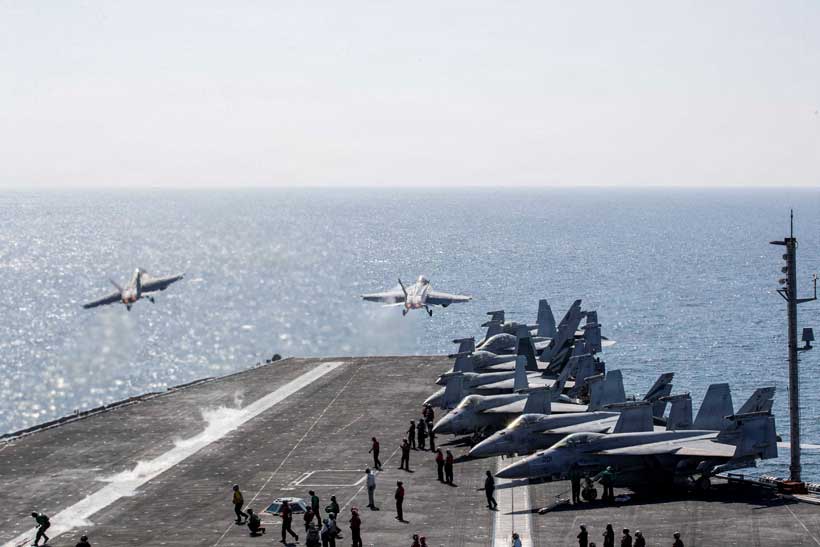
The United States and Iran traded new attacks overnight into Thursday, intensifying an exchange that has threatened the collapse of their agreement to end the war. According to President Trump, the ceasefire between the United States, Israel and Iran was “over.”
The deadly exchanges included reported U.S. strikes against Iranian military-related targets, Iranian retaliation against U.S. interests and regional partners, and continued Israeli military operations.
It’s a familiar pattern in U.S./Israel-led regional conflicts. Ceasefires may temporarily interrupt hostilities, but absent an accompanying political framework they fail to resolve the structural drivers of conflict.
The renewed confrontation has expanded beyond the bilateral U.S.-Iran relationship. It now intersects with Israel’s continuing military operations, the Gaza genocide, ethnic cleansing in the West Bank, lethal tensions in Lebanon, persistent unease in Syria, Jordanian balancing between adversaries, Iraqi efforts to avoid being dragged in an economic abyss, the Gulf countries’ disrupted security and broader regional security rivalries.
Stay ahead of the geopolitical week.
MD Briefing delivers expert analysis across five global fronts — the Indo-Pacific, energy, geoeconomics, European security, and the Middle East — every Monday morning. Free.
Rather than isolated crises, these theatres increasingly form an interconnected strategic landscape in which developments in one arena quickly reverberate across others.
Israel’s continuing campaign
Since the June ceasefire, the Netanyahu government has publicly reaffirmed its commitment to maintaining military pressure against Iran. Prime Minister Netanyahu absolutely needs strategic tension at the eve of the fall election.
As a result, Israeli leaders argue that previous operations significantly degraded Iran’s military capabilities while emphasizing that continued vigilance remains necessary to prevent their reconstruction. Read: only the Obliteration Doctrine can finish the job.
This declared policy extends beyond Iran itself. Israeli operations have continued in Gaza, southern Lebanon and, periodically, Syria, reflecting a security doctrine that views these fronts as strategically interconnected rather than separate conflicts.
Rather than viewing Gaza, Lebanon and Iran independently, Israeli strategic planning increasingly treats them as components of a single security environment – essentially, a recast Greater Israel vision – shaped by deterrence, military superiority and the perceived need to prevent hostile capabilities from emerging across multiple fronts.
Over time, this strategy has no future. While military operations may reduce immediate threats, they also increase the probability of regional retaliation, strengthen incentives for asymmetric responses and complicate diplomatic initiatives.
Military success on individual battlefields does not translate into durable regional stability.
One regional theatre, not separate wars
The conflicts stretching from Gaza to Iran increasingly resemble a single regional security system rather than discrete wars.
In Gaza, military operations continue amid an ongoing humanitarian crisis. But neither Palestinian genocide nor the West Bank’s settler violence and ethnic cleansing is any longer considered newsworthy.
Along Israel’s northern frontier, exchanges with Hezbollah and operations in southern Lebanon remain volatile. Meanwhile, Israeli mass atrocities and bombardments have displaced over 20% of Lebanon’s population.
Yet, Gaza and Lebanon are barely reported in Western media any longer. When mass atrocities become daily staple, they’re no longer news.
Syria continues to serve as a theatre for strikes targeting military infrastructure associated with Iran and allied groups, with Israel’s incursions into the Quneitra and Deraa provinces, presumably to search civilians.
Caught in the crosshairs, Jordan is scrambling to intercept hundreds of missiles and drones aimed at U.S. and Israeli targets.
As bases housing U.S. troops in Iraq are frequently targeted by Iranian-aligned non-state militias, Iraqi officials can only condemn U.S. strikes on Iraqi soil as a violation of sovereignty. Local citizens bear the brunt of violence. Direct military exchanges between Israel, the U.S. and Iran have moved beyond the proxy confrontations that characterized much of the previous decade.
These theatres are linked through overlapping military deployments, intelligence networks, missile capabilities, logistics corridors and alliance structures. Decisions taken in one arena now have immediate consequences elsewhere.
Strategic costs of escalation
This regionalization also alters strategic calculations. States increasingly evaluate military operations not solely in terms of local objectives but also their implications for deterrence across the wider Middle East.
Paradoxically, escalation risks, which should be reduced and marginalized, have become cumulative rather than isolated – which means that they are being amplified and compounded.
The consequence is a conflict system whose boundaries continue to expand geographically while becoming progressively more difficult to compartmentalize or contain.
Renewed hostilities carry consequences extending well beyond the battlefield. Military expenditures likewise continue to rise as regional governments devote additional resources to missile defense, intelligence, naval deployments and force readiness.
Such expenditures inevitably compete with (and over time, crowd out) longer-term investments in infrastructure, education and economic diversification.
These economic consequences are not confined to the Middle East. Higher transportation costs, volatile energy prices and increased geopolitical uncertainty affect inflation, financial markets and global growth prospects.
As previous periods of regional instability have demonstrated, the cumulative economic burden of sustained military confrontation frequently exceeds the immediate physical destruction associated with individual military operations.
Economic costs of energy shock, food security
The Middle East remains central to global energy markets, maritime commerce and international investment flows. Consequently, even limited disruptions around the Persian Gulf and Strait of Hormuz influence shipping costs, insurance premiums and commodity prices.
Investors typically respond by increasing risk premiums while delaying investment decisions amid heightened uncertainty.
Unlike previous regional crises, the current conflict directly involves the world’s principal energy chokepoint—the Strait of Hormuz—through which roughly one-fifth of globally traded crude oil and a significant share of liquefied natural gas (LNG) exports transit.
Even absent a sustained closure, heightened military risks can raise insurance costs, reroute shipping and increase market volatility.
Under a contained conflict scenario, crude oil prices could remain in the US$85-100 per barrel range.
However, any prolonged disruption to Gulf shipping or energy infrastructure could push prices toward US$110-140. At the same time, an extreme scenario involving significant interruption of Hormuz traffic could temporarily drive prices above US$150, even if strategic reserves moderate the shock.
Natural gas markets—particularly in Europe and Asia—would experience parallel upward pressure through LNG supply constraints and higher transport costs.
Heaviest burden in the Global South
The implications extend far beyond energy. Higher fuel prices increase fertilizer production costs, transportation expenses and irrigation costs, placing additional pressure on global food systems.
Low-income food-importing countries in North Africa, Sub-Saharan Africa and parts of South Asia would face renewed import inflation, deteriorating balance-of-payments positions and heightened fiscal stress.
Countries already affected by conflict, drought or debt distress would be especially vulnerable. Such indirect consequences often persist long after military operations themselves have subsided.
Whether viewed through legal, humanitarian or strategic perspectives, the cumulative effect is growing pressure on norms that have traditionally governed the conduct of armed conflict.
The renewed U.S.-Iran confrontation, together with Israel’s continuing regional military campaign, spread corrosive damage across the region.
As economic risks accumulate alongside humanitarian pressures, the space for negotiated political settlements narrows.
*Author’s note: The original commentary was published by the Informed Comment (US) on July 10, 2026
