


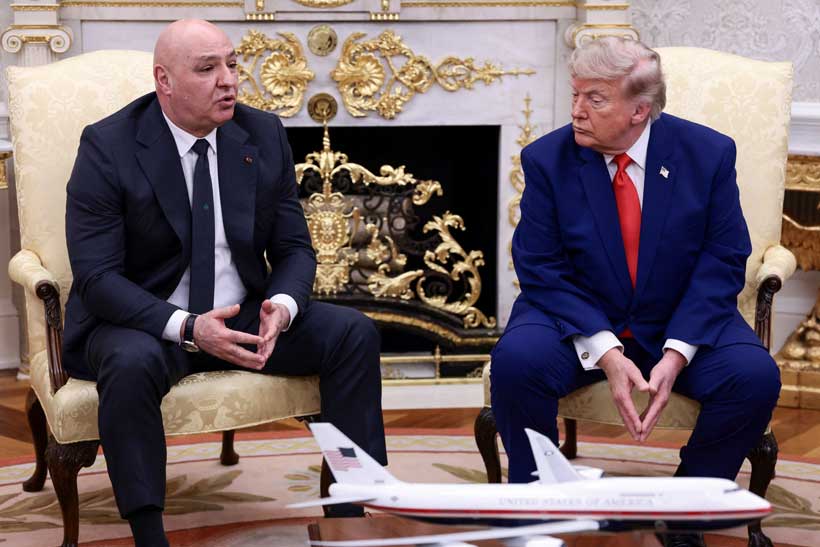
Chinese intelligence, military, political, and strategic circles analyzed and assessed the significance of the meeting between US President Donald Trump and his Lebanese counterpart, President Joseph Aoun, at the White House on Tuesday, July 21, 2026. These circles in Beijing viewed the meeting as a form of great power struggle or great power polarization. China believes that Washington is attempting to use its influence in Lebanon and the Middle East to undermine Beijing’s efforts to build a multipolar world order. Consequently, any political development in Lebanon that serves the interests of the Western and American axis is considered a direct challenge to Chinese security and strategic interests in Lebanon, the Levant, and the Middle East. This is especially true given the apparent US rapprochement with Lebanon, which included offering numerous concessions, such as Trump’s statement that the US is prepared to assist Lebanon, including reviewing the progress of the Lebanese army in securing villages in the experimental zones following the Israeli withdrawal and addressing the issue of Hezbollah, while also expressing the US administration’s willingness to engage in dialogue with Hezbollah. This was followed by an announcement from US President Trump on social media that he plans to reinstate direct flights to Lebanon by all US airlines. If this plan comes to fruition, it will be the first time in over 40 years that direct flights between the two countries will resume. With US President Donald Trump’s announcement that his administration has officially directed American airlines to resume direct flights to Lebanon, ending a ban that lasted more than 40 years since the hijacking of TWA Flight 847 in Lebanon in 1985.
In this context, Chinese intelligence circles view Lebanese President Joseph Aoun’s visit to the White House as a fundamental strategic shift. According to analyses by Chinese think tanks and intelligence agencies, this move aims to strengthen Lebanese state institutions and the army, enabling them to extend their sovereignty, undermine Hezbollah’s influence, and work towards establishing a sustainable settlement with Israel under US auspices. This visit has emerged as a significant strategic shift, according to Chinese political and diplomatic circles, for several reasons, including the US desire to activate a settlement on the ground. Joseph Aoun’s official visit to Washington coincided with the Lebanese army’s deployment in the experimental zones from which the Israeli army withdrew. In southern Lebanon, this marks the first practical test of the framework agreement signed under US auspices. The agreement aims to ensure the gradual withdrawal of Israeli forces from towns in southern Lebanon. From a Chinese perspective, this move also aims to undermine the influence of Tehran and Hezbollah. According to Chinese analyses, the US administration seeks to establish the Lebanese Armed Forces as the sole armed force in the country, amidst ongoing efforts to dismantle Hezbollah’s military infrastructure and remove it from the security landscape in southern Lebanon. Furthermore, these US moves and tactics in Lebanon, according to Chinese political and intelligence analyses, aim at regional repositioning. This means that these US steps coincided with ongoing tensions and military escalation between the United States and Iran, the escalation of the Strait of Hormuz crisis, and the commencement of new US military strikes against Tehran, despite Pakistani mediation efforts supported by China. This situation is prompting Washington to bolster the role of legitimate governments in the frontline states to reduce the sphere of influence of both Iran and China, according to assessments by Chinese intelligence circles.
In this context, Chinese intelligence circles view Lebanese President Joseph Aoun’s visit to the White House and his meeting with US President Donald Trump through a strategic lens in Beijing. They see it as a tactical shift by the US towards bolstering the influence of the official Lebanese military establishment, isolating Tehran by undermining Hezbollah’s control, and establishing a settlement with Israel under Washington’s auspices. This could even be a future step towards Lebanon joining the Abraham Accords with Israel, also under US auspices. Chinese analytical centers are monitoring the dimensions of this rapprochement and the developments in the Lebanese situation as an attempt to isolate Iranian influence. Chinese circles believe that the US administration is trying to repeat previous scenarios to contain regional chaos by relying on the Lebanese army as the sole force in control. From China’s perspective, Trump, through this support, seeks to weaken the resistance axis against Israel and Washington, which is backed by Tehran, especially given the outbreak of a wider conflict between the United States and Iran, making the neutralization of Lebanon a valuable bargaining chip. Here, Chinese strategists view the deployment of the Lebanese army in the experimental zones, areas of Israeli withdrawal, and the Lebanese army’s subsequent control of all villages within these zones as a sensitive field test. This is especially true given that the Lebanese army’s success in asserting its sovereignty would represent a diplomatic and political victory for the United States, contributing to what Trump termed his peace legacy, while failure could reignite a civil war or lead to a new escalation.
Chinese think tanks, military intelligence, and political and strategic think tanks are analyzing this American pragmatism, exemplified by the offer of dialogue with Hezbollah. They are also examining the extent to which Trump’s willingness to negotiate directly with Hezbollah—at the request of Lebanese President Joseph Aoun—has piqued Beijing’s interest. This reflects Trump’s pragmatic deal-making mentality, which does not exclude adversaries when it serves American interests, achieves desired stability, or paves the way for ending the crisis. Therefore, relevant circles in Beijing analyzed the significance of US President Trump’s announcement of the resumption of direct flights between Lebanon and the United States as a tool of soft power. The Chinese view the decision to resume direct flights by American airlines (a measure suspended since the TWA plane crash of 1985) as a strategic step to connect Washington with the Lebanese diaspora and support the collapsing Lebanese economy through tourism and investment. Beijing considers this move a form of American soft power to align Lebanese interests with the West and reduce the room for maneuver for any Eastern influence, such as potential Chinese investments in Lebanon’s energy and infrastructure sectors.
Stay ahead of the geopolitical week.
MD Briefing delivers expert analysis across five global fronts — the Indo-Pacific, energy, geoeconomics, European security, and the Middle East — every Monday morning. Free.
For this reason, Chinese intelligence circles analyzed the political and strategic dimensions of the American decision to resume direct flights with Lebanon. Although the current American administration markets the decision as a step to support the Lebanese economy and facilitate communication between the Lebanese diaspora and expatriate communities in North America and their homeland, Chinese diplomatic circles and strategic analysis centers view this step with deeper dimensions, including the American desire to support the legitimacy of the Lebanese state. The step is seen as direct American support and a political reward for Lebanese President Joseph Aoun and his institutional legitimacy, coinciding with the implementation of the Framework Agreement and efforts to extend the sovereignty of the Lebanese army exclusively over Lebanese territory and disarm Hezbollah militias and other militias and movements allied with it. This move also aims to undermine regional influence from Iran and Eastern powers like China in favor of Washington and the West. The resumption of flights between Washington and Beirut represents an expansion of US economic influence in Lebanon, a new strategy by Washington to integrate Beirut into the Western system and curb the growing Iranian and Chinese influence in the Eastern Mediterranean. It also carries security and political weight for China, reflecting Washington’s desire to send a message of international confidence in the infrastructure and security of Beirut International Airport, despite the ongoing challenges of the regional conflict stemming from the Iran war and the Strait of Hormuz crisis.
On the other hand, Chinese intelligence circles have analyzed the current technical obstacles that could hinder the full resumption of direct flights between Lebanon and the United States. Despite Washington’s political decision to resume direct flights, the actual implementation of these flights, according to Chinese analyses, still faces obstacles that will require time to overcome. These include a security review, as the actual commencement of full direct flights between Lebanon and the United States necessitates a rigorous technical review and assessment, as well as a comprehensive audit by the US Federal Aviation Administration (FAA) of safety procedures at Beirut Airport. This is in addition to the US travel warnings still in place, advising its citizens against traveling to Lebanon, which remains classified as a high-risk area. The US State Department continues to maintain Lebanon at Level 4 of its travel advisory (Do Not Travel) due to ongoing regional tensions. In addition to the primary reason for the reluctance of American companies themselves to resume direct flights to Lebanon, none of the major American airlines, such as American Airlines and Delta, have announced flight schedules. This is especially true given that some of them have suspended flights to neighboring destinations in the region for security reasons, primarily due to the Iran War.
Based on the preceding analysis, we conclude that the relevant intelligence and strategic circles in China consider the American arrangements in Lebanon to be part of a convergence of interests that Washington seeks to coordinate or neutralize with regional powers, such as Iran and its allies, and China in particular. Therefore, China views this American-Lebanese rapprochement as an extension of American hegemonic policies aimed at containing Chinese influence and preventing Lebanon from participating in China’s Belt and Road Initiative. Lebanon’s geographical location on the Mediterranean coast is considered by China to be a vital link in the Chinese Silk Road. Therefore, Beijing fears that US diplomatic pressure could force the Lebanese government to reject Chinese investments, thus disrupting China’s plans for commercial expansion in the Levant and limiting its economic influence in Lebanon. This is especially concerning given that China is Lebanon’s most prominent trading partner, and the financial influence of the United States, particularly the complete dominance of its institutions over the Lebanese banking system, prevents Beirut from establishing full economic partnerships with Beijing for fear of incurring US sanctions.
