


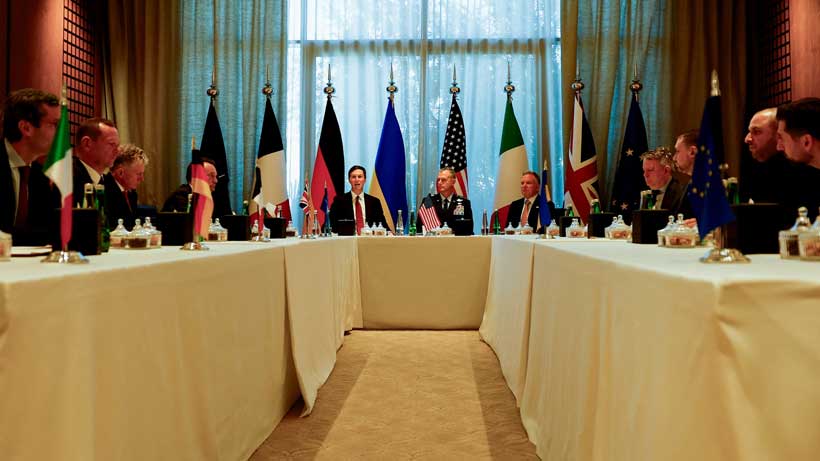
Russian, Ukrainian and US officials have entered a second day of peace talks in Abu Dhabi, but despite positive assessments from Washington and Kyiv, there is little public evidence that the negotiations have brought the two sides closer to ending the war. Fundamental disagreements over territory, Ukraine’s future security and Russia’s demands for a broader European security arrangement continue to complicate efforts to reach a settlement.
The meetings, which resumed on Wednesday, represent the latest US-led attempt to secure an agreement after more than four and a half years of Russia’s full-scale invasion. However, the absence of visible compromises and continued attacks on both sides suggest that diplomatic progress remains fragile.
What Is Being Discussed in Abu Dhabi?
Ukraine’s chief negotiator, Rustem Umerov, confirmed that the second day would begin with trilateral discussions involving Russia, Ukraine and the United States. A separate meeting with European partners was also planned.
Ukrainian President Volodymyr Zelenskyy described the first day of discussions as substantive, saying humanitarian and security issues had been addressed. He also indicated that the possibility of a summit involving the Russian, Ukrainian and US presidents could be discussed.
Stay ahead of the geopolitical week.
MD Briefing delivers expert analysis across five global fronts — the Indo-Pacific, energy, geoeconomics, European security, and the Middle East — every Monday morning. Free.
US Secretary of State Marco Rubio characterised the opening day as very productive, although neither Washington nor Kyiv disclosed specific agreements. The second day is the final one currently scheduled for the meetings.
The talks are particularly significant because they mark the first direct negotiations between Russian and Ukrainian representatives since February. Yet the two sides entered the discussions with sharply different expectations, and no early breakthrough has emerged.
Territory and Security Remain the Biggest Obstacles
The central challenge is that Moscow and Kyiv continue to disagree over the basic terms of a possible settlement.
Russian forces control approximately one-fifth of Ukrainian territory. Moscow has maintained its demand for Ukraine to surrender the entire eastern Donbas region before a peace agreement can be reached. Zelenskyy has repeatedly rejected giving up territory that Ukrainian forces have fought to defend.
Security guarantees present another major obstacle. Both sides want assurances about their future security, but their preferred arrangements are fundamentally different. Russia has demanded that Ukraine adopt neutral status and abandon its ambition to join NATO, while Kyiv has sought guarantees that would prevent another Russian invasion.
These disagreements go beyond the question of where a future ceasefire line might be drawn. They concern Ukraine’s sovereignty, its ability to determine its own security partnerships and the broader European security order.
Continued Attacks Undermine Diplomatic Progress
The negotiations have proceeded alongside renewed reports of attacks on both countries, highlighting the difficulty of separating diplomacy from the continuing military confrontation.
Ukrainian Prime Minister Sergii Koretskyi said Russian forces had struck six major electricity substations across four central regions of Ukraine. Energy company Naftogaz also reported that Russian jet drones had hit one of its facilities in the eastern Dnipropetrovsk region, causing a fire and damaging equipment.
In Russia’s Smolensk region, drone debris reportedly struck an apartment building and killed two people, according to the TASS news agency, citing the regional governor.
Russia’s Defence Ministry separately claimed that its forces had struck a cargo vessel in the Black Sea, southwest of Odesa, which was allegedly carrying weapons and military equipment for Ukraine’s armed forces. These battlefield reports could not be independently verified.
The continued targeting of energy infrastructure and other strategic assets reinforces the uncertainty surrounding the negotiations. Even as officials discuss a possible settlement, neither side appears to have suspended its military operations.
Trump Increases Pressure as Europe Seeks a Role
US President Donald Trump has intensified pressure on Kyiv to reach an agreement, warning that Ukraine could face a “very bad thing” if it does not bring the war to an end. He has also suggested that a major agreement could be close, although previous predictions of an imminent breakthrough have not produced a settlement.
Washington’s renewed diplomatic push has also raised questions about Europe’s role in negotiations over a war that has fundamentally reshaped the continent’s security environment.
European officials have sought a place at the negotiating table, arguing that any durable settlement will have direct consequences for European security. However, Russia has shown little interest in including European representatives in the current discussions.
Russian Foreign Minister Sergei Lavrov has argued that negotiations should address a broader European security framework before moving to the specific terms of the war. European Commission President Ursula von der Leyen has taken a different position, arguing that wider security discussions should follow a ceasefire.
Lavrov rejected the proposal, claiming that European governments were seeking to give Ukraine time to recover and prepare for further fighting. The Kremlin also confirmed on Wednesday that its delegation had not been in contact with European representatives in Abu Dhabi and had no plans to do so.
The disagreement illustrates a wider diplomatic divide: Moscow wants to address its demands concerning European security as part of the negotiations, while European leaders insist that ending the fighting must come first.
Putin’s Position Could Determine the Outcome
Another major uncertainty is whether Russian President Vladimir Putin is prepared to soften his position on territorial concessions and Ukraine’s future alignment.
Putin is not attending the Abu Dhabi talks, but Kremlin spokesperson Dmitry Peskov said he was being kept constantly informed by the Russian delegation.
There has been no public indication that the Russian president is willing to abandon the demand for Ukraine to surrender the entire Donbas region. This remains a significant obstacle because Kyiv has consistently rejected territorial concessions that would compromise its sovereignty.
Meanwhile, Russian advances along the front line have slowed this year, but Moscow continues to target Ukrainian cities and energy facilities. Ukraine, in turn, has intensified attacks on Russian oil refineries and other infrastructure.
The military situation therefore remains an important factor in both sides’ negotiating calculations. Neither government has publicly indicated that it is prepared to accept the other’s central demands.
What Happens Next?
The immediate question is whether the second day of negotiations can produce a concrete diplomatic outcome, such as an agreement to continue discussions, progress on humanitarian issues or preparations for a leaders’ summit.
However, even an agreement to hold further talks would not necessarily indicate that a broader settlement is within reach. The most difficult issues, particularly Donbas, security guarantees and Ukraine’s relationship with NATO, remain unresolved.
For Washington, the challenge is to translate diplomatic pressure into an agreement that both sides can accept. For Kyiv, the priority is to avoid a settlement that leaves Ukraine exposed to renewed Russian aggression. Moscow, meanwhile, continues to pursue territorial and security demands that Ukraine and its European partners consider unacceptable.
Abu Dhabi may provide a platform for renewed diplomacy, but without movement on these fundamental disagreements, the negotiations risk becoming another round of discussions without a clear path towards ending the war.
With information from Reuters.
