


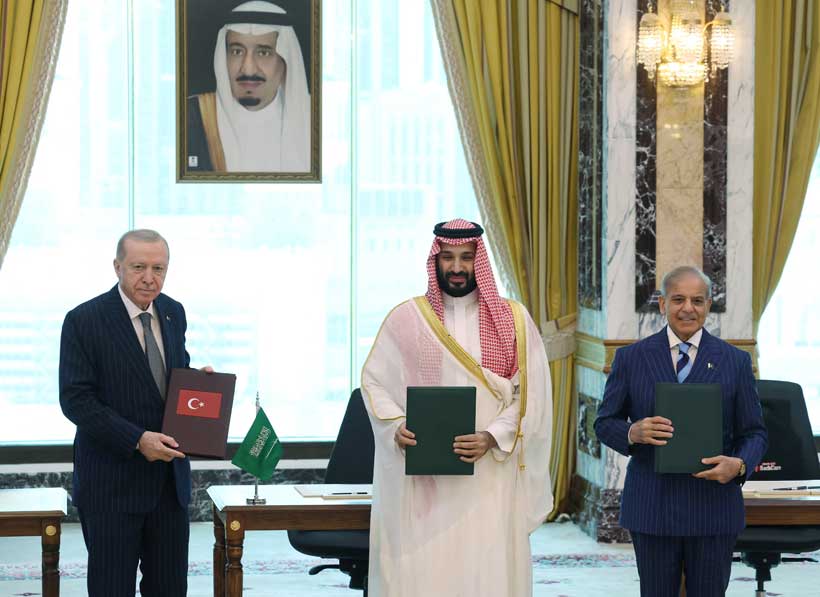
When the defence ministers of Pakistan, Türkiye, Qatar and Indonesia signed the Badr Memorandum of Understanding in Doha on 21 October, the instinctive comparison was with the Makkah Joint Defence Agreement that Pakistan, Türkiye and Saudi Arabia had concluded barely ten weeks earlier. Both arrangements place Islamabad and Ankara at their centre, and both were shaped by the same deteriorating security environment in the Gulf. Yet reading Badr as a smaller sibling of the Makkah pact misses what is genuinely new about it. The MJDA answers an old question of alliance politics: who will come to a state’s defence if it is attacked. Badr addresses a question the war in the region has made just as pressing: who will build the weapons, sustain the supply lines and develop the capabilities on which deterrence ultimately rests.
Capability without commitment
The memorandum establishes a quadrilateral partnership centred on defence-industrial collaboration, technology transfer and military cooperation. Its stated focus areas are joint production, technical training, research and development, and the broader development of members’ defence capabilities. It also brings industrial institutions directly into the framework, with Pakistan’s Defence Industrial Production Organization and Türkiye’s Presidency of Defence Industries participating alongside the four defence ministries. According to reporting on its structure, an executive board drawn from the four states will identify joint projects, while a strategic board will approve them and set implementation timelines.
What the agreement deliberately omits is as important as what it contains. Unlike the MJDA, under which an armed attack on one member is treated as an attack on all three, Badr carries no mutual defence obligation. Members are not bound to come to one another’s aid in the event of external aggression. The result is a distinct model of regional security cooperation: one that combines industrial integration with military-to-military ties, but stops short of collective defence commitments that would constrain each member’s room for manoeuvre.
Why production now matters
The timing is not incidental. Badr was signed as the US-Iran war entered its eighth month. The prolonged confrontation has exposed Gulf infrastructure, energy facilities and maritime routes to sustained risk, and with Washington’s attention absorbed by Tehran, Gulf states have had reason to ask how far the US security umbrella can stretch. Reports of US weapons shortages and depleted stockpiles across West Asia have reinforced a lesson that every protracted conflict eventually teaches: in a long war, the binding constraint is often not the strength of alliance commitments but the depth of industrial capacity behind them.
Stay ahead of the geopolitical week.
MD Briefing delivers expert analysis across five global fronts — the Indo-Pacific, energy, geoeconomics, European security, and the Middle East — every Monday morning. Free.
Gulf states are not abandoning their reliance on the United States. But they increasingly want additional defence options, and greater strategic flexibility in which to exercise them. Here the region’s own record is instructive. The GCC’s 2000 Joint Defence Agreement, the Peninsula Shield Force created in 1984 and the Unified Military Command established in 2013 all promised collective security, yet fell short of the integration originally envisaged, largely because member states diverged on threat perceptions and decision-making. Badr sidesteps that problem by design. Its members do not need to agree on who their adversaries are; they need only share an interest in building capabilities together. In a region of divergent threat assessments, cooperation that does not depend on a common enemy is considerably easier to sustain.
Built on existing foundations
Badr is also less a leap into the unknown than a consolidation of partnerships already in motion. Qatar has invested in Türkiye’s defence industry for more than a decade, and Turkish-made Bayraktar TB2 drones, armoured vehicles and assault boats have entered Qatar’s military inventory as bilateral cooperation has shifted towards joint investment and production. Pakistan and Türkiye have worked together on the MILGEM naval programme, under which corvettes for the Pakistan Navy were built both in Istanbul and at Karachi Shipyard, a practical exercise in technology transfer rather than off-the-shelf procurement. Indonesia and Türkiye, meanwhile, co-developed the Kaplan MT medium tank through a partnership between FNSS and PT Pindad.
What Badr adds is a framework that ties these bilateral tracks into a single quadrilateral structure with a clear division of labour. Türkiye brings technological expertise, systems integration and a mature defence-industrial base; Pakistan and Indonesia offer manufacturing capacity, skilled workforces and sizeable domestic markets; and Qatar contributes investment capital. With Doha providing financial backing and each partner supplying complementary industrial and technological strengths, the arrangement could provide a flexible basis for long-term cooperation, though its durability will depend on whether these complementarities hold once concrete projects require members to share costs, technology and control.
Complementary, not competing
On paper, Badr and the MJDA are complementary rather than competing. The Makkah pact, anchored in Riyadh and modelled on the Saudi-Pakistan Strategic Mutual Defence Agreement of September 2025, offers collective deterrence; Badr, anchored in Doha, offers capability development. Pakistan and Türkiye belong to both, which links a Saudi-centred defence track to a Qatari-centred industrial one. Overlapping memberships of this kind are not unusual, but they do raise practical questions about how the two states would prioritise resources, production capacity and political attention if the interests of Riyadh and Doha were to diverge, as they did sharply during the 2017 Gulf crisis.
This layered arrangement also suits the particular preferences of each participant. Qatar can deepen defence ties without assuming treaty obligations that might complicate its diplomatic posture as a regional mediator. Indonesia, whose foreign policy has long been guided by its “free and active” doctrine of non-alignment, could hardly join a Gulf mutual defence pact; an industrial partnership allows Jakarta to take part on terms consistent with that tradition. The flexibility that makes Badr appear modest is precisely what makes it possible, although the same flexibility means that no member is obliged to stay committed if priorities shift.
Interests and trade-offs
Each member enters Badr with distinct interests, and each faces its own trade-offs. For Türkiye, the framework offers a channel for an industry already expanding rapidly: its defence and aerospace exports rose by 48 per cent in 2025, and SIPRI data show its arms exports increased by 122 per cent over the past five years, making it the world’s 11th-largest arms supplier. Yet Ankara’s export interests sit in some tension with its partners’ ambitions. Technology transfer and local production are precisely what Pakistan and Indonesia seek, and both reduce the market for finished Turkish systems over time.
Qatar gains a route to diversify its defence relationships and to develop a domestic industrial base rather than relying solely on imports. As the principal financier, however, it will need assurance that its capital produces capabilities it can use, not merely contracts for its partners’ industries. Pakistan and Indonesia, for their part, gain access to co-development, financing and new markets, with Pakistan’s Defence Industrial Production Organization formally part of the framework. Both, however, face fiscal constraints on long-term programmes, and both already maintain diversified procurement relationships with other suppliers that Badr will complement rather than replace.
From memorandum to production line
None of this is guaranteed. Memoranda of understanding are easy to sign and hard to operationalise. Defence-industrial partnerships demand sustained financing across long procurement cycles, agreed rules on intellectual property and technology sharing, and some alignment of export policies among members with different strategic priorities. Several platforms in the partner states also still rely on foreign-sourced components such as engines and electronics, leaving jointly produced systems exposed to third-country export controls. Whether the executive and strategic boards can translate stated intent into funded projects will determine whether Badr becomes a working industrial alliance or another well-intentioned framework.
Yet the model itself is significant regardless of how quickly projects materialise. Badr reflects a broader shift towards customised security partnerships in a region where states want more options without more entanglements. It offers a template for cooperation built on capability rather than commitment. Asking less of its members than a mutual defence pact may make the arrangement easier to sustain; it also makes it easier to neglect. As the Gulf’s security landscape grows more layered, the measure of Badr will not be the ceremony in Doha but whether its four partners jointly design, finance and build a system none could have produced as efficiently alone.
