


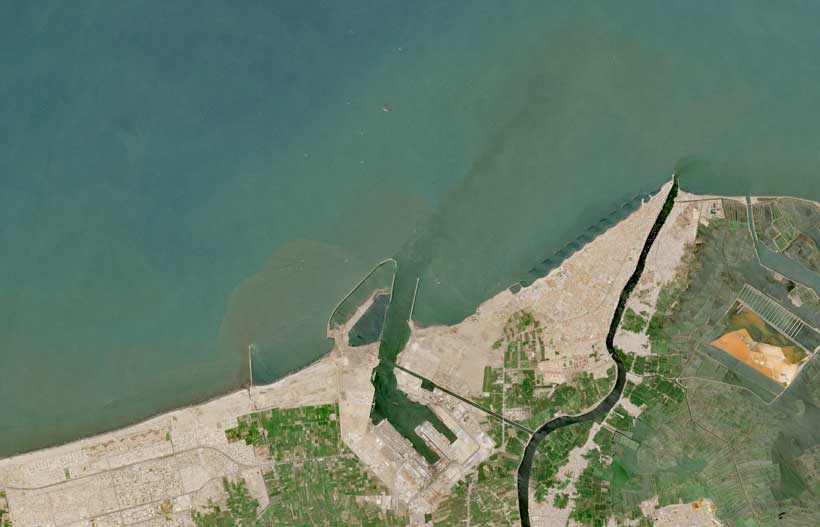
Chinese research centers, in their analyses of the Middle East, specifically after the attack on the Egyptian port of Damietta on July 29, 2026, and the fire that broke out on two ships (a floating regasification facility and a gas tanker) in the port of Damietta, caused by an unknown drone, and the targeting of two ships, one of which was a regasification vessel (containing parts belonging to an American company) by a drone, focus on de-escalation and protecting international trade routes and energy security, while China puts forward a number of conspiracy theories and hypotheses concerning groups, such as the Muslim Brotherhood, in attacking the port, and pointing to the possibility of the involvement of non-state actors or groups like the Muslim Brotherhood to create internal security disruption in coordination with the Israeli Mossad, which supports them in reaching power in Egypt, or China directing accusations to the Israeli side of trying to drag Egypt into a battle with Iran in an attempt to push the Egyptian army and the Egyptian military establishment to be drawn into regional conflicts in favor of hostile powers. With increasing Chinese speculation linking the Damietta port incident to the current regional escalation related to ongoing conflicts in the region or to parties seeking to expand the scope of tension, such as Israel, this comes within the current regional context. The incident coincides with widespread regional tensions and military conflict in the region, including an exchange of strikes and drone attacks between regional and international powers, such as the United States, Iran, and Israel. This is especially significant given Tehran’s denial of any involvement in the attack and Iranian Foreign Minister Abbas Araqchi’s assertion that the attack on the Egyptian port of Damietta may fall under the category of Israeli false flag operations aimed at undermining stability and embarrassing Egypt. Here, the only party to publicly point the finger at Israel was Tehran, with Iranian Foreign Minister Abbas Araqchi hinting that the attack might have been a false flag operation carried out by Israel to implicate other parties and undermine regional peace. This occurred despite continued Israeli denials, with official Israeli military sources categorically denying these Iranian claims and asserting their lack of involvement in the incident.
In this context, Chinese strategic assessments consider the targeting of infrastructure, ports, and energy facilities in Egypt a direct threat to its economic interests, given Egypt’s pivotal role as a trade gateway and key logistics hub on the Belt and Road Initiative and China’s Maritime and Military Silk Road. This is due to Egypt’s strategic importance in the Chinese vision as a global logistics center, with the Suez Canal and Egyptian ports representing an essential and indispensable link for trade between Asia and Europe, crucial for securing global supply chains for China. Here, Beijing is keen to protect its massive investments in Egyptian ports and logistics zones to ensure the smooth flow of goods and the stability of energy supplies. The security of energy facilities in Egypt and its Mediterranean neighbors is a crucial pillar for the stability of energy markets, upon which international trade depends.
Chinese intelligence, military, political, and strategic circles have assessed that targeting Egyptian ports and energy infrastructure strategically serves to undermine Egypt’s role as a regional logistics hub and a secure alternative for energy supplies in the Eastern Mediterranean. This, in turn, harms China’s Belt and Road Initiative projects, given Egypt’s central role within them. This also serves the interests of the Israeli Mossad and its new director, Roman Goffman, who assumed his post in June 2026. Their aim is to internationalize the crisis and, through these operations, push the international coalition and the United States to intensify direct military operations against the infrastructure of its regional adversaries, such as Iran and its ally China, while diverting attention from other fronts. There may be an official link or credible reports from Chinese intelligence agencies connecting the appointment of the new Mossad chief, Roman Gofman, to the attack on Damietta port by two unidentified drones. Despite the incident being subject to cautious official and local Egyptian investigations, no conclusive data has yet emerged regarding the identity of those responsible. However, the background of the appointment of the new Mossad chief, Roman Gofman, reflects a serious strategic and military shift for China, given Gofman’s field-based military mindset and his management of the Mossad’s new operational approach, which has shifted from the traditional Mossad espionage management to a more field-based military strategy. This raises concerns within Chinese intelligence agencies regarding Gofman’s background as head of the Israeli Mossad, a direct choice by Benjamin Netanyahu, who previously appointed him as Netanyahu’s military secretary. Gofman’s appointment on June 2, 2026, was a departure from tradition, coming from the Israeli army and his previous role as Netanyahu’s military secretary, rather than from within the traditional ranks of the Mossad. Therefore, Chinese intelligence and military analysts see the dominance of a confrontational, field-based military mindset in the Mossad’s new operational approach. For the Chinese Ministry of State Security, which oversees Chinese intelligence, Gofman’s appointment reflects an Israeli inclination towards the Mossad. The Mossad’s intelligence operations are managed with the mindset of a field general and direct military confrontation. This applies almost exactly to the Damietta port incident, given the nature of the event itself. The port was subjected to a mysterious drone attack targeting a maritime area, which affects strategic infrastructure and Egyptian sovereignty and harms China’s logistical interests in Egyptian ports.
While Chinese intelligence and military agencies rejected accusations in Western, American, and Israeli intelligence reports suggesting that the Iranian Revolutionary Guard or its proxies, such as the Houthis, were behind the attack on the Egyptian port of Damietta, under the pretext of targeting a regasification vessel with American ties within the energy supply conflict and expanding regional pressure, Beijing refuses to be drawn into these unreliable Western and especially Israeli intelligence speculations before completing the examination of the drone fragments and remains to pinpoint its launch point with absolute certainty. Furthermore, they are exploring avenues for joint Chinese-Egyptian military and defense cooperation to protect ports. Egypt and Egyptian national security are far removed from the mechanisms of politically exploiting the incident for the benefit of various parties. Therefore, official Chinese statements affirm that Egyptian national security is a red line and that any response or action will be based on established facts from investigations, not media speculation. This is coupled with a commitment to regional de-escalation to maintain the stability of international supply chains and the interests and investments of China’s Belt and Road Initiative in Egypt and the region.
Stay ahead of the geopolitical week.
MD Briefing delivers expert analysis across five global fronts — the Indo-Pacific, energy, geoeconomics, European security, and the Middle East — every Monday morning. Free.
Herein lies the dimension of the Chinese position: joint cooperation with Egypt and a rejection of politicizing the issue. Beijing’s diplomatic vision aligns with the principle of not being swayed by undocumented Western intelligence narratives before the completion of technical investigations and the establishment of forensic and field certainty. This is to protect energy interests and seaports of strategic importance to China. The attack on the Egyptian port of Damietta by two unidentified drones falls within the sphere of shared Chinese-Egyptian concern, as protecting infrastructure and seaports is part of the security of global trade and energy supply lines, in which China plays a pivotal role and maintains a strategic military and defense partnership with Egypt.
