


The Middle East – for many Western observers – is something akin to Long Covid. One day you believe you are through the worst of it, turning a corner, and the next you are back reliving all the headaches, fatigue and brain fog, short of breath and sleep deprived. In psychology, the condition might be described as “deja vecu” or chronic deja vu, where one is perpetually reliving past experiences. What it must be like for those who live in its most affected parts is unimaginable. The question today, as rockets rain down across the Persian Gulf, is which particular chapter of the region’s long torment is being revisited. And, what comes next?
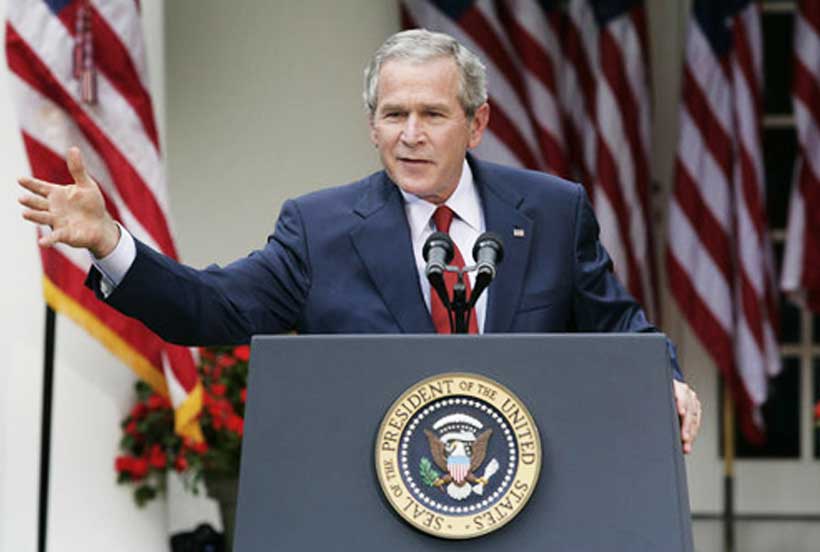
In 2016, commenting on U.S. policy towards the Middle East, then-presidential candidate Donald Trump stated, “we would have been better off if we never looked at the Middle East for the last 15 years.” Given the state of the region after the invasion of Iraq in 2003, with the Islamic State rampaging across Syria and Iraq in 2016, who could have argued with him disclosure: I served in the George W. Bush administration’s State Department from 2004]? The toppling of Saddam Hussein opened a Pandora’s box, the repercussions of which are still rippling today. Ironically, Bush had campaigned on a similar message to that of the present occupant of 1600 Pennsylvania Ave, Washington, DC, promising “no-more-nation-building” on his own road to the White House.
That, of course, was all before 9-11. In the weeks and months that followed, looking for an answer to the question “Why us?” President Bush had a personal epiphany, of sorts:
“Sixty years of Western nations excusing and accommodating the lack of freedom in the Middle East did nothing to make us safe—because in the long run, stability cannot be purchased at the expense of liberty. As long as the Middle East remains a place where freedom does not flourish, it will remain a place of stagnation, resentment, and violence ready for export.”
Stay ahead of the geopolitical week.
MD Briefing delivers expert analysis across five global fronts — the Indo-Pacific, energy, geoeconomics, European security, and the Middle East — every Monday morning. Free.
Bush was not wrong. On 9/11, the inherent tensions and failures in American policy towards the Middle East (MENA) since World War II had come home to roost. It is not that there had been no prior wake-up calls or that American ambivalence about “lack of freedom” in the region was the only issue. Beginning with alleged involvement in the 1949 overthrow of Syria’s first, post-independence, democratically elected prime minister and Operation Ajax in 1953 that returned the Shah to power in Iran, also ousting that country’s first democratically elected prime minister, the U.S. had established a solid track record of antipathy towards popular forms of government in MENA. The contribution to the region’s stability, or lack thereof, ever since is worthy of debate.
For Bush, despite earlier reticence about foreign entanglements, valid concerns that 9/11 might not have been a one-off conspired to force his hand. It was time to make amends. With the 2003 launch of his Freedom Agenda, on the heels of the Global War on Terror, the die was cast. A half century of coddling dictators and authoritarians to secure U.S. national security interests had come to an end, or so we were led to believe at the time. America would now embrace and support reformers and democracy enthusiasts across the region, righting the wrongs of the previous half century while liberating Arab populations in the process. The argument, as articulated by former Russian refusenik Natan Sharansky in his then-influential “Case for Democracy,” was that “democracies are basically peaceful—the leaders of the democracies have war as the last possible choice—dictatorships are belligerent.” What was needed then to prevent another 9/11 was more democracy in the Middle East, the reasoning went in the Bush White House, and fewer dictators.
Nevertheless, notwithstanding initial enthusiasm amongst many Arab activists and significant U.S. outlays in support of the president’s ambitious vision, 23 years on, the political nature of the Middle East remains much as Bush found it. One might even argue that the region is, in many respects, much worse in 2026, American good intentions aside. Libya’s wild man, Muamar Qaddafi, may be gone, but so is the country’s territorial integrity. Syria’s brutal Assad dynasty may have collapsed, but only to be replaced by Al Qaeda lite. Meanwhile in Cairo, President Trump’s “favorite dictator” has many Egyptians romanticizing the bad old days under Hosni Mubarak. And the list goes on: humanitarian disaster in Yemen, crisis in Lebanon, authoritarian revival in Tunisia…
What went wrong? Well, what went right? Where the U.S. made its most significant investments in the wake of 9/11, in Iraq and Afghanistan, the costs have been incalculable, economically, politically, and strategically; the benefits negligible; and the repercussions likely to be felt for generations. The economic burden for those two interventions, alone, is estimated to have cost the American taxpayer 4-6 trillion dollars to date, a total that continues to climb as the long-term costs of veterans’ care and related expenses continue to accrue. The loss of life on all sides has been no less significant. As one looks on at events playing out at the moment in the Straits of Hormuz, the gods of unintended consequences must be shaking their heads at the national amnesia that has kept generations of American policymakers in the Middle East’s thrall.
Given sacrifices and setbacks across the Middle East since 9/11, forgetting about what transpired before, it is worth pondering whether the plight of the region and its citizens, not to mention Western consumers, would have been better served by the prevailing status quo of authoritarianism President Bush encountered on his watch, absent poorly conceived and badly implemented American benevolence and armed interventions that followed. It is at least worth a debate, but one thing is for certain: the drama playing out today in the Persian Gulf is not likely to improve matters, for we have seen this movie one too many times before, and it has never ended well, or differently.
