


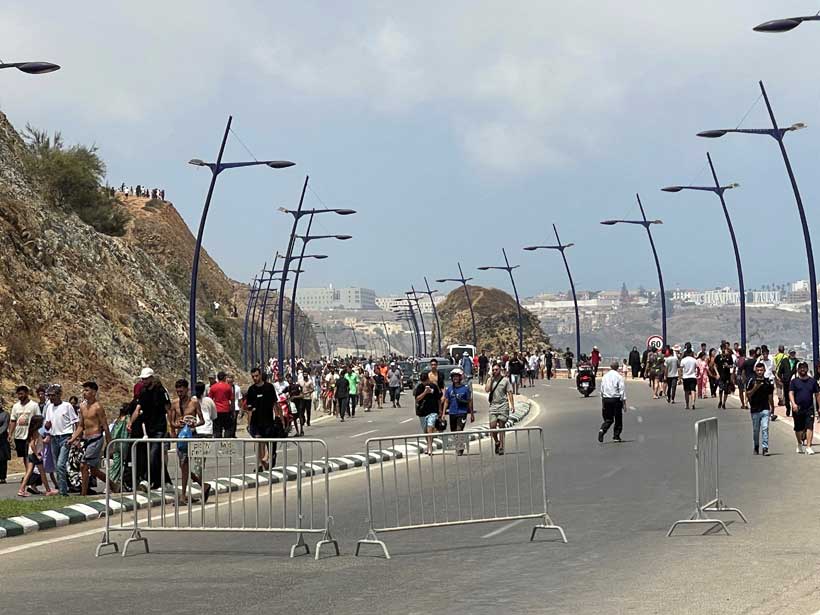
China can leverage its efforts to address the border migration crisis between Spain and Morocco by promoting humanitarian diplomacy, funding border development projects, and advancing President Xi Jinping’s concept of a shared future for mankind. These tools allow Beijing to expand its geopolitical influence and offer an alternative model for security and development cooperation in the Western Mediterranean. China’s intervention mechanisms are evident in its humanitarian diplomacy, providing financial and logistical assistance for managing camps for Moroccan refugees and alleviating the burdens of migration, thus enhancing its image as a positive international actor. Furthermore, China’s active participation in the border development projects between Morocco and Spain, through investment in infrastructure and joint industrial zones, aims to create local job opportunities for Moroccan youth and reduce the drivers of migration. This aligns with China’s promotion of the shared future for humanity concept by linking regional stability to comprehensive security and economic cooperation under the umbrella of Chinese initiatives.
This is where many of China’s geopolitical objectives stem from: penetrating Europe’s southern gateway through the Spanish cities of Ceuta and Melilla. China aims to bolster its economic, political, developmental, service, social, and humanitarian presence in the border regions between Africa, Morocco, and Europe. This involves building strategic partnerships and strengthening ties with both Rabat and Madrid, offering economic solutions to chronic crises such as the flow of irregular migrants across the borders, while simultaneously promoting the Chinese model. China can then implement various mechanisms and plans to leverage its developmental and humanitarian efforts within Africa, and Morocco in particular, by capitalizing on major national partnerships between China and these countries. Here, China can capitalize on the deepening crisis of the influx of refugees and undocumented Moroccan migrants into the Spanish enclaves of Ceuta and Melilla by providing international support and establishing service and development associations and institutions. Through these entities, China could offer specialized support programs to the border dispute areas between Spain and Morocco, in accordance with Chinese President Xi Jinping’s principle of a shared future for mankind.
China’s geopolitical objectives include attempting to bolster its influence through Europe’s southern gateway via the Spanish enclaves of Ceuta and Melilla. This would be achieved through Chinese control of (infrastructure, expanding trade, and balancing international power dynamics). The most prominent economic and logistical motivations behind China’s presence in the maritime border region of Ceuta and Melilla with Morocco lie in securing Chinese trade routes; connecting Chinese supply lines with Spain, Europe, and Morocco thanks to proximity to the Strait of Gibraltar; and supporting the Belt and Road Initiative’s expansion into European and African markets. Therefore, the authorities in the Spanish enclaves of Ceuta and Melilla could invite China to invest in their infrastructure, leveraging the influx of thousands of young Moroccan migrants and their contributions to developing new infrastructure projects. This could be achieved by encouraging China to acquire or participate in the development of ports surrounding the region, such as the Nador West Med port. Such an approach would serve China’s strategic and diplomatic objectives of counterbalancing Western influence and reducing American and European dominance in the Mediterranean basin. This would be accomplished by deepening China’s technological and security penetration through the supply of surveillance and communication technologies to the borders adjacent to Ceuta and Melilla, thereby strengthening its digital and sustainable presence.
In this context, China can leverage the irregular migration crisis between Spain and Morocco by promoting humanitarian diplomacy, establishing border development projects, and activating the principle of a shared future for mankind. China’s most prominent development and humanitarian support mechanisms are evident in the Spanish cities of Ceuta and Melilla, aimed at controlling the flow of irregular Moroccan migrants through Chinese infrastructure projects. These projects include Chinese funding of service and social centers near the Spanish-Moroccan border to alleviate unemployment and poverty among Moroccan youth. China also promotes institutional partnerships by establishing joint development associations with direct Chinese financial support to improve local living conditions). Here, the geopolitical dimensions of China’s principle of a shared future for mankind become apparent through international cooperation and the provision of development and humanitarian aid. Through the framework of African-Chinese cooperation, efforts can be made to reduce the drivers of irregular migration, with Beijing employing a strategy of soft diplomacy to solidify its presence as an international actor contributing to the resolution of regional humanitarian crises without direct political intervention.
Stay ahead of the geopolitical week.
MD Briefing delivers expert analysis across five global fronts — the Indo-Pacific, energy, geoeconomics, European security, and the Middle East — every Monday morning. Free.
The borders of the Spanish enclaves of Ceuta and Melilla witness recurring crises due to the influx of irregular Moroccan migrants, such as large-scale crossing attempts that have seen tens of thousands attempt the crossing, with most returning either voluntarily or forcibly. Here, China’s Belt and Road Initiative can provide numerous relief mechanisms for these irregular Moroccan migrants, despite their subjection to strict European and Spanish immigration laws. However, Chinese-Moroccan development cooperation in neighboring Moroccan territories can help provide local job opportunities for Moroccan youth, thus reducing the incentive to risk irregular migration to the Spanish enclaves of Ceuta and Melilla. China and Morocco are linked by a joint implementation plan for China’s Belt and Road Initiative, focusing on infrastructure, technology, and industry. With Chinese investments in Morocco, linked to the Belt and Road Initiative, concentrated on several projects such as the Tangier Tech project), and with Spain, the borders of the two enclaves (Ceuta and Melilla) are managed through bilateral agreements between Morocco and Spain to address irregular migration flows. However, Morocco and Spain could involve China in managing the logistics ports there and leverage its Belt and Road Initiative to activate numerous development, humanitarian, and investment projects to serve the Moroccan people, particularly those living along the Spanish border. This would also allow them to benefit from the human capital of the thousands of young Moroccans who migrate irregularly to Spanish territory, specifically to the cities of Ceuta and Melilla.
