


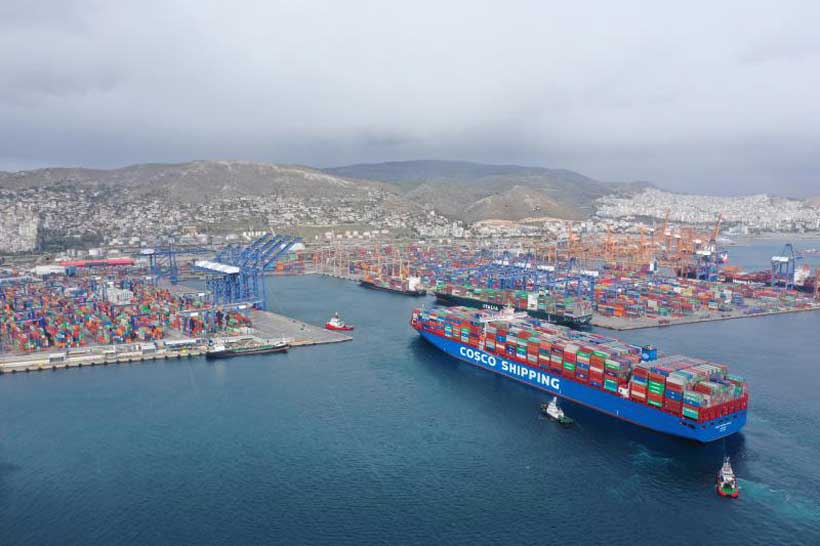
Chinese investment in European ports presents a complex issue, balancing economic efficiency with security concerns. While these Chinese investments and logistics and maritime projects in European ports provide significant financial support and contribute to stimulating supply chains and shared growth, Brussels and other EU member states are approaching them with increasing caution. The EU’s perspective on this vital Chinese infrastructure has shifted from viewing it merely as a trade gateway to considering it a sensitive strategic and security asset, particularly given concerns about the implications of China’s geographical presence and expansion. Chinese companies, most notably the COSCO Chinese Shipping Group, hold investment stakes in more than twenty major European ports. The Greek port of Piraeus stands out as a prime example of complete Chinese control over port operations, strategically viewed as a key gateway for China’s Belt and Road Initiative in Europe. Conversely, these Chinese investments are raising increasing concerns within the European Union for several strategic reasons related to economic security and sovereignty. Brussels, where the European Commission is headquartered in Belgium, fears strategic dependence on China and is moving towards imposing restrictions and tightening controls on foreign investments in vital infrastructure, particularly those involving China. Furthermore, there is European apprehension about operational dependence on China. Some member states and NATO fear the risks associated with access to sensitive information related to China’s supply chains.
For this reason, Beijing has consistently warned the European Union against pursuing protectionist policies or unjustified discriminatory restrictions against its companies, emphasizing its determination to take firm countermeasures to protect its global economic interests. China has also repeatedly warned the EU against imposing trade restrictions or protectionist policies against China. While Chinese authorities have officially affirmed their intention to take firm countermeasures against any discriminatory or unilateral measures targeting their companies, they simultaneously call for adherence to dialogue and fair competition. The official Chinese response to European concerns regarding its logistical and maritime presence in European ports was that Brussels, the seat of the European Commission, has consistently wavered between welcoming Chinese capital inflows and imposing unjustified restrictions. Europe has no reason to fear China’s presence in its ports; ports are not mere pawns in a great-power game but rather engines of shared growth. This statement accurately reflects the official Chinese position on European concerns, as Beijing views its investments in European port infrastructure as fundamentally purely economic relations aimed at facilitating the logistics of mutual trade and rejects considering them as geopolitical tools for exerting influence. China justifies its presence in European ports as necessary to support supply chains. Acquiring stakes in major European container terminals, such as the ports of Hamburg in Germany and Piraeus in Greece, is essential for securing global supply chains and reducing transaction costs for China. Furthermore, China defends its presence in European ports as a means of stimulating shared growth. Beijing asserts that Chinese capital inflows revitalize European ports, support employment, and ensure the continuation of shared economic growth, especially given China’s status as the EU’s largest trading partner in terms of imports.
The most prominent European concerns regarding Chinese control of European ports stem from an apprehension about China’s logistical and maritime influence on economic sovereignty. There are growing European fears of the continent being subjected to commercial dominance or monopolistic practices that could divert shipping routes and marginalize neighboring European facilities in favor of Chinese maritime supremacy. Furthermore, European concerns relate to national security, as European parties fear that commercial port infrastructure could be used for purposes beyond trade, such as intelligence gathering or exerting political influence on host countries. There are also European concerns regarding the Chinese presence in areas of concentration and influence of European military logistics. The proximity and presence of Chinese naval vessels near some European ports or NATO facilities raises defense and security concerns. Therefore, Brussels’ current policy to address these challenges involves the European Commission adopting new strategies and stricter legislation to scrutinize foreign direct investment. This aims to ensure the protection of vital infrastructure and reduce strategic dependencies without completely closing the door to fair commercial investments, according to the European perspective represented by the European Commission, headquartered in Brussels.
For these reasons, economic relations between China and the European Union have witnessed significant tensions due to the EU’s growing trade deficit and concerns about markets being flooded with subsidized Chinese products. Consequently, a number of European measures have been taken against China. EU officials have confirmed they are currently studying new mechanisms to address industrial oversupply and protect domestic manufacturing from dumping practices and China’s extensive presence in the market, targeting vital sectors in Europe such as electric vehicles, renewable energy, and sensitive supply chains. China has rejected the dumping accusations, emphasizing that the superiority of its products stems from market strength and competitive advantage. The Chinese Ministry of Commerce has warned that it will respond forcefully to defend its interests if Brussels imposes restrictive and discriminatory measures.
Stay ahead of the geopolitical week.
MD Briefing delivers expert analysis across five global fronts — the Indo-Pacific, energy, geoeconomics, European security, and the Middle East — every Monday morning. Free.
Despite the escalating tensions between China and the European Commission and EU member states, there appears to be a mutual desire to avoid a full-blown trade war. Both sides are seeking to use dialogue to address trade imbalances and find common ground. Ongoing diplomatic efforts indicate Beijing’s desire to keep European markets fully open to its products without any restrictions, protectionist policies, or discrimination.
