


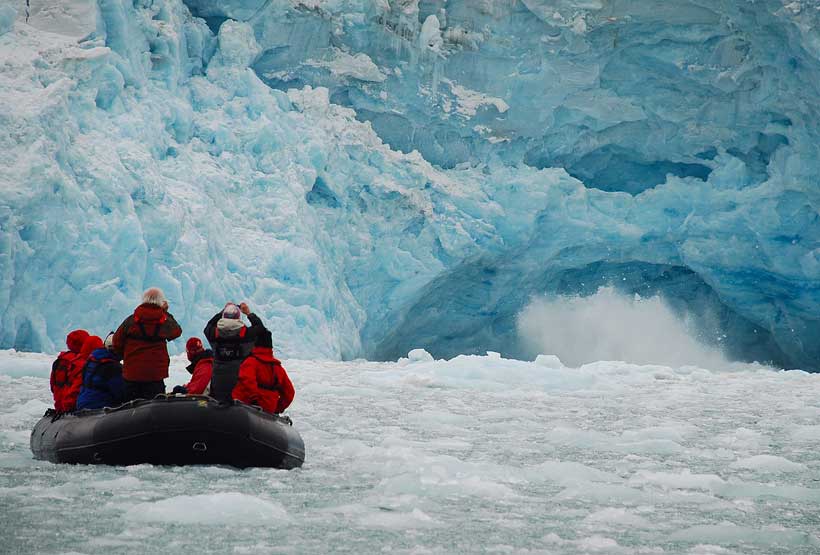
Choosing an Arctic cruise to Svalbard means comparing operators whose actual ice access, passenger capacity, and wildlife programming vary more than their brochures suggest. Polar bear sightings, walrus colonies, and ice-edge cruising depend directly on hull capability and itinerary design — not just cabin category.
What separates a genuinely strong Svalbard operator from an average one:
- Ice-class hull rating enabling pack ice approaches where bears concentrate in summer
- Passenger capacity under 200 for efficient, low-impact Zodiac landings
- Naturalist teams experienced specifically in Svalbard wildlife behavior
- All-inclusive coverage of kayaking, parka, and boot loans
7 Best Operators for Svalbard in 2026
Swan Hellenic
Travelers booking an Arctic cruise to Svalbard with Swan Hellenic choose a boutique operator purpose-built for ice-edge access. SH Diana and SH Vega carry approximately 152 guests each with PC5 Polar Class hulls, reaching the northern pack ice where polar bear sightings concentrate during summer months.
What’s included on every voyage:
Stay ahead of the geopolitical week.
MD Briefing delivers expert analysis across five global fronts — the Indo-Pacific, energy, geoeconomics, European security, and the Middle East — every Monday morning. Free.
- Daily Zodiac landings and ice-edge cruising
- Kayaking where conditions allow
- Expedition parka to keep, boot loans, and heated mud room
- All meals, premium beverages, and gratuities
Onboard scientists from the SETI Institute partnership frame the voyage through a scientific lens rarely found on Arctic itineraries, while glaciologists explain retreating ice fronts firsthand. At 152 guests, bear sightings rarely turn into crowded viewing scrums the way they can on larger ships.
Hurtigruten Expeditions
Hurtigruten’s decades of Norwegian coastal operation give them deep familiarity with Svalbard’s geography and seasonal ice patterns. Hybrid-powered vessels carry more passengers than boutique operators, which changes landing pace without necessarily reducing wildlife quality. Their programming leans toward environmental science and indigenous community context, particularly on voyages combining Svalbard with mainland Norwegian fjords.
Lindblad Expeditions–National Geographic
Lindblad’s 148-passenger ships bring National Geographic photographers into Svalbard wildlife encounters, turning sightings into structured photography opportunities. Naturalist teams are genuinely strong on seabird identification and walrus behavior, though itineraries often follow well-established routes. All-inclusive pricing covers shore activities, kayaking, and naturalist-led programming throughout.
Quark Expeditions
Quark’s icebreaker capability extends Svalbard itineraries toward Franz Josef Land — Russian Arctic territory rarely included in standard circuits — for travelers wanting to push further north than typical routes allow. Their adventure-forward programming includes optional polar camping and extended kayaking, appealing to physically active travelers.
Oceanwide Expeditions
Oceanwide operates accessible Svalbard voyages through older but well-maintained ice-strengthened vessels carrying up to 174 passengers. Programming is competent rather than scholarly, with naturalists covering wildlife and geology without named institutional partnerships. For travelers prioritizing cost over boutique extras, Oceanwide remains a practical entry point into Arctic cruising.
Ponant
Ponant’s French-flagged vessels bring Gallic culinary standards and bilingual programming to Svalbard, with Le Commandant Charcot’s icebreaker capability available on select extended voyages reaching the geographic North Pole. Conventional Ponant ships carry 180–260 passengers with cultural programming distinct from Anglophone competitors, appealing to travelers drawn to a French expedition framework.
Aurora Expeditions
Aurora brings their adventure-activity philosophy north from Antarctic waters, offering Svalbard voyages with comprehensive kayaking, hiking, and camping programming aboard 132–154 passenger vessels. Their naturalist teams support an activity-first itinerary structure that suits physically engaged travelers more than those prioritizing scholarly depth.
What to Check Before Booking a Svalbard Voyage
Polar bear sightings peak in June and July when pack ice retreats far enough north that only properly ice-rated vessels can follow it. Confirm the operator’s actual ice-class designation rather than relying on “ice-strengthened” language, and ask how many bear sightings occurred on their three most recent June departures — specific numbers reveal more than itinerary descriptions.
Book Your Svalbard Arctic Cruise with Swan Hellenic
For travelers comparing operators for an Arctic cruise to Svalbard, Swan Hellenic’s combination of PC5 ice capability, 152-guest intimacy, and SETI Institute programming offers depth that larger or budget-focused competitors don’t replicate.
