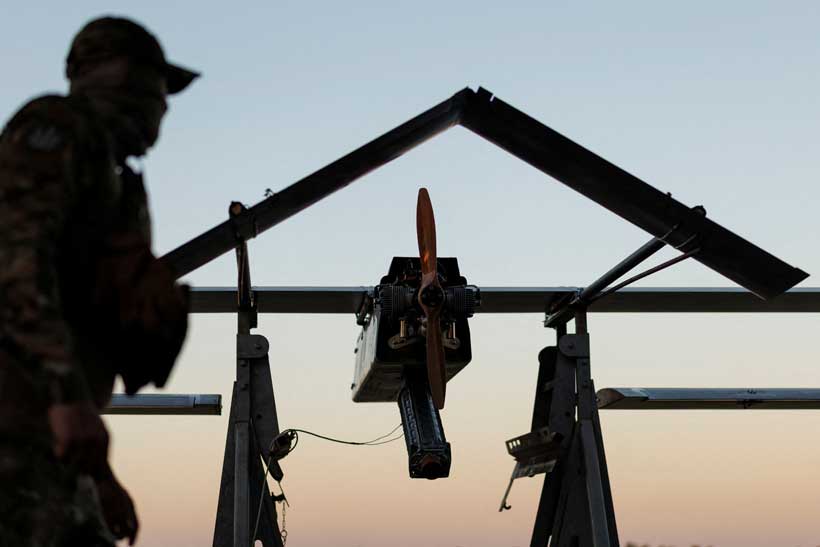
The Crimean Peninsula, Russia’s pivotal stronghold, is witnessing a siege that could place the occupation by Russian forces in an untenable position. After four years of slowly degrading air defenses in the peninsula, the Ukrainian Armed Forces (AFU) are conducting near-daily drone and missile strikes aiming to place the Kremlin into a lose-lose situation over Crimea.
Constant AFU strikes in Crimea on fuel depots, air bases, and naval facilities are causing a major disruption for Russian logistics in Southern Ukraine, which is slowly making Moscow’s regional capabilities in the peninsula untenable. Unless Russia dramatically shifts its priorities to defensive consolidations instead of continuous offensives with minimal gains, Crimea remains exposed to daily AFU attacks, and the peninsula’s position will remain precarious or existential for the Putin regime.
Ukraine’s Siege of Crimea
During the Russian invasion of Ukraine, in the summer of 2022, the AFU conducted its first major missile attacks against military targets in Crimea, which became a major feat on the peninsula, which the Kremlin turned into a stronghold. However, Ukraine was at a disadvantage as Russia fortified Crimea with a plethora of air defense systems ranging from S-300s and S-400s, along with other various logistics and hardware.
Furthermore, the AFU only received a few Army Tactical Missiles (ATACMS) and as many Storm Shadow/SCALP missiles as the UK and France could provide. Adaptation would be needed, and it could come in the form of a homegrown defense industry for Kyiv.
During the past several years, Ukraine has rapidly expanded its defense sector to the point where the AFU can field seven to eight million unmanned systems per year, ranging from underwater seaborne to first-person view (FPV) drones. Kyiv is also domestically producing its own ballistic missiles, such as the Sapsan and FP Flamingo series.
Prior to the siege, the AFU frequently targeted airfields, air defense systems, logistical routes, and the Black Sea Fleet, which made Russian naval positions on the peninsula untenable. The Kremlin would withdraw its Black Sea Fleet from Crimea around the late summer of 2024 towards a safer distance from Novorossiysk.
After softening defenses in the peninsula, the AFU’s drone teams conducted their middle strike campaign in the late spring of 2024—aiming to place Crimea under siege, isolate Russian forces in the south, and make resupply difficult to nonexistent, leading to a logistics breakdown.
The middle strike campaign is making Russian military logistics routes, such as the R-280, difficult for resupply, and the North Crimean Canal Bridge, the Chongar Bridge, and others are being incapacitated by frequent attacks. Furthermore, targeting fuel depots has led to the suspension of petroleum distributions in Crimea, with Moscow making desperate efforts to resupply the increasingly isolated peninsula.
Russian irredentism is intertwined with Crimea.
For Russia, occupying and permanently annexing Crimea intertwines with Russian nationalism and irredentism. In 1783, the Russian Empire captured and annexed Crimea from the Crimean Khanate, then a key ally of the Ottomans.
Empress Catherine the Great founded several key cities in the peninsula, such as Sevastopol and Simferopol, which became essential points for Russian force projection. The Black Sea Fleet, Russia’s most prized fleet, was headquartered in the peninsula for several centuries to launch Russian naval power.
The conquest of Crimea represents Russia’s true foothold into Europe, as wider access to the Black Sea allowed its navy to expand into the Mediterranean and logistically support Moscow’s allies in the Balkans. Even when the Russian Empire fell, the Soviet Union would retain its foothold in Crimea by deporting the Crimean Tatars, Greeks, Armenians, and others and resettling Russians and Ukrainians, with Kyiv being transferred to the peninsula by the Kremlin.
Despite Crimea’s transfer to Ukraine under the Soviet Union, the peninsula voted in favor of Ukrainian independence from the USSR. Still, under a leasing deal, Russia retained its naval base in Sevastopol for the Black Sea Fleet. The leasing deal would expire due to the 2014 seizure of Crimea, which would change the trajectory of the region to this day.
Against the backdrop of Maidan, Putin, fearing Ukraine would establish its own independent ties with the West, ordered the invasion and seizure of Crimea in 2014. Under the guise of unmarked troops, infamously known as ‘little green men,’ Russian forces seized the entire peninsula, including Ukraine’s remaining navy, and solidified the position of the Black Sea Fleet in Crimea.
Moscow’s annexation of Crimea became a rallying call of imperial irredentism, as Vladimir Putin has personally compared himself to Peter the Great. Due to the lukewarm reaction by the international community to the unrecognized annexation, Crimea would be a pivotal launching point of the 2022 full-scale invasion of Ukraine, and the peninsula is a critical logistical hub for the war.
Enacting the Logistical Trap
Arguably, another key goal of Kyiv’s central middle strike strategy is to lure Moscow into committing even greater quantities of logistical supplies that can be incapacitated or destroyed. Over the past several months, highways along the Russian-occupied South have been littered with destroyed supply convoys, and in the Black Sea and Sea of Azov, tankers and vessels have been frequently struck by Ukraine’s unmanned systems operators.
Currently, the R-280 in Southern Ukraine is being referred to as a new ‘Highway of Death’ akin to what was seen at the end of the Gulf War. The R-280 is Russia’s critical logistical route in the South meant to connect the command center of Rostov-on-Don to Crimea by connecting critical occupied Southern cities such as Mariupol, Melitopol, and Berdyansk.
According to Ukraine’s unmanned system units and open-source intelligence accounts, the R-280 is responsible for thousands of destroyed vehicles per month, including fuel trucks, heavy transportation support, and Russian military armored vehicles. The rate of destruction will be exceedingly difficult for Russia to replace—especially as its wartime economy is feeling the pressure of perpetual warfare and the fuel crisis.
Furthermore, over 100 transportation, logistical, and fuel vessels are incapacitated or sunk in the Sea of Azov, which is located only several kilometers from Crimea. Many of the attacked vessels could have been utilized to resupply the beleaguered Russian troops in Crimea, which exacerbates the logistical breakdown the Kremlin seemingly cannot mitigate.
Putin is Caught Between a Rock and a Hard Place
Ukraine’s middle strike campaign and logistical breakdown put the Kremlin in its most precarious position since the initiation of the full-scale invasion. Fuel shortages from the AFU’s constant strikes on energy resources have led to an indefinite suspension of diesel exports and further petroleum imports from India, Japan, and South Korea.
Russia’s wartime economy, initially stabilizing the country from sanctions, is now starting to buckle, with the middle strike campaign further exacerbating socioeconomic pressures. The Russian city of Orenburg is unable to pay North Korean workers due to economic deterioration and now has to rely on further African labor.
Vladimir Putin, over the next few months, will be forced to make complex decisions over Crimea’s situation. Russia will need to bring in billions of dollars’ worth of logistics, such as air defense systems and electronic jamming, to stave off the AFU’s middle strike campaign. However, due to ships constantly being attacked in the Sea of Azov and convoys being incapacitated along the R-280, this will be logistically challenging and dreadful for the Russian military.
Putin may be forced to use the Kerch bridge as a logistical route, which would make it a major military target. The bridge partially collapsed in 2022 due to a Ukrainian truck bomb, and with hundreds of ballistic missiles being produced each month, the AFU could target a fuel resupply train.
If the AFU campaign continues to turn Crimea into an untenable position where Russia’s military garrison may need to withdraw from the peninsula, Putin’s hold on power will be at its weakest. Aforementioned, Crimea represents an imperial prize of Russian irredentism and naval projection. The overall Russian invasion of Ukraine in 2014 and 2022 was initiated from Crimea. Without the peninsula, the Kremlin would be at its most vulnerable since the collapse of the Soviet Union.
Putting Crimea under siege is not only psychological but also strategic. If Russia were to be forced to abandon the peninsula, Ukraine could take a major Russian military logistical hub off the chessboard during the war and further degrade the credibility of the Kremlin. Likewise, if the AFU makes Crimea’s position untenable through the logistics breakdown, other occupied areas in the South, such as Kherson and Zaporizhzhia, also become untenable for the Russian military to hold.
How Crimea Went from Russia’s Greatest Prize Towards an Untenable Position
The Crimean Peninsula, Russia’s pivotal stronghold, is witnessing a siege that could place the occupation by Russian forces in an untenable position.