The United States has barred aircraft linked to Sudan’s military junta, the Sudanese Armed Forces (SAF), from operating in its airspace and is tightening the screws on the regime’s access to international borrowing.
These steps follow the Sudanese regime’s failure to comply with US demands, made more than a year ago, that it stop all chemical weapons use and comply with its obligations under the Chemical Weapons Convention. The US’s latest notice, published in the Federal Register on 20 July, formalizes action under the Chemical and Biological Weapons Control and Warfare Elimination Act.
The junta had proposed it do its own inquiry. Unsurprisingly, the US rejected that and demanded the junta accept independent international inspections and make a full report of what chemical weapons it is storing and where. The junta’s failure to comply has promoted this new action. At the same time, human rights organizations and UN officials have voiced growing international concern over SAF aerial bombardments in civilian areas, including the reported use of unguided ‘barrel bombs’ that are widely condemned as indiscriminate and unlawful under international humanitarian law.”
Its practical effect is stark. Foreign air carriers owned or controlled by the Sudanese government will have their authority to fly to or from the United States suspended, effectively shutting the door on state-linked aircraft. The US will also oppose new loans and technical assistance to Sudan from international financial institutions while also tightening export restrictions and keeping a tight grip on licenses for goods and technology headed for the country.
Stay ahead of the geopolitical week.
MD Briefing delivers expert analysis across five global fronts — the Indo-Pacific, energy, geoeconomics, European security, and the Middle East — every Monday morning. Free.
In plain terms, it means less money, less trade, and fewer ways for the authorities to breathe economically. It also underlines Washington’s willingness to treat the regime as an international pariah. The sanctions are intended to stay in place for at least a year.
The new sanctions package puts new pressure on Sudan’s rulers at a moment when the country’s conflict is deepening and diplomacy is going nowhere. The move lands alongside a broader American effort to cut off the financial and logistical networks feeding the war.
In late June, Washington sanctioned eight individuals and entities it said were helping sustain the conflict through procurement and recruitment operations, including the supply of weapons, explosives, and foreign fighters to both the Sudanese Armed Forces and the Rapid Support Forces. That action reinforced a growing US view that the war is being prolonged not just by the armies themselves but by a transnational web of enablers. Washington had already moved in this direction in March 2026, when the State Department designated the Sudanese Muslim Brotherhood as a Specially Designated Global Terrorist organization and initiated steps to list it formally as a Foreign Terrorist Organization, underscoring its role in mobilizing fighters and external support that further entrenches the conflict.
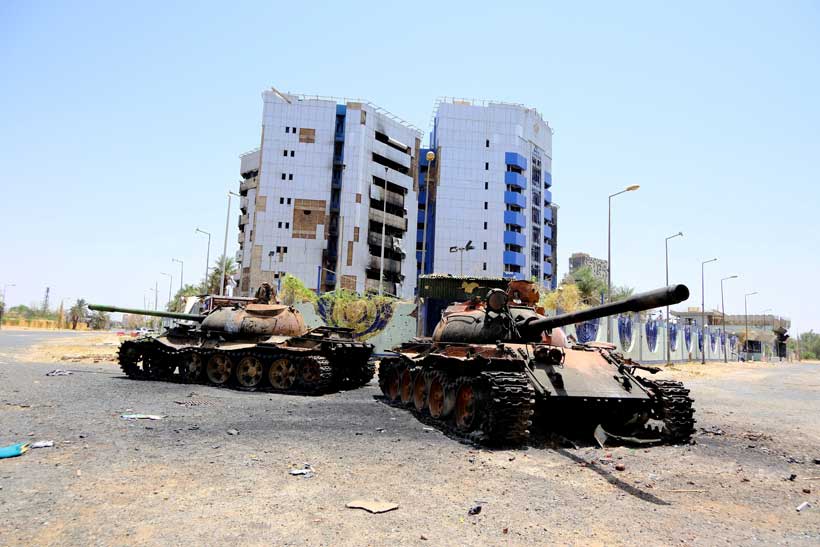
The context is grim. Sudan’s war, now in its third year, has produced mass displacement, famine conditions, and mounting allegations of atrocities by both sides. The US has increasingly framed its policy as an attempt to force a humanitarian truce while cutting off external support to the belligerents.
What makes this round of sanctions more consequential is its symbolic reach. The chemical weapons finding gives Washington a legally and politically heavier basis for escalation than ordinary conflict-related sanctions. It tells banks, exporters, and governments that doing business with Sudan is not merely risky but incompatible with US policy. For the SAF, that narrows options further, even if it does not end the war on its own. An uncomfortable aspect is that Saudi Arabia has emerged as a key external backer of the SAF, providing financial, military, and diplomatic support to General Abdel Fattah al‑Burhan.
In effect, the message from Washington is that Sudan’s military rulers can no longer expect the usual space to borrow, trade, and fly while the conflict continues. The pressure is now being applied across the board, and the airspace and the balance sheet have both become instruments of punishment.