


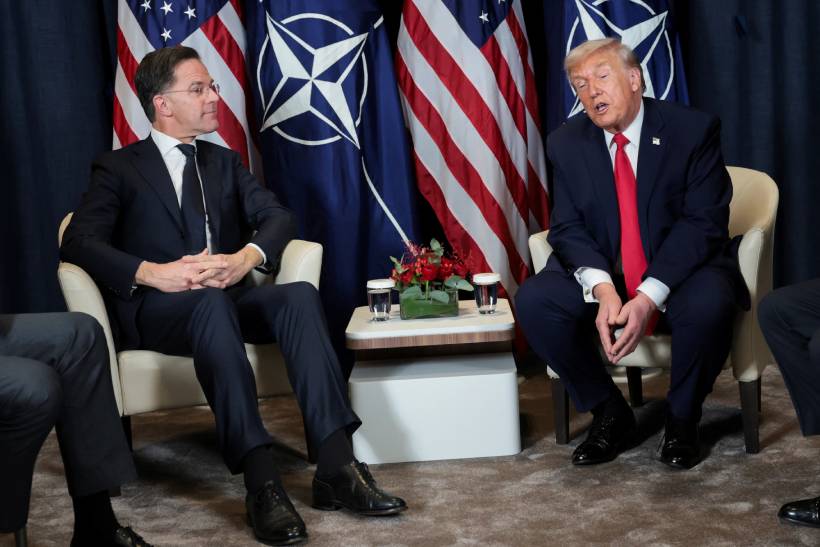
As Turkey prepares to host NATO’s upcoming summit, Donald Trump has once again placed the alliance’s future at the centre of US strategic recalibration.
His second presidency has accelerated efforts to reshape both European security and NATO itself. Signalling a more transactional approach to long-standing alliances and a renewed push to reassert American influence over the global order.
This agenda reflects a broader shift towards redefining long-standing alliances through a transactional lens, directly challenging diplomatic traditions.
Either In Or Out
Stay ahead of the geopolitical week.
MD Briefing delivers expert analysis across five global fronts — the Indo-Pacific, energy, geoeconomics, European security, and the Middle East — every Monday morning. Free.
In a move to exponentially increase NATO’s defence spending, the US administration has stimulated a budgetary gambit: more spending or risk a US withdrawal from the alliance.
A pressure mechanism creating urgency among member states and forcing high officials to reassess their fiscal priorities and strategic engagements.
As US diplomats heightened the tension behind closed doors: NATO members were strongarmed to allocate 5 percent of their national GDP to core defence requirements and security.
Directly opposing the reluctant parties to the willing members ready to opt-in this new Trumpian defence vision. A successful operation orchestrated by the master of the Art of the Deal – resulting in a fragmented 32-member bloc questioning the alliance’s existence under its current format.
A clear sign of Trump’s US-tainted ambitions for NATO, sidelining the economic disparities rooted at the heart of the alliance.
Not without any critics – highlighted by Spain, Belgium and Slovakia – this new pact engages an aggressive vision of defence. A policy standard vehemently cheered and appreciated amongst high level US intelligence officers seeking to thwart the global ambitions of its long-term adversaries.
Evidently, NATO faces an existential dilemma as its core is strained by competing global interests and domestic budgetary constraints. A balancing act Trump’s administration has so far failed to ease – prioritizing its interests and increasing burden sharing at all costs.
A new reality, where peace through strength is guaranteed by hefty defence investments, operational development and the modernization of military forces.
This paradigm emphasizes readiness and rapid response capabilities, placing technological superiority and interoperability at the forefront of NATO’s future.
An Alliance Craving Strength
As the US administration sees it: the stronger NATO appears, the more conflicts it can prevent. If there is any truth to this hegemonic perspective, it is not without any fallacies.
In a move to conceive his vision, Donald Trump relies on a long-standing fear – Europe’s inability to stand up to Moscow without Washington’s military aid.
A hallmark approach that has forged US influence over the transatlantic alliance. And simultaneously exposed NATO’s asymmetrical nature. For the Europeans, this dysfunctional relationship jeopardizes its own strategic dependency and enhances its submission to American engagement.
As the US deepens its reliance on military strength, it risks undermining NATO’s diplomatic consensus decision-making mechanism. Leaving might as the powerbroker for military direction – a defining strategy of US statecraft.
As the US administration hails this operational signature, Europeans are stranded seeking for a more altruistic approach. A wicked situation Trump positively receives – and even bets on.
If there is any hope for NATO to succeed, European officials must oppose US unpredictability and develop beyond the transatlantic security umbrella.
A new reality, demanding sustained coordination across defence industries and joint cooperation between national institutions.
Changing Generational Stagnation Has A Cost
For generations, European leaderships have been reluctant – and failed to form a cohesive and functional defence framework.
Leaving a gaping hole for US superiority; resulting in successive American administrations profiting of Europe’s stagnating defence architecture.
This pathological European cocktail: relying on reserve forces mixed with political unwillingness to adopt joint defence policies has structurally weakened the European bloc.
Creating a systemic pattern of indecisiveness and underinvestment exposing the vulnerabilities of the US’s most reliable partner.
For too long, the Europeans have entrusted their raison d’être and their defence sovereignty to the French and British – the two powers possessing nuclear deterrence. This Franco-British union has perpetuated a fictitious sense of co-shared military viability.
A false doctrine the Trump administration has turned to its advantage.
As Trump continues to send shockwaves, European officials are left second guessing if their current capabilities can match their ambitions. A reality highlighted by Europe’s inability to successfully deal with major crises and international operations.
Overcoming Strategy Inertia
It is time for European officials to reopen discussions on armament, defence industrial policy and military cooperation. Yet the challenge extends far beyond defence spending alone.
For years, restrictive European policies have constrained strategic economic growth, weakening the continent’s industrial competitiveness and, by extension, its military contributions on the international stage.
Prolonged underinvestment, sluggish productivity growth, and declining industrial dynamism – in comparison to the United States and, increasingly Russia – have ruined Europe’s ability to sustain credible military power. Without addressing these shortcomings, higher defence budgets alone will prove inefficient.
This economic reality sits at the heart of Europe’s defence dilemma. Evidently becoming an essential factor European leaders must address to reassure Trump.
Questions related to defence spending, establishing joint military ventures and rebuilding the military industries must become strategic priorities. Rebuilding Europe’s defence posture requires more than political commitment – it demands a renewed course and economic vision capable of sustaining long-term military readiness.
A wake-up call for deeper integration, this moment should prompt Europeans officials to establish their credibility as reliable security partners – seeking to build a collective defence.
A wish the US administration is unequivocally hoping for.
At an EU political level, the Granada declaration has designed a strategic course for military mobility and resilience. An ambitious project highlighting a generational shift in Europe’s defence sector.
As Trump continues to lead a fragilized NATO – European partners should expect more ambiguity.
Beyond military preparedness, Europe must strengthen its energy security, cyber defence and industrial coordination to withstand future geopolitical shocks.
Trump’s ambitions are a clear lesson for Europe: American security guarantees can no longer be taken for granted. And critical investments and decisive policies must become Europe’s key compass.
As Trump’s efforts to reshape NATO continue, the resilience of Europe’s security architecture will determine whether the continent can project power, credibility, and strategic influence without relying on Washington’s leadership.
