


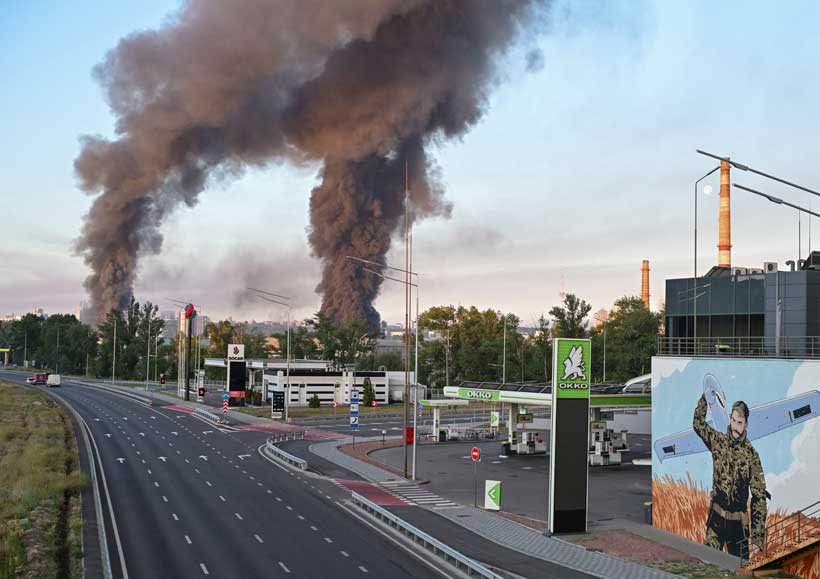
Russia launched another large-scale overnight missile and drone attack on the Kyiv region, killing at least 14 people, injuring dozens, and damaging warehouses and civilian infrastructure. The assault highlights Moscow’s continued focus on overwhelming Ukraine’s air defenses while intensifying pressure on the capital.
Heavy Strike Targets Kyiv Region
Emergency officials said Russian strikes killed 14 people and injured 27 across the Kyiv region, while authorities in the capital reported one death and 24 injuries. Warehouses, storage facilities, and industrial sites were among the locations hit, with rescue teams continuing to search through collapsed buildings for survivors.
The attack also triggered fires and an ammonia leak, adding to the challenges facing emergency responders.
Missile Barrage Tests Ukraine’s Air Defenses
According to Ukraine’s Air Force, Russia launched four Zircon hypersonic missiles, 24 Iskander-M ballistic missiles, and 115 drones overnight.
Stay ahead of the geopolitical week.
MD Briefing delivers expert analysis across five global fronts — the Indo-Pacific, energy, geoeconomics, European security, and the Middle East — every Monday morning. Free.
While Ukrainian air defenses intercepted or suppressed 98 drones, officials said no missiles were successfully destroyed, underscoring the growing challenge posed by Russia’s expanding use of advanced ballistic weapons.
Patriot Missile Debate Gains Urgency
The latest assault comes as Kyiv continues urging Washington to provide additional PAC-3 Patriot interceptor missiles, one of the few systems capable of intercepting advanced ballistic missiles.
At the same time, discussions continue between the United States and Ukraine over potential domestic production of Patriot missiles, despite uncertainty surrounding the Trump administration’s long-term support for the initiative.
Escalation Continues on Both Sides
Russia said it targeted logistics hubs and supply facilities it claims support Ukraine’s military operations.
Meanwhile, Ukraine continued its campaign against Russian logistics infrastructure, reportedly striking another logistics hub linked to Russian retailer Wildberries, reflecting Kyiv’s broader effort to disrupt Russian supply chains far from the front lines.
Russia Is Increasing Pressure on Ukraine’s Air Defense Network
The latest strike suggests Russia is shifting toward saturation attacks that combine ballistic missiles, hypersonic weapons, and large drone swarms to exhaust Ukraine’s increasingly strained air defense systems. While drones can often be intercepted, advanced missiles such as the Iskander-M and Zircon remain significantly harder to stop, increasing pressure on Kyiv to secure additional Patriot interceptors. At the same time, Ukraine’s retaliatory strikes on Russian logistics networks indicate that both sides are increasingly targeting the infrastructure that sustains military operations rather than relying solely on battlefield gains. As missile stockpiles, interceptor availability, and industrial production become central to the conflict, the war is evolving into a contest of endurance in which logistics and defense manufacturing may prove as decisive as frontline combat.
With information from Reuters.
