



On May 31, Lebanese Prime Minister Nawaf Salam gave a televised address in which he condemned Israel’s invasion and intensified attacks on southern Lebanon as a dangerous escalation, warning that a “scorched-earth policy” will never bring security to Tel Aviv: “Israel must understand that with its scorched-earth policy, collective punishment, and the bulldozing of villages and towns, it will gain neither security nor stability.”
As Salam said, this process is now advancing. “Israel is practicing mass displacement that amounts to collective punishment. It no longer targets only specific locations or areas, but has adopted a policy of comprehensive destruction of cities, towns, and all aspects of life within them.”
Tactical wins, strategic devastation
Israel’s Obliteration Doctrine is a lethal mix of scorched earth policy, collective punishment and civilian victimization, coupled with massive indiscriminate bombardment and systematic use of artificial intelligence (AI), as I have demonstrated in The Obliteration Doctrine (2025) and The Fall of Israel (2024).
Stay ahead of the geopolitical week.
MD Briefing delivers expert analysis across five global fronts — the Indo-Pacific, energy, geoeconomics, European security, and the Middle East — every Monday morning. Free.
This doctrine often goes hand in hand with ecocide, which Israel has committed in Gaza and is committing in Lebanon. The net effect is ethnic cleansing and, given continued and unhindered escalation, genocidal atrocities.
Whether Prime Minister Netanyahu, former PM Naftali Bennett or former head of the Israeli defense forces Gadi Eisenkot will win the 2026 Israeli legislative election is effectively immaterial. With or without Netanyahu, the Obliteration Doctrine will prevail.
Netanyahu brought to power the most far-right Messianic government in Israeli history. Naftali Bennett is a millionaire politician and the ex-leader of a religious Zionist far-right party. Ironically, the more “moderate” of the three is the ex-military chief Gadi Eisenkot who first tested the Obliteration Doctrine in Dahiya, a Shia enclave in Beirut in 2006.
The greatest threat to Israel’s long-term future is not external enemies alone, but the transformation of military escalation into a permanent governing principle. Once security policy becomes inseparable from territorial expansion, ethnic cleansing and perpetual warfare, the consequences extend far beyond the battlefield.
From Gaza to Lebanon and Iran – and back
The Gaza war has already produced one of the gravest humanitarian crises of the 21st century. Across much of the Global South, public opinion increasingly interprets the destruction of Gaza through the lens of displacement, collective punishment and ethnic cleansing. Understandably, the expansion of military operations into Lebanon has reinforced those perceptions.
This divergence in perception is becoming one of the defining geopolitical fault lines of our era. In the view of the Global South, military realities on the ground continue to outpace diplomacy. The question is no longer whether the conflict will reshape the region, but how extensive that transformation will become.
In The Obliteration Doctrine, my greatest concern was that “what happens in Gaza won’t stay in Gaza.” It is now a lethal blueprint and a broader regional template. Hence, the large-scale destruction of towns, repeated displacement of civilians, and continuing cross-border operations in Lebanon.
The broader U.S.-Israel-Iran confrontation has become increasingly intertwined with the Lebanon-Gaza conflict, with attacks, counter-attacks and continuing tensions around the Strait of Hormuz generating major energy-market disruptions.
The energy crisis connection
The strategic significance of the conflict has increased dramatically because it now intersects directly with the U.S.-Israel-Iran confrontation. Even partial disruptions have triggered sharp increases in oil and gas prices and heightened concerns regarding inflation, growth and supply security.
Since the escalation of regional conflicts stretching from Gaza and Lebanon to the Red Sea and the Persian Gulf, energy markets have become increasingly vulnerable to disruption. Shipping routes, insurance costs, strategic chokepoints and investment decisions have all been affected by growing instability. What began as the devastation of Gaza has evolved into a crisis with potentially global economic consequences.
The Middle East remains the world’s most important energy-producing region. Even when actual supply disruptions remain limited, the risk premium generated by military escalation can significantly increase energy prices. Such increases function as a global tax on growth – as the epicenter of the crisis, Asia is a prime example.
For advanced economies already burdened by high debt levels and slow productivity growth, persistent energy inflation undermines economic recovery. For developing countries dependent on imported energy, the consequences are even more severe. Rising fuel costs translate into higher food prices, greater fiscal deficits and heightened social instability.
The Gaza-Lebanon crisis is therefore not merely a regional conflict. It is part of a wider process linking geopolitical fragmentation, energy insecurity and economic deceleration.
US-Israel connection
Washington remains Israel’s indispensable strategic partner. Military cooperation, intelligence sharing and diplomatic support continue to provide the foundation of Israel’s security architecture. Yet the relationship faces growing contradictions.
American policymakers increasingly confront a centrifugal dilemma. On one hand, they seek to preserve Israel’s military superiority and deterrence capabilities. On the other, they must manage the economic and geopolitical consequences of prolonged regional conflict.
At the same time, these policymakers are challenged by the increasingly vocal Israel lobby, the export exigencies of the US military contractors and the rising opposition of the American electorate, particularly the younger voter cohorts.
Every expansion of the war imposes costs on broader American interests. Energy volatility threatens global growth. Escalation risks confrontation with regional powers. Humanitarian devastation fuels anti-American sentiment across much of the Global South.
So, Washington’s objectives are becoming increasingly complex and self-defeating. It seeks Israeli security without regional war, deterrence without escalation, and strategic dominance without bearing the full economic and political costs of prolonged conflict.
As those goals are proving increasingly difficult to reconcile, Washington is burdened by both Israeli insecurity and a regional war, escalation without deterrence, the full spectrum of costs of the prolonged conflict – and increasing concerns about crumbling strategic dominance in the region.
Expanding arc of war – and risks of miscalculation
The most significant recent development is the gradual fusion of multiple conflicts into a single strategic theater. Gaza, Lebanon, the Red Sea, Syria, Iraq and the Persian Gulf increasingly form interconnected fronts within a broader contest between the U.S.-Israel partnership and Iran’s regional network.
Military actions in one arena now generate repercussions across the others.
This expanding arc of war magnifies the risks of miscalculation. A localized confrontation that might once have remained contained now possesses the potential to trigger regional escalation, energy shocks and wider geopolitical fragmentation.
This is precisely how localized wars become systemic crises.
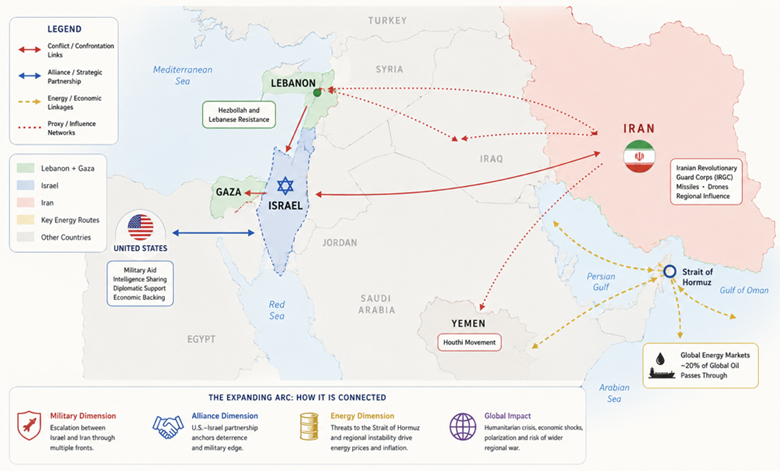
The Expansive Arc of War
Israel risks validating the warning implicit in both The Fall of Israel and The Obliteration Doctrine: that a state can achieve tactical successes while simultaneously undermining the foundations of its own long-term security and legitimacy.
Every tactical win is setting the stage for further strategic failure, deeper divides internally, and greater international estrangement.
International crisis of credibility
The international response has exposed a growing crisis in global governance. Until the devastation of Gaza, many Western governments emphasized Israel’s security concerns while expressing futile concern about civilian casualties in the Middle East.
Many countries in Asia, Africa and Latin America have a markedly different perspective, focusing on humanitarian suffering, displacement and alleged violations of international law. As these narratives diverge, confidence in international institutions continues to erode.
For much of the Global South, the perception of selective enforcement of international norms has become increasingly difficult to ignore. If international law appears applicable to some states but not others, its legitimacy inevitably suffers. This credibility gap may prove one of the most enduring consequences of the conflict.
The central question is no longer whether the Gaza war has transformed the Middle East. It has. The question is whether the region is moving toward stabilization or toward a broader doctrine of permanent conflict.
If military escalation continues, the consequences will extend far beyond Israel, Lebanon and Gaza. Energy insecurity, economic fragmentation, humanitarian crises and geopolitical polarization will increasingly shape the international system.
The tragedy is that all parties face mounting risks. Lebanon risks further devastation. Gaza faces a reconstruction challenge of historic proportions. The United States risks strategic overstretch. The international community risks institutional irrelevance.
The road ahead
Modern conflicts are no longer judged solely by military outcomes. They are judged by their developmental consequences. A military victory that produces permanent economic devastation can become a strategic defeat.
The tragedy of the current moment is that every actor increasingly perceives escalation as necessary while simultaneously fearing its consequences.
Lebanon risks deeper devastation. Gaza faces prolonged humanitarian catastrophe and uncertain political futures. Iran confronts mounting economic and military pressures. The United States faces growing strategic commitments. Israel confronts rising diplomatic isolation even as it seeks greater security.
In the resulting obliteration dynamic, military escalation progressively destroys the political and economic foundations needed for lasting peace.
In this view, the debate over ethnic cleansing, genocide and obliteration is not merely a legal or moral argument. It is a debate about whether the region can escape a cycle in which every military victory plants the seeds of the next catastrophe – and possibly of an overwhelming global downturn.
*Author’s note: The original version was published by the Informed Comment (US) on June 4, 2026.
