


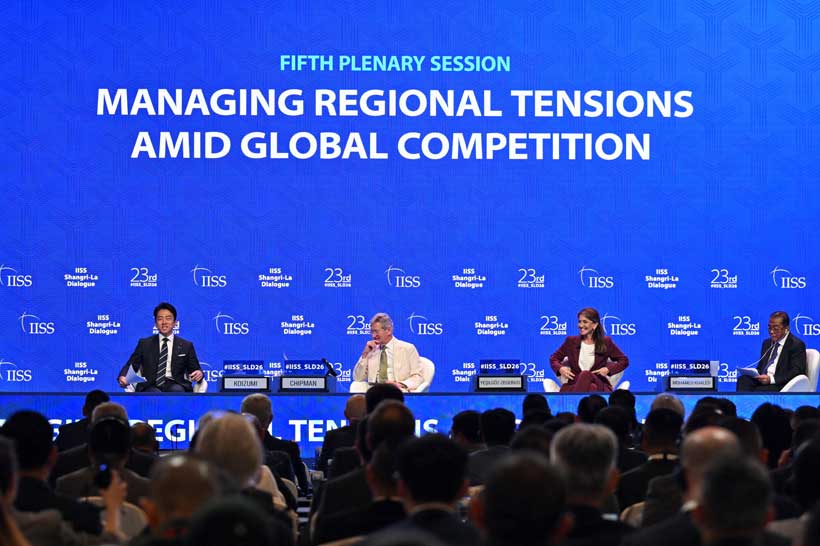
What particularly caught my attention analytically was the coverage broadcast by China’s state television and CGTN on June 1, 2026, following the launch of the Shangri-La Dialogue in Singapore. Their report explored how the Shangri-La Dialogue’s statements reflected progress in bilateral relations between China and the United States and why stable relations between the two countries are essential for the Asia-Pacific region. The CGTN analysis highlighted a positive shift in the diplomatic tone between Beijing and Washington, based on the outcomes of the Shangri-La Dialogue 2026 in Singapore, which came just two weeks after the bilateral summit between Presidents Xi Jinping and Donald Trump in Beijing. The analytical dimensions of this Chinese media coverage and the political signals conveyed by the Shangri-La Dialogue 2026 can be summarized through China’s formulation of the concept of constructive strategic stability within the framework of the outcomes of the presidential summit between Xi Jinping and Trump. Chinese coverage emphasized that this constructive strategic stability, agreed upon by Xi and Trump in Beijing, represents a necessary safety net preventing economic and technological competition from escalating into open military confrontation. While the Chinese report focused on monitoring and analyzing the shift in diplomatic tone, it observed a move from the sharp verbal clashes that characterized previous Shangri-La Dialogue summits to a focus on managing differences. This was further confirmed by US Secretary of Defense Pete Hegseth’s remarks during the dialogue, when he described the outcomes of the Beijing summit as a great framework established by both leaders.
And so the Shangri-La Dialogue 2026 emerged amidst acute international turmoil, particularly the energy crisis resulting from the closure of the Strait of Hormuz in the context of a potential US-Israeli war against Iran. Chinese media emphasized that the stability of the Beijing-Washington axis is the only safeguard against the spillover of these conflicts and wars into the Asian arena. Chinese media reports also conveyed the position of ASEAN countries and the stances of Asian officials, such as Singapore’s Defense Minister Chan Chun Sing, who affirmed that the Sino-American consensus provides Southeast Asian countries with breathing space and spares them the pressure of having to choose sides in a polarized environment.
The most prominent themes of the Chinese report and the dimensions of the vision broadcast by the Chinese channel, regarding the future of Chinese-American relations and their impact on the Asia-Pacific region, were the focus on indicators of progress in bilateral relations (according to the Chinese vision) through the shift from confrontation to communication. Here, the report of the Chinese channel CGTN focused on the fact that the statements of the two delegations (Chinese and American) at the Shangri-La Dialogue security forum in Singapore tended towards a desire for dialogue and building trust instead of direct confrontation, with the adoption of the concept of constructive strategic stability. The Chinese media report indicated that the two sides agreed on the framework reached at the Beijing summit. In a notable move highlighted in the report, US Secretary of Defense Pete Hegseth stated during the dialogue, he said, “The new vision of building relations based on mutual respect and recognition of capabilities is a genuine, fundamental, and meaningful vision for the history of peace in the region and the world.” In addition to demonstrating the Chinese desire to activate the agreement with the US, the report also highlighted that Chinese experts, such as former Chinese Ambassador to Washington Cui Tiankai and representatives of the People’s Liberation Army, emphasized that the crucial test now is translating this political agreement with Washington into concrete military actions and practices on the ground to ensure the sustainability of the truce.
Here, stable Sino-American relations are imperative for the Asia-Pacific region to avoid a policy of narrow alliances and blocs. China believes that attempts to build closed circles or exclusionary alliances, such as the recent moves between Japan and the Philippines with US support, destabilize the region. Therefore, stable relations between the two powers prevent Asia from fracturing into rival military blocs, reviving the atmosphere of the Cold War. Furthermore, given China’s desire to secure maritime routes and the regional economy, in light of current global geopolitical turmoil, such as the energy and waterway crises in the Strait of Hormuz, the Asia-Pacific region needs a stable security umbrella. Therefore, the Chinese report emphasized that the major powers’ departure from a zero-sum mentality protects the close economic interdependence and supply chains in the region and provides a safety net for ASEAN countries. Sino-American stability gives Southeast Asian nations, or ASEAN, breathing space and spares them political pressure to choose sides, thus reinforcing ASEAN’s central role in leading regional security.
Stay ahead of the geopolitical week.
MD Briefing delivers expert analysis across five global fronts — the Indo-Pacific, energy, geoeconomics, European security, and the Middle East — every Monday morning. Free.
China’s strategic vision regarding the recent military and political moves of US allies in the Asia-Pacific region is highlighted by understanding and summarizing the dimensions of the Chinese position advocating for the concept of common security. Beijing believes that regional security is not achieved by isolating certain parties, but rather through comprehensive cooperation that includes everyone without exception, rejecting the Cold War mentality. China classifies emerging alliances, such as the military rapprochement between Manila and Tokyo sponsored by Washington, as a revival of the politics of axes that divide the region into hostile camps. Meanwhile, China is apprehensive about Reciprocal Access Agreements (RAAs), as China views with concern the recent defense agreements that allow for the deployment of Japanese forces in the Philippines, considering them a direct American attempt to encircle it maritimely and stifle its influence in the South China Sea. Therefore, the Chinese perspective emphasizes that stable relations between Beijing and Washington are the only guarantee for economic prosperity in the region, given that the two countries represent the largest economic and military powers there.
On the other hand, despite China’s optimistic tone regarding diplomatic progress with Washington, the Chinese side has drawn numerous red lines and issued continuous warnings. The Chinese CGTN report reiterated Beijing’s firm positions on the Taiwan issue. The Chinese delegation participating in the Shangri-La Dialogue security conference in Singapore reaffirmed that the Taiwan issue is a purely internal matter for China and a red line that cannot be compromised, warning that separatist forces threaten peace across the Taiwan Strait. China emphasized the concept of common security with Beijing through the CGTN report, defending its Global Security Initiative (GSI). The report stated that no country can build its absolute security at the expense of undermining the security of other countries.
Based on the preceding understanding and analysis, we can summarize the analytical landscape of Chinese media reports regarding the Shangri-La Dialogue in Singapore 2026, which highlighted Beijing’s current vision calling for a temporary strategic truce and prudent management of geopolitical competition. China is leveraging this media coverage to present itself to the international community as a responsible party committed to regional peace, thus placing the onus on the United States to test Washington’s commitment to translating the promises made at the Beijing summit into concrete policies on the ground.
