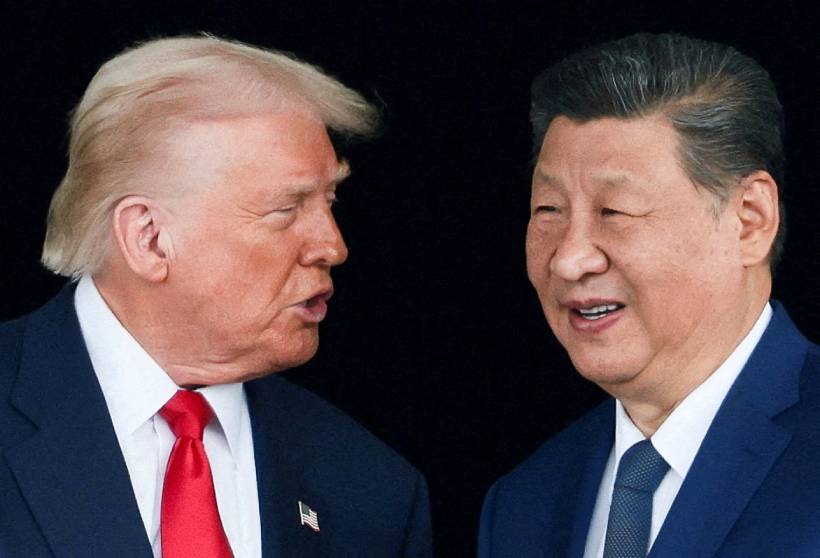
For decades, geopolitical scholars have been concerned about a potential hot war between China (the “rising” power) and the US (the “ruling” power) because of the Thucydides Trap, which warns that conflict between the two will very likely occur when a rising power becomes strong enough to unseat the ruling power. Harvard professor Graham Allison has collated 16 cases of it in the past 500 years, in which 12 resulted in hot wars and only four did not. Although scholars like Allison acknowledge that there are no universally agreed-upon metrics of national power, their consensus is that such metrics should at least account for three fundamental power attributes: (1) military power, including technology and war preparedness, (2) economic power, including size and industrial capacity, (3) soft power, including trade and diplomacy. In this article, I shall demonstrate that in all three attributes (metrics), today’s China is either on par with or has already overtaken the US. Therefore, the so-called rising power has already risen, and the so-called ruling power no longer rules. The Thucydides Trap is over between China and the US; the 17th case has resulted in no hot war. The intriguing question is: why are we still talking about it? Even the president of China brought up this topic at the Trump-Xi summit in May. The answer lies in a common mental condition: denial.
Military Power: (a) technology, (b) war preparedness
Technology: To meaningfully compare military power between China and the US, we shall avoid unrealistic war scenarios, such as nuclear wars (no winner), or ground invasions (illogical). We shall focus on realistic scenarios, namely Taiwan and the South China Sea. Because these battlegrounds would occur in the ocean and the sky, we shall compare the two nations’ industrial capacity and technological ability in making (1) battleships, (2) missiles and (3) fighter jets.
(1): In the past three decades, the US has essentially lost its ability to build battleships, while China’s ability has soared. In 2024, an article from the US Naval Institute said, “The United States does not have the shipyard capacity to build new ships and fully maintain or repair ships it currently holds in inventory.” In the same year, an US Navy intelligence briefing said that China’s shipbuilding capacity was over 230 times that of the US, while a CSIS report said that China “possesses the world’s largest maritime fighting force.”
Stay ahead of the geopolitical week.
MD Briefing delivers expert analysis across five global fronts — the Indo-Pacific, energy, geoeconomics, European security, and the Middle East — every Monday morning. Free.
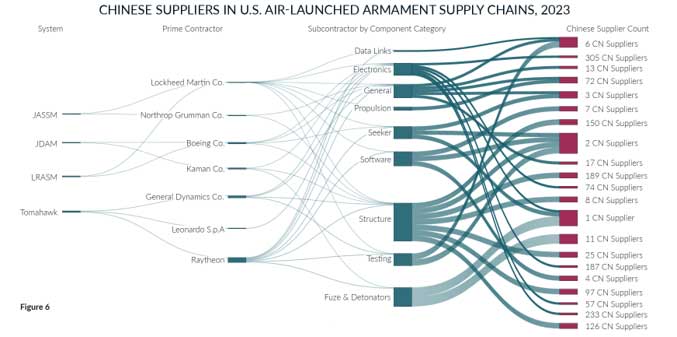
(2): China has many types of hypersonic missiles (speed over five Mach), while the US has none. The US does have a few relatively advanced missiles. But to build them, it has to import almost half of its required semiconductor components from China, as illustrated in the graph below:
(3): Because of trade wars between them, China has restricted the sale of rare earths to the US, materials critical in making advanced weapons, including fighter jets. Consider the F35, one of America’s most advanced fifth generation fighter jets. Building a single F35 requires 920 pounds of rare earths. Without rare earths, these jets cannot be completed. A 2026 report says that the US plans to deliver 300 of its F35 jets without radar, implying that pilots who fly these jets will have to fight their air battles blindfolded. As for China, its capability in building fighter jets is increasing rapidly both in quality and quantity.
War Preparedness: Credible war scenario predictions reveal how prepared a given country is for war. The US secretary of war Peter Hegseth said in April 2025 that if a hot war were to occur between the US and China over Taiwan, China’s hypersonic missiles would annihilate the US carriers before those carriers could reach flight distance to Taiwan, resulting in a total destruction of all the US fleets in 20 minutes. The Pentagon basically agrees with Hegseth. After conducting multiple war simulations between the US and China over Taiwan and the South China Sea, the Pentagon concluded in its December 2025 Overmatch Brief that the US would “most likely suffer decisive defeat.”
Economic Power: (a) size, (b) manufacturing capacity
Size: The economies of China and the US belong to a separate league by size; each is at least 4-5 times the size of the world’s third economy. That having said, comparing their sizes presents a dilemma because in measuring the size of a given economy, economists use two different yardsticks: Nominal GDP and GDP by PPP. Because each yardstick has its own merits, economists do not favor one over the other. Our problem here is that depending on the yardstick used, the outcome can be completely opposite. Using Nominal GDP, today’s US economy is roughly 1.5 times larger than that of China. Using GDP by PPP, today’s Chinese economy is roughly 1.3 times larger than that of the US. For the sake of our discussion, we shall consider these two economies similar in size.
Manufacturing Capacity: Here, the two countries differ tremendously. China’s manufacturing capacity today is about twice that of the US, exceeding the combined capacity of the next nine countries.
Soft Power: (a) trade, (b) diplomacy
Trade: In 2001, the US was the number one trading partner with the rest of the world. By 2023, China overtook the US as number one and its trade volume has continued to grow. By 2025, its trade with the world reached a new historic high, with a record $1.2 trillion surplus.
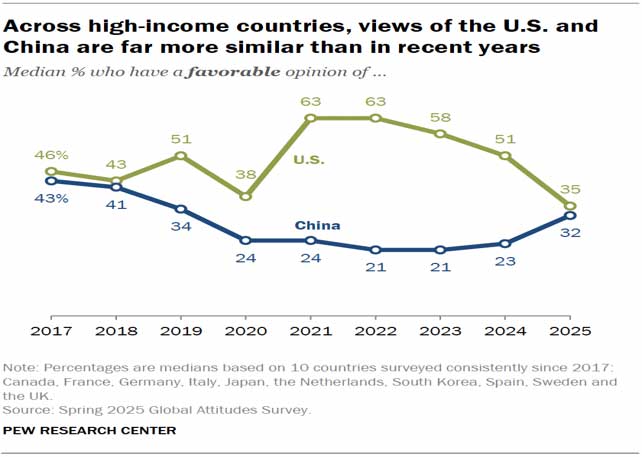
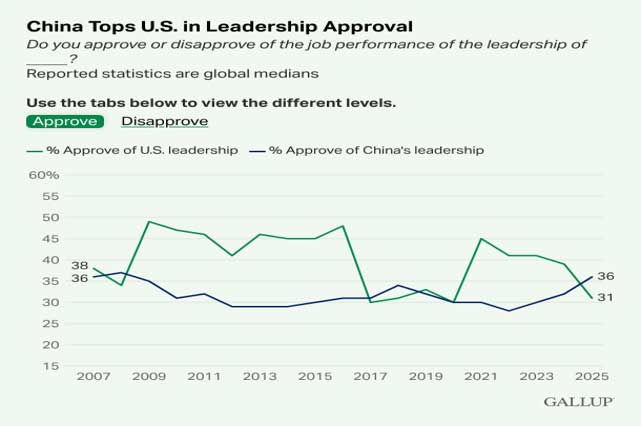
Diplomacy: Without reliable yardsticks, it is difficult to objectively evaluate a country’s diplomatic ability. With that limitation in mind, we shall analyze some opinion polls regarding how China and the US are being perceived across the world, cognizant that such polls are likely affected by confounding factors, such as race, religion and social ideologies. Overall, polls done in recent years are slightly in favor of China in relative terms, although the two nations are quite similar in absolute terms. A 2025 Pew Research poll of 24 countries showed that although the final numbers were similar, “views of the U.S. have worsened while opinions of China have improved,” as depicted in the graph below:
A 2026 Gallup poll of 44 countries showed that “U.S. leadership approval falls to 31% as China’s climbs to 36%,” as depicted in the graph below:
Conclusion:
Summarizing the above discussions, aside from economy size and diplomacy, where the two countries are similar, in all other national-power metrics, China clearly outmatches the US. Therefore, the net result suggests that China has already unseated the US from its hegemonic throne. The window of opportunity for the Thucydides Trap has passed. Objectively speaking, this trap is no longer relevant. Then, why is it still newsworthy? It is because human beings often do not behave objectively. Our actions are guided more by emotions than by intellect. Here, clinical psychology can help shed some light.
After the collapse of the former Soviet Union around 1991, the US became the world’s sole hegemon and foresaw no candidate nation that could threaten its top-dog status. It probably felt invincible. When warnings first emerged around 2012 that China (a nation that could barely feed itself three decades ago) might become such a candidate by 2030, the US leadership dismissed the warning as something bizarre and surreal. When these warnings continued to come forth in the ensuing years, the US remained in disbelief and would not confront the matter rationally. Instead, it behaved erratically, such as by starting trade wars with China, pressuring Canada to detain the CFO of Huawei (a Chinese tech company) and restricting chip sales to China, as if the way to stop a boy from growing up were to make him wear undersized shoes and tight T-shirts. It treated the rise of China as a nightmare that just needed to be shaken off. Instead of formulating a coherent strategy about how to coexist with a rising China, the US authorities responded with “shakes and jerks,” hoping that some “miracle” would fall from the skies and make this whole China thing go away. Meanwhile, they have lost valuable time, while China has swiftly and quietly surpassed the US in national power. Refusing to face the reality until even today, they cling onto the notion of the Thucydides Trap, not because they want to avoid a hot war with China, but because they refuse to acknowledge and accept that they have already lost.
Such irrational behaviors are known in clinical psychology as living in denial, a relatively common mental condition where the patient refuses to accept and confront his disease. There is no telling how long such a patient may remain in denial. Aware of this US mental predicament, China is all too happy to string and play the US along. Strategically speaking, its behavior is rational. In any long-term contest, if your opponent (for whatever reason) starts to dream or sleepwalk, you would be wise to foster that behavior and not to wake him up, even when the contest is already over.