


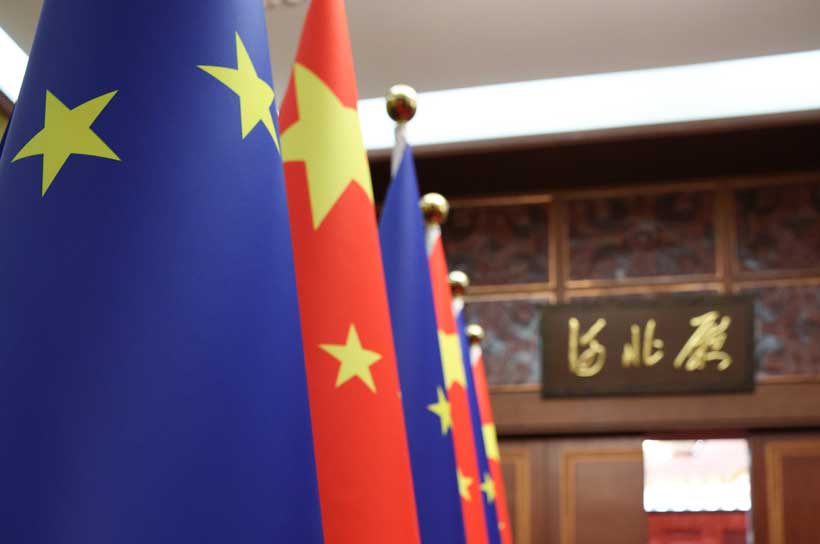
Last Friday, as the European Commission met in conclave to discuss how to get tough with China, a very different debate took place on the other side of the world. The Xi’an Dialogue brought together a group of globally distinguished European and Chinese scholars, international lawyers, trade gurus and former Ambassadors, to “explore the scope for common ground between China and Europe in a time of economic turbulence”[1].
The Commission meeting agonised over the threat to Europe posed by China’s export competitiveness and supply chain domination, from rare earths to electric cars. Beyond recognising that a “coherent and robust” response to the Chinese juggernaut was needed, the debate was inconclusive.
But the tone and assumptions remain negative. The emphasis is on China as a “strategic rival”, not a partner. The windows for cooperation are closing. The EU is both clutching, straw-like, at its existing trade tools to try to dampen Chinese imports, while searching for a more effective instrument to strike systemically at Chinese industrial overcapacity. It may palliate some symptoms but not the causes.
Why Jaw Jaw is better than War War
Stay ahead of the geopolitical week.
MD Briefing delivers expert analysis across five global fronts — the Indo-Pacific, energy, geoeconomics, European security, and the Middle East — every Monday morning. Free.
The Xi’an dialogue took a radically different approach. It was an experiment to see whether there was more that unites us than divides. Whether civil society writ large can shore up the bridges that governments are demolishing. The assembled scholars understood that Europe and China are equals, sharing the same planet, and that cooperation, not confrontation, is the only way to manage our relationship in the long term. That, in Churchill’s words, “jaw jaw is better than war war”. Listening leads to dialogue. Dialogue leads to understanding, understanding leads to agreement, in the words of one participant.
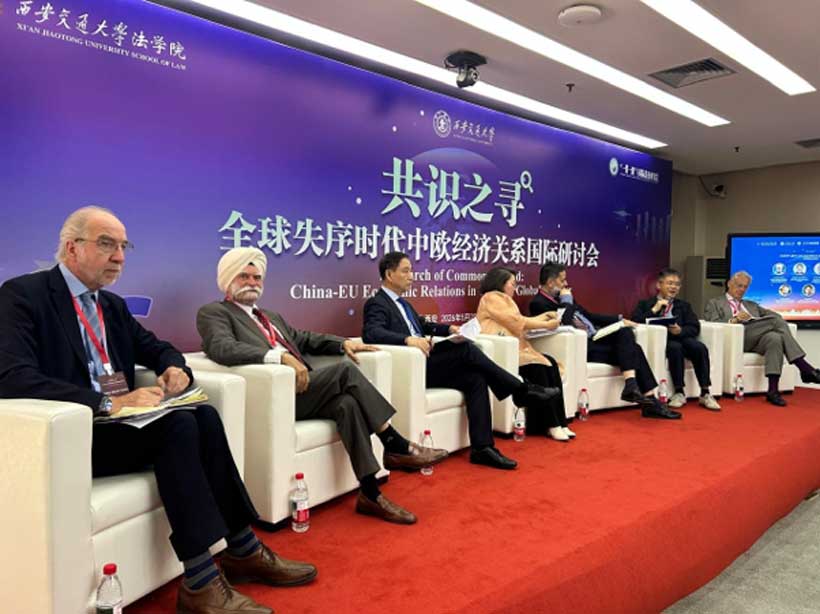
The choice of Xi’an for this conversation was not fortuitous. The home of Jiaotong University, one of China’s most renowned seats of learning (now celebrating its 130th Anniversary), Xi’an was of course the start of the Silk Road. In my opening remarks I expressed the hope that, just as Xi’an symbolised trade and the intercourse of ideas between East and West, so this inaugural Xi’an dialogue would see new ideas generated to strengthen China-EU economic and trade relations.
Let A Hundred Flowers Bloom
They were. This dialogue was momentous. Xi’an provided a safe space for honest conversations about China-EU relations: what drives our differences? What are the strengths and weaknesses of our respective political systems and how do they shape trade policy? What lessons can Europe can learn from China’s industrial policy (and China’s mistakes), as it embarks gingerly on its own? Can China and Europe cooperate to revive the WTO in the face of a destructive USA (answer: probably yes)? Does the Century of Humiliation still influence China’s scepticism about the West or is it just a convenient device to tap into European guilt? How historically deep-seated is China’s resentment towards any form of trade discrimination? Is it true that China wants a politically weak Europe that lacks the sinews to ally with the USA? And is that desire compatible with the strong EU economy that China needs as its US market shrinks? Should Europe stop flagellating itself and be proud of its economic and social model?
The Mountains are High and the Emperor is Far Away
Those were just some of the topics debated with candour during this two day conference, while the winds of Shaanxi, blowing down from the Gobi, boiled at 35c outside. Anyone who thinks that Chinese intellectuals are afraid of speaking freely will have had his or her prejudices confounded in Xi’an. Many Chinese participants were openly critical of their country’s policies and honest enough to explain what had worked and what had not.
And they often showed far greater knowledge of European policy and law than vice versa, for example in one colleague’s brilliant and scathing critique of the forthcoming Industrial Accelerator Act. This, I remarked, showed two things. First, that whereas China seems to understand Europe well, the reverse is not true. Europe needs to understand China better. It is undamentally ignorant. But secondly, China being far less transparent and rule-of-law based than Europe, unsurprisingly Chinese commentators are far better equipped than their European counterparts who cannot find the facts.
Cross The River By Feeling the Stones
The subjects in Xi’an ranged widely, from AI to critical raw materials to WTO, to competition and industrial policy, to the historical and cultural drivers of the two regions’ economic paths. But the real innovation was that this dialogue happened at all. In an environment of growing friction, competing models of governance, divergent political alliances, and with a possible trade war looming, it was courageous of Jiaotong University, and its International Law Faculty, headed by the indomitable Professor Peter Van Den Bossche (one of the world’s top trade lawyers and a former Chair of the WTO Appellate Body), to take the gamble of bringing together this strong-minded group with a mandate to ‘seek truth from facts’ as Deng might have said, and find common ground. Just Do It! was the title of one of the papers presented to the Dialogue.
Which was why we saw in one room voices from leading universities and think tanks ranging from the Delors Foundation and the Bruegel Institute, to London and Durham and Luiss Universities, from the World Trade Institute and Tsinghua and Peking Universities to the Chinese Academy of Social Sciences.
Peter Van Den Bossche in his closing remarks to this remarkable event echoed the suggestion that the Xi’an Dialogue take place annually. To stay in Xi’an given the symbolism of the city and to ensure full Chinese ownership. Over time the Dialogue may find a place in the pantheon along with the Boao Forum, Aspen or the Munich Conference.
The two regions represent over a third of global GDP and world trade – so this is too important a relationship to fail. But it will suffer through neglect. All of us in Xi’an felt keenly our obligation to promote dialogue and understanding, and to ensure that the voices of academia, civil society, independent commentators and the private sector are listened to by governments[2].
Europe, instead of announcing as it does from time to time a condescending unilateral “China Strategy” should engage with China informally – at every level – to see if trust can be built, differences explained and respect developed. China for its part should be more transparent and ready to accezpt Europe as an equal partner.
The Xi’an dialogue is ready to help. Through the Xi’an dialogue we can help governments to identify the common ground on which – while respecting our differences and divergences, some of which are fundamental – we can plant the seeds of a positive long term partnership.
[1] In Search of Common Ground : China-EU Economic Relations in a Time of Global Disorder. Xi’an China, 29-30 May 2026. Full programme at: https://ielp.worldtradelaw.net/content/files/2026/05/Xian-Conference-Handbook.pdf?attribution_id=6a1040ad938ae40001633178&attribution_type=post
[2] The full conference proceedings will be published in the coming weeks and be available online and the conference organisers will invite the Chinese government and the EU Commission to take account of the conference conclusions, factor them into their management of future economic relations, and involve the conference participants and other non governmental representatives in future consultations on the bilateral relationship.
