


The war in Ukraine has fundamentally reshaped how policymakers think about defense industrial capacity. What once appeared sufficient has proven inadequate—limited stockpiles, fragmented production structures, and nationally bounded supply chains—under a protracted and high-intensity conflict environment. At the same time, the growing risk of instability in the Indo-Pacific region, particularly around Taiwan, whether in the form of a full-fledged war or a naval blockade, suggests that future crises may not be geographically isolated. Instead, these crises could develop simultaneously across regions, imposing unprecedented strains on allies’ defense and industrial systems.
Under such circumstances, traditional defense cooperation models—grounded in procurement and short-term transactions—are no longer sufficient. For technologically advanced middle powers such as the Netherlands and South Korea, the key challenge is not merely to conduct cooperation but to build a durable and trans-regional industrial alignment that would ensure some degree of deterrence under a dual-contingency scenario—where Europe and Asia are simultaneously stressed. This necessitates a transition from procurement to integration, from efficiency to resilience, and from nationally bounded production to distributed industrial ecosystems.
Industrial Integration at Sea
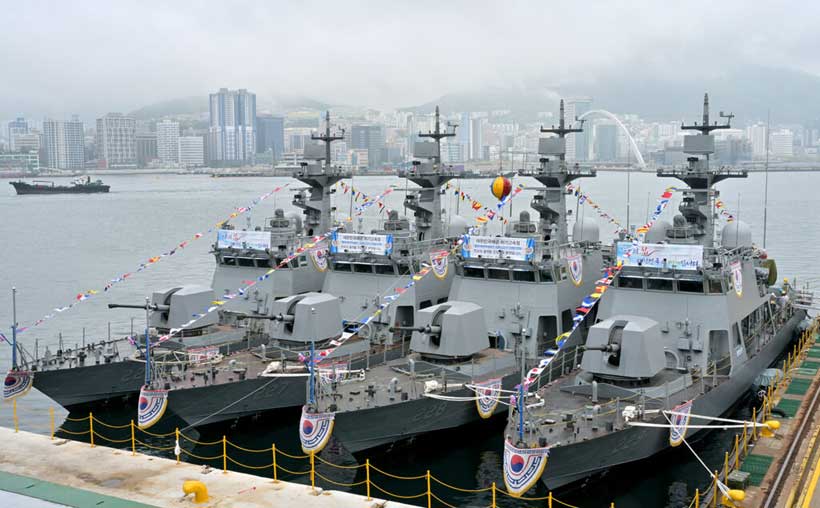
The most immediate path to such integration lies in naval industrial cooperation. In this field, the Netherlands and South Korea have highly complementary strengths. Dutch firms like Damen Shipyards and Thales Netherlands offer expertise in modular ship design, advanced radar systems, and naval electronics. Meanwhile, South Korea—centered around HD Hyundai Heavy Industries and Hanwha Ocean—has demonstrated exceptional efficiency when it comes to large-scale shipbuilding and rapid production cycles. Although each country possesses its own independent capacities, it could generate capabilities that neither could sustain alone under crisis conditions if combined.
Stay ahead of the geopolitical week.
MD Briefing delivers expert analysis across five global fronts — the Indo-Pacific, energy, geoeconomics, European security, and the Middle East — every Monday morning. Free.
Thus, rather than pursuing a parallel development program, both countries could align their respective industrial strengths through a coordinated approach toward modular naval platforms. This is far from an abstract proposal. The operational requirement is already evident. European waters, especially the Baltic and North Seas, face persistent vulnerabilities in mine warfare and the safeguarding of maritime infrastructure. Concurrently, in the Indo-Pacific, demand for distributed maritime capabilities, including unmanned systems and flexible patrol assets, is surging. A shared development of platforms such as offshore patrol vessels (OPV), unmanned surface vessels (USV), and minesweepers would therefore directly supplement overlapping operational gaps.
The peculiarity of this approach hinges not on simple co-development, but on the structuring of production itself across regions. For instance, South Korea can focus on hull construction, while mission systems—ranging from combat management systems to electronic devices—can be integrated in the Netherlands. The final assembly within Europe could enable timely delivery to NATO forces and lessen dependency on relatively vulnerable long-range logistics. With the passage of time, this structure would create a distributed naval industrial foundation that could sustain production even under disruption.
The same logic applies to defense production in a broader sense. The Ukraine war revealed the difficulties of Western defense industries in sustaining massive production over a long period of time. South Korea has demonstrated its ability to scale production, especially in the field of artillery and armored systems—evidenced by the recent export of K9 self-propelled howitzers and K2 tanks to Poland—while the Netherlands is deeply integrated into the European supply chain and its logistics networks. If these advantages are properly aligned, a resilient production model—one in which roles are distributed based on comparative advantages—can be established. South Korea can focus on systems for which large-scale production is required, and the Netherlands and its European partners could specialize in high-end subsystems, integration, and lifecycle support.
This system does not necessitate a rigidly prearranged plan or a formalized wartime commitment. Instead, it could be gradually built through shared standards, industrial interdependence, and pre-existing supply relationships. The result would be the creation of a mutually reinforcing production ecosystem capable of adapting to disruptions across regions rather than a single integrated arsenal.
The Technological Core
Beneath such visible cooperation, a fundamental requirement exists—the stable accessibility of advanced technologies. Modern military capabilities are increasingly reliant on semiconductors, which underpin everything from precision-guided munitions to ISR platforms and AI-enabled command-and-control systems. If credible access to advanced semiconductors is not possible, even the most sophisticated weapons systems could lose operational viability.
Also in this domain, the Netherlands and South Korea occupy uniquely complementary positions. The Netherlands controls the world’s most advanced lithography technology through ASML, and South Korea leads semiconductor fabrication through Samsung Electronics and SK Hynix. Despite such complementarity, a structured mechanism that links semiconductor cooperation to defense resilience does not exist at this juncture.
To resolve this gap, both countries should move from commercial coordination to strategic alignment. Instead of creating a rigid state-controlled system, both Amsterdam and Seoul could start by discerning critical vulnerabilities in defense-related semiconductor flows, sharing risk assessments, and aligning supply chain priorities. As time elapses, this could evolve into a more structural cooperation that includes joint investment, supply diversification strategies, and contingency planning for disruption scenarios.
In a dual-contingency environment, such coordination becomes more than a matter of efficiency. It becomes a question of operational continuity. By connecting upstream technological capacity to downstream manufacturing capabilities, the Netherlands and South Korea could contribute to creating a more resilient trans-regional foundation for advanced defense systems.
Sustaining Power Across Regions
Nonetheless, industrial and technological cooperation cannot function without resilient logistics. When maritime chokepoints such as the Strait of Malacca and the Suez Canal turn into points of rivalry, while Europe’s major land corridors face Russian threats, the ability to maintain the flow of supplies would likely become the key challenge.
Here again, the Netherlands and South Korea could play mutually complementary roles. While the Port of Rotterdam serves as a crucial hub for NATO logistics, Busan functions as a key gateway in Northeast Asia. If coordination between these hubs is strengthened through shared planning, information exchange, and operational training, overall trans-regional resilience could be enhanced even without creating rigid new structures.
The key objective is not to establish a formal “corridor,” but to enable the logistics system to preserve its function under strain. Joint naval exercises focused on convoy protection, mine countermeasures (MCM), and maritime domain awareness (MDA) could support this goal. In particular, the digital integration of logistics systems could facilitate the movement of high-value and time-sensitive defense components.
To sustain these efforts over time, cooperation should be anchored in an institutional foundation. Structured yet flexible mechanisms such as a Netherlands-South Korea Defense Industrial Council could facilitate the alignment of government agencies, industrial stakeholders, and existing alliance structures while providing consistency. Its primary role would be to ensure coordination and long-term strategic direction rather than impose hierarchy.
Crucially, these efforts at institutionalization should be connected to broader NATO and Indo-Pacific security structures. The value of bilateral cooperation hinges on complementing and reinforcing existing alliance mechanisms and not merely duplicating them. Regular joint exercises based on realistic scenarios such as simultaneous contingencies across regions would further translate industrial and technological cooperation into operational readiness.
Conclusion
The newly emerging security environment is defined not only by increasing threats but also by their interconnected nature. For the Netherlands and South Korea, the task is to adapt to a world in which crises in Europe and East Asia are linked.
This does not necessitate immediate, large-scale integration—it is unrealistic. Instead, it requires gradual and goal-oriented alignment, which includes connecting industrial capabilities and reinforcing logistical resilience. As time elapses, these measures could develop into a functionally integrated—if not formally unified—cooperation.
In this context, the connection between Rotterdam and Busan should be understood through the lens of a strategic concept. In other words, it is the perception that deterrence in the 21st century depends on the capacity to sustain operations across regions, apart from military capabilities themselves.
In an era of simultaneous contingencies, that ability may become a decisive factor.
